Style & Context
Influences
Barbara Kruger, Public Enemy covers, Warholian repetition, protest poster design
Location
This reflects hip-hop's evolution from street corners to digital spaces where observation never stops.
Visual Language
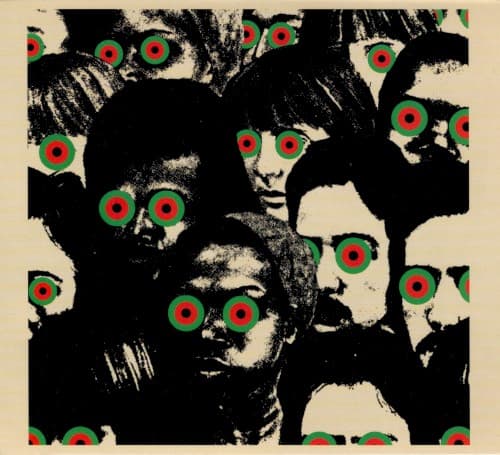
The technique merges documentary photography with agitprop graphics to create urgent visual protest language.
Symbols
Concentric target circles
The bullseyes literally mark these artists as targets of surveillance systems and systemic observation.
Eyes replaced by symbols
The erasure of human eyes suggests dehumanization through constant monitoring and algorithmic reduction.
Multiple faces overlapping
The collaged arrangement mirrors fragmented identity under perpetual digital and social surveillance pressure.
Where Sound Meets Image
Danger Mouse's reputation for sample-heavy, genre-blurring production finds its visual equivalent in this layered, disorienting composition. The experimental hip-hop within likely deconstructs conventional structures just as this cover deconstructs faces into surveillance data. The downtempo, alternative production suggests music that moves through shadowy spaces, and this cover visualizes that paranoid atmosphere where every movement is tracked, recorded, and analyzed.
The cover updates hip-hop's visual vocabulary of resistance for the algorithmic age, moving beyond police brutality imagery to interrogate how technology itself becomes an instrument of control. Its influence appears in subsequent album art that treats surveillance culture as aesthetic language, proving that hip-hop design can critique power structures through visual metaphor as effectively as lyrics do through wordplay.