Style & Context
Influences
Romare Bearden, Kara Walker, contemporary editorial illustration, sketchbook aesthetics
Location
Chicago's South Side manifests through transit imagery and communal spaces rather than skyline glamour or drill aesthetics.
Visual Language
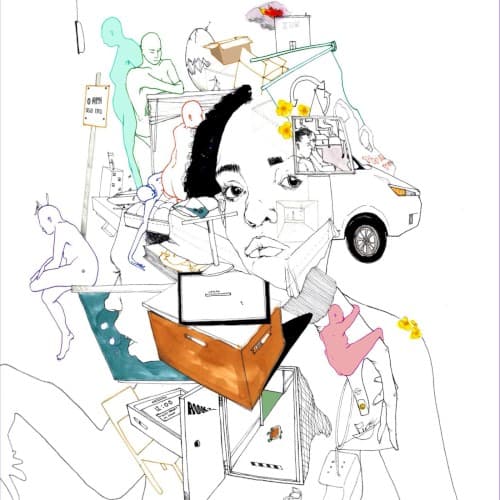
The delicate line work and layered composition create a visual diary effect that matches Noname's confessional poetry.
Symbols
Fragmenting face portrait
The central face dissolving into sketched vignettes represents the fragmented self navigating multiple identities and experiences.
Wooden boat anchored at chest
The vessel suggests journey and diaspora, carrying ancestral weight while floating through introspective waters of self-discovery.
Transit van and urban infrastructure
Chicago's public transportation system signals working-class movement and the city's role shaping Noname's perspective on community.
Where Sound Meets Image
The cover's fragmentary structure perfectly mirrors Room 25's stream-of-consciousness lyricism and jazz-rap looseness. Just as Noname weaves between childhood memories, political awakening, relationship anxieties, and Chicago observations, the collage jumps between domestic interiors, urban infrastructure, and vulnerable human forms without linear narrative. The pencil-sketch technique echoes the album's lo-fi warmth and spoken-word intimacy, while the boat and water imagery connects to tracks exploring ancestry and displacement. The everyday objects—vans, stairs, simple rooms—ground her abstract introspection in the material reality of working-class Black life that fuels her conscious storytelling.
This cover helped establish the aesthetic language for introspective Black women in hip-hop during the late 2010s, proving album art could whisper rather than shout. Its sketchbook intimacy influenced subsequent jazz-rap and poetry-rap releases that prioritized vulnerability over bravado, demonstrating how fragmentation and negative space could communicate emotional complexity better than polished photography. The design's rejection of traditional hip-hop visual codes—no jewelry, no cars as status symbols, no posed confidence—opened space for artists exploring mental health and feminism to opt for gentler, more literary presentation.