The Poet Who Chose Jazz Over Fame: Noname's Quiet Revolution
Fatimah Nyeema Warner operates under a name that became both manifesto and contradiction. Noname emerged from Chicago's fertile spoken word scene in the early 2010s, carrying poetry's cadence into hip-hop with such naturalness that the boundary between the two dissolved completely. Her breakout verse on Chance the Rapper's "Lost" in 2013 announced an artist who could command attention through understatement, her soft-spoken delivery hiding sharp observations about identity, struggle, and survival.
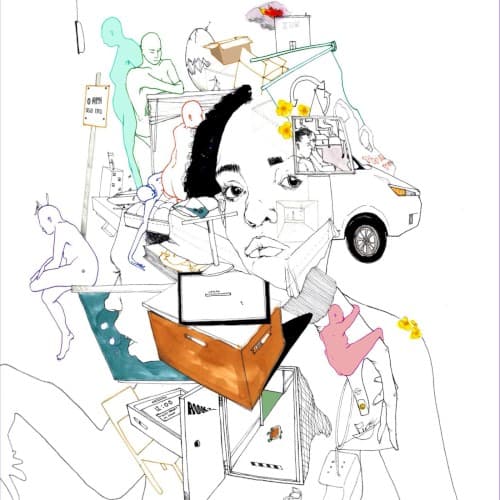
What distinguishes her immediately is restraint. In an era defined by maximalism and constant self-promotion, she built her career on whispered confessions over live instrumentation that breathed and shifted like a small jazz ensemble in a basement club. Her 2016 debut mixtape Telefone arrived with minimal fanfare and became a word-of-mouth phenomenon, proof that hip-hop still had space for intimacy and introspection. By the time Room 25 landed in 2018, she had refined her approach into something singular—a fusion of Chicago's poetic lineage, jazz's improvisational spirit, and rap's narrative power.
Her career trajectory defied industry logic. She sold out tours without radio play, built a devoted following without chasing streams, and eventually walked away from major platforms to maintain creative control and political principles. Born in 1991 on Chicago's South Side, she represents a generation of artists reshaping hip-hop's commercial expectations while honoring its roots as Black expression and resistance.
Jazz Lineage Meets Spoken Word: Noname's Sonic Identity
The production on a Noname track feels like overhearing a conversation in a room you weren't meant to enter. Her primary collaborators—including Phoelix, Saba, and Monte Booker—construct soundscapes rooted in live jazz instrumentation: upright bass lines that walk through chord changes, Rhodes keyboards that shimmer beneath her voice, drum patterns that swing rather than knock. This isn't boom-bap with jazz samples grafted on; it's actual jazz composition serving hip-hop's rhythmic framework. The result sounds closer to Robert Glasper's experimental fusion than traditional rap production.
Her vocal approach stems directly from slam poetry's performative tradition. She rarely raises her voice, letting conversational tone carry emotional weight. Lines land softly but cut deep, delivered with the measured pacing of someone who spent years sharpening words in front of live audiences before ever entering a booth. There's no vocal layering, minimal ad-libs, almost no hooks in the conventional sense. What could read as minimalism is actually precision—every syllable deliberate, every pause meaningful.
The contrast between her gentle delivery and her unflinching subject matter creates constant tension. She'll describe systemic racism, gentrification's violence, or personal heartbreak in the same calm voice one might use discussing the weather. This tonal control makes her political commentary hit harder; there's no performance of anger, just clear-eyed analysis delivered like testimony. Compared to peers like Rapsody or Little Simz who bring fiercer vocal energy, Noname's power lies in her refusal to shout, making listeners lean in rather than commanding attention through volume.
From Open Mics to Industry Exile: Noname's Unconventional Path
Her foundation was Chicago's Young Chicago Authors program, the same creative incubator that shaped Chance the Rapper, Saba, and Mick Jenkins. She performed at open mics under her birth name before adopting Noname around 2010, building reputation slowly through the city's interconnected spoken word and hip-hop scenes. These weren't parallel communities—they overlapped constantly, with poets rapping and rappers incorporating verse techniques. Her early collaborations with Chance and Mick Jenkins positioned her within Chicago's emerging alternative scene, but her first major national exposure came through features rather than solo work.
"Lost" changed that equation. Her verse on Acid Rap demonstrated she could hold her own alongside Chance's kinetic energy while operating in a completely different register. The attention it generated led to Telefone, which she released independently in 2016 after rejecting label advances. The project arrived with no physical release, minimal promotion, just dropped on streaming and mixtape sites. Its ten tracks sketched vivid portraits of Chicago life—watching friends get lost to violence and addiction, navigating young romance, processing grief and joy simultaneously. Production courtesy of Phoelix, Cam O'bi, and others felt cohesive despite multiple contributors, unified by their commitment to organic instrumentation and space.
Room 25 two years later marked dramatic growth without abandoning her core approach. Recorded partially during a trip to Africa that shifted her political consciousness, the album engaged more directly with capitalism, colonialism, and America's racial violence. Songs like "Blaxploitation" and "Montego Bae" featured sharper social critique delivered with the same conversational ease. The production expanded slightly—more layered arrangements, occasional electronic elements—but remained rooted in jazz's harmonic vocabulary. Critics recognized it as a career peak, a 9/10 artistic statement that proved her debut's promise wasn't accidental.
What followed complicated her narrative. She grew increasingly vocal about industry exploitation, social media's harmful effects, and white audiences consuming Black pain without supporting Black liberation. In 2019, she launched the Noname Book Club to promote radical literature and political education. She challenged J. Cole publicly after he released "Snow on tha Bluff" in 2020, which many interpreted as critique of her activist tone on Twitter. Her response track "Song 33" was characteristically measured but uncompromising, calling out respectability politics and the double standards applied to Black women's anger.
By 2021, she announced her retirement from music, citing the impossibility of making art for predominantly white audiences while trying to advance Black liberation. She followed through, mostly—pulling music from streaming services briefly, focusing on her book club and community organizing. The 2023 album Sundial arrived after this supposed retirement, a short project that felt like both goodbye and continuation. Its six tracks featured some of her most experimental production yet and her most explicit political statements. Whether it represents a full return or an occasional creative outlet remains unclear. She's made it plain she won't tour in ways that require performing for audiences she doesn't trust, won't engage with platforms she considers extractive, won't compromise her principles for career advancement.
Redefining Success: Noname's Impact Beyond Streaming Numbers
Her influence operates on two levels simultaneously. Musically, she's part of the lineage connecting jazz-rap's '90s pioneers like A Tribe Called Quest and The Roots to contemporary artists who refuse genre boundaries. Smino, Saba, and other Chicago contemporaries share her commitment to live instrumentation and compositional depth, while newer artists like Pink Siifu and MIKE incorporate her intimate vocal approach into their own experimental work. She proved that hip-hop could embrace poetry's techniques without losing rhythmic power, that jazz fusion could feel contemporary rather than retro, that commercial success wasn't the only metric that mattered.
But her larger impact concerns the industry itself and artists' relationship to fame. She rejected the entire promotional cycle that typically defines rap careers—no major label deal, minimal interviews, antagonistic relationship with social media, eventual withdrawal from streaming platforms. She challenged assumptions about what artist success should look like, modeling a career built around artistic integrity and political consistency rather than maximizing reach. For younger artists watching major labels collapse and streaming services pay fractions of pennies, her independent path offers alternative possibilities even as it highlights the difficulties of sustaining such choices.
Her book club and organizing work expanded hip-hop's traditional boundaries. While conscious rap has always included political education, she built actual infrastructure for community learning and mobilization, turning abstract politics into concrete practice. This shift from artist to organizer, from performer to facilitator, represents one possible future for hip-hop's role in Black liberation movements—less focused on individual celebrity, more committed to collective power.
The contradictions don't resolve easily. She wanted to reach people but rejected most platforms for doing so. She created profound art about Black experience then questioned whether art was sufficient response to oppression. She built a following then seemed ambivalent about maintaining it. These tensions ensure her legacy remains contested—some see principled resistance to exploitation, others see self-defeating purity politics. What's inarguable is that her 2016-2023 run produced some of the decade's most beautifully crafted hip-hop, that she expanded what conscious rap could sound like, and that she asked uncomfortable questions about who profits when Black artists share their stories with the world.