Style & Context
Influences
film noir cinematography, crime scene documentation, confessional photography
Location
The institutional corridors evoke Houston's Fifth Ward projects where survival required constant moral negotiation and self-documentation.
Visual Language
The high-contrast lighting and architectural framing create cinematic tension worthy of the Scarface film legacy.
Symbols
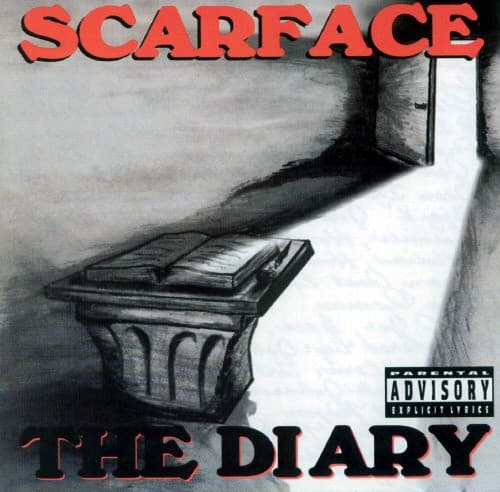
Open journal on pedestal
The diary becomes a confessional altar where Scarface's written testimony stands exposed to judgment.
Empty corridor with single doorway
The narrow path represents limited choices between incarceration, death, or the difficult route toward self-awareness.
Harsh directional light
Divine illumination cuts through darkness, forcing uncomfortable self-examination that defines the album's narrative arc.
Where Sound Meets Image
The sparse visual directly mirrors tracks like 'I Seen a Man Die' and 'Hand of the Dead Body,' where Scarface narrates death, guilt, and spiritual reckoning with journalistic detail. The empty corridor reflects the isolation heard throughout the album—even surrounded by people, the narrator walks alone with his conscience. The open doorway parallels 'The White Sheet,' where death's door stands perpetually ajar. The diary itself represents the album's structure: personal entries cataloging a life lived between violence and attempts at moral accounting.
This cover established a visual language for introspective Southern rap that influenced albums like Goodie Mob's Soul Food and later projects by Z-Ro. The diary motif presaged hip-hop's memoir era, anticipating how rappers would increasingly frame albums as literary testimony rather than party soundtracks. Its rejection of visual excess influenced the minimalist approach southern artists used to differentiate themselves from coastal flash.