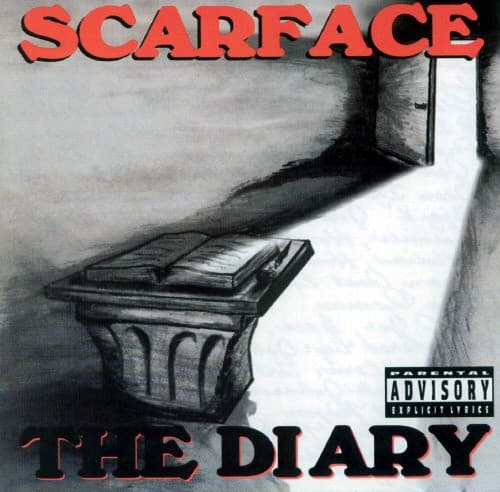
Scarface The Diary — The Album That Proved Houston Had a Conscience
No rapper has ever sounded this haunted on a major label release. The Diary landed in the fall of ninety-four like a confession no one asked for, raw and unfiltered, from an artist who refused to cosplay as a cartoon villain anymore. While West Coast g-funk was printing money and Bad Boy was buffing New York's commercial shine, Scarface sat in Houston writing obituaries for men who were still alive. The album plays like therapy without the therapist — just a microphone, a spiral notebook, and thirteen tracks of someone trying to explain why violence feels like gravity when you grow up where he did.
This was the third solo album from the Geto Boys' most introspective member, but the first one where Brad Jordan stopped hiding behind the Scarface persona long enough to let you see the cracks. The South Side of Houston has always produced hard rappers, but few have been this honest about what that hardness costs.
Every verse here sounds like it was written at three in the morning, the kind of hour when lies stop working and you have to face what you actually did, what you actually saw, what you actually became. The album stands alongside landmarks of introspective hip-hop from that era, proving Southern rap could dig just as deep emotionally.
Why does this album still feel like required listening thirty years later? Because most gangsta rap sells the fantasy. The Diary sells the bill.
The Sound of Houston Thinking Out Loud
Mike Dean and N.O. Joe built the sonic foundation here, and what they constructed sounds like the inside of a church basement at dusk — dark, cavernous, reverb-heavy, the kind of space where your voice echoes back at you whether you want it to or not. The production leans on live instrumentation: slow-rolled basslines, mournful piano chords, sparse drum programming that never rushes. This is not the sound of a party. This is the sound of a man sitting alone in a room with the lights off, replaying mistakes on a loop.
Dean's work here rewrote what Southern rap could sound like in ninety-four. No bounce. No funk. Just weight.
The beats breathe with the lyrics instead of competing against them, creating pockets of silence where Scarface's delivery — that low, measured, deliberate flow — lands like testimony in a courtroom. N.O. Joe's contributions carry that same patient menace, loops that repeat until they become hypnotic, until the listener stops trying to escape and just sits in it.
Scarface's writing here operates on two levels simultaneously: street reporter and moral philosopher. He describes violence with the specificity of someone who has seen it up close, but he also interrogates it, questions it, mourns it. The album refuses to glorify murder even as it describes murder in detail.
That tension — between documentation and condemnation — gives The Diary its unbearable emotional weight. He never preaches, never lectures, just lays out the math and lets you do the addition yourself.
The album is not flawless. A few tracks in the back half lose momentum, and the album's unrelenting darkness makes it a difficult front-to-back listen on casual rotation. But those weaknesses feel intentional, like Scarface designed this to be an ordeal rather than entertainment.
What does The Diary want to be? Not your favorite album. It wants to be the one you cannot forget.
The Journey From Guilt to Grief
The first stretch of The Diary establishes the thesis: survival in Houston requires moral compromises most people will never have to calculate. The album opens with scene-setting and tone-building, then immediately shifts into confessional mode. By the time you reach the centerpiece tracks, Scarface has already walked you through the logic of street life — the rules, the codes, the justifications — and now he is going to show you what those justifications actually cost.
The middle section is where the album becomes unbearable in the best way. This is not background music. This is music that demands you stop whatever you are doing and listen to what this man is saying.
The sequencing here is surgical: every track builds on the emotional stakes of the previous one, and the cumulative effect is suffocating. Scarface does not offer relief or escapism. He offers clarity, which turns out to be worse.
The back half shifts from external violence to internal collapse. The pacing slows. The beats get sparser. The mood turns from angry to exhausted.
This is where the album risks losing listeners who came for bangers, but it is also where Scarface completes the arc — from action to consequence, from bravado to regret, from G to ghost. The final tracks do not resolve anything. They just stop, like a conversation that ends because there is nothing left to say.
The Album That Redefined What Southern Rap Could Say
The Diary sits at the top of Scarface's catalog, and depending on the day, it competes with The Fix for the crown. This is the album where he stopped being a Houston rapper and became a Southern poet, the one who proved that gangsta rap could carry philosophical weight without losing its edge. No other album in his discography cuts this deep or aims this high.
Who should listen? Fans of Nas, Raekwon, or anyone who believes rap albums can be literature. Fans of Kendrick Lamar's confessional mode owe this album a debt whether they know it or not.
Who might struggle with it? Listeners looking for club records or easy rotation material. The Diary is not casual listening. It is homework. It is required reading. It ages you.
How has it aged? Better than almost anything from ninety-four. The production still sounds current because it never chased trends.
The writing still feels urgent because the issues Scarface addressed — poverty, violence, systemic neglect, moral injury — have not gone anywhere. If anything, the album sounds more prophetic now than it did on release, a warning that went unheeded.
Start with the title track, then go straight to the centerpiece. If those two songs do not lock you in, this album might not be for you. If they do, clear your schedule and listen to the whole thing in one sitting.
Similar albums worth exploring: Mobb Deep's The Infamous, UGK's Ridin' Dirty, and Z-Ro's Let the Truth Be Told. The Diary's influence can be heard in every Southern rapper who chose introspection over flexing, every artist who treated the mic like a confessional booth instead of a victory lap.
This is the album that taught the South it could think out loud.
Track Listing
Intro
●Scarface sets the scene with a somber instrumental backdrop and snippets of dialogue that immediately establish the album's tone. The intro is brief but effective, using ambient street sounds and a slow piano loop to prepare the listener for the confessional journey ahead. No wasted motion here — just atmosphere and intent.
The White Sheet
▲Mike Dean's production here is pure dread: a minimalist piano loop, a crawling bassline, and Scarface describing a murder scene with the detachment of a crime photographer. The hook is hypnotic and bleak, and the verses move with the slow inevitability of a eulogy. What makes this track devastating is not the violence itself but the way Scarface describes it as routine, as Tuesday, as another name added to a list that never stops growing. The production gives him room to narrate without embellishment, and he uses every second of that space to paint a picture most rappers would turn into a punchline. This is not a flex. This is a scar.
No Tears
▲N.O. Joe crafts a dirge here, a beat that sounds like it is being played at half speed, with muted horns and a bassline that hits like a slow heartbeat. Scarface's flow matches the production's patience, and the lyrics dissect grief without sentimentality. The chorus — a refusal to cry even as he catalogs loss — captures the emotional paralysis that comes from seeing too much death too young. This track would influence Houston's sound for the next decade: slow, heavy, unshakeable. The second verse, where Scarface describes attending a funeral and feeling nothing, is one of the most chilling moments in his entire catalog.
Jesse James
▲This is Scarface at his most defiant, channeling outlaw mythology through a Southern lens. The production is more uptempo than the previous tracks, with a galloping rhythm and a looped sample that gives the song a cinematic scope. Scarface compares himself to Jesse James not as a hero but as a man trapped by his own reputation, unable to escape the role he has been assigned. The verses are dense with detail, and the hook — sung rather than rapped — adds a layer of melancholy that undercuts the bravado. It is one of the few moments on the album where Scarface allows himself to sound almost triumphant, but even that triumph feels cursed.
G's
●A rare moment of levity, relatively speaking. The beat knocks harder than anything else on the album, and Scarface sounds looser here, more willing to flex and play the role of the untouchable street king. But even in celebration mode, he cannot help slipping in reminders of the cost — bars about friends in prison, enemies in the ground, trust as a luxury he cannot afford. The track functions as a brief exhale before the album returns to its suffocating thesis, and it is placed perfectly in the sequence to keep the listener from drowning too early.
I Seen a Man Die
▲The centerpiece. Mike Dean's production here is sparse to the point of cruelty: a skeletal bassline, a few piano notes, and silence everywhere else. Scarface uses that emptiness to deliver the most harrowing storytelling of his career, describing a shooting in vivid, unflinching detail — the sound of the gunshot, the way the body fell, the look in the dying man's eyes. What makes this track unbearable is not the violence but the aftermath: Scarface admitting he did nothing to help, admitting he has become numb to death, admitting he is terrified he might be next. The hook is sung, mournful, almost gospel, and it turns the song into a hymn for the damned. This is the track that defines The Diary, the one that every other song on the album orbits around. It is Required Listening not because it is enjoyable but because it is true.
One
▲Scarface strips the production down even further here, just a somber loop and his voice, contemplating mortality and legacy. The verses read like a last will and testament, Scarface addressing his family, his enemies, and God with equal directness. The tone is elegiac, exhausted, like a man who has already written his own obituary and is just waiting for the date to fill itself in. It is one of the album's quietest moments, but also one of its most emotionally direct.
Goin' Down
●A descent into paranoia. The beat is jittery, with dissonant piano stabs and a tempo that feels like it is rushing toward something awful. Scarface describes the mental toll of street life — the sleeplessness, the mistrust, the sense that every phone call might be the police or a setup. The verses are dense and claustrophobic, and the hook reinforces the inevitability of collapse. This track would not work on most albums, but here, placed after the slow crawl of the previous songs, it hits like a panic attack.
One Time
●A brief interlude-length track that functions as a moment of reflection. The production is minimal, and Scarface's vocals are processed to sound distant, almost ghostly. It is a palate cleanser before the final stretch, but it also deepens the album's pervasive sense of isolation.
Hand on the Dead Body
●Scarface returns to street narrative here, but the energy is lower, the tone more resigned than aggressive. The beat is heavy and plodding, and the verses describe violence as inevitable rather than thrilling. The hook is blunt and matter-of-fact, and the track feels like Scarface going through the motions of being a gangsta rapper while his mind is somewhere else entirely. It is solid but not essential, a reminder that even on a masterpiece, not every song can carry equal weight.
Mind Playin' Tricks '94
▲A sequel to the Geto Boys classic, but this version is lonelier, more introspective. The original was about collective paranoia; this one is about personal collapse. Scarface revisits the same themes — fear, isolation, mental fracture — but from the perspective of someone who has been carrying that weight for years and can no longer hold it up. The production mirrors the original's eerie atmosphere, but the tempo is slower, the mood heavier. It is a brilliant reworking that honors the source material while deepening its emotional stakes.
The Diary
▲The title track and the album's thesis statement. Scarface reads from his own journal, describing his life with brutal honesty — the violence he has committed, the friends he has lost, the guilt he carries. The production is minimal, almost bare, just a slow loop and a bassline that sounds like a heartbeat slowing down. The verses are written in first person, no metaphors, no exaggeration, just documentation. The hook is a simple refrain that reinforces the album's central question: what do you do when you survive everything but cannot live with what you had to do to survive? This is Scarface's "Sing About Me," decades before Kendrick wrote it. Essential.
Outro
●A brief closing instrumental that fades out like the end of a confession. No resolution, no redemption, just silence. The perfect ending for an album that refuses to offer comfort.