
The Architect of Southern Street Narratives
Brad Jordan didn't invent Southern hip-hop, but as Scarface, he gave it a voice that refused to flinch. Emerging from Houston's Fifth Ward in the late 1980s as part of the Geto Boys, he brought a cinematic darkness to rap that felt less like performance and more like testimony. Where other rappers projected invincibility, Scarface explored vulnerability within violence, paranoia alongside ambition, depression threaded through street chronicles. His pen moved like a film director's camera—intimate, unflinching, morally complex.
By the time he launched his solo career in 1991, Scarface had already helped reshape the national perception of Southern rap through the Geto Boys' controversial breakthrough. But his solo work revealed deeper dimensions: a producer's ear for mournful soul loops, a storyteller's patience with narrative structure, and a willingness to examine the psychological toll of the streets rather than just document the action. He became the South's answer to East Coast lyricism without abandoning regional identity, proving Houston could produce technical mastery and intellectual depth alongside its signature sound.
Three decades later, his influence radiates through every rapper who treats albums as confessional spaces, who pairs street content with introspective honesty, who understands that the most powerful gangster narratives acknowledge fear and consequence. Scarface didn't just represent Houston—he elevated what Southern rap could articulate about American life.
Cinematic Realism and Soul-Sampling Craftsmanship
Scarface's sonic signature blends Isaac Hayes-level orchestration with street-level immediacy. His production choices favor warm soul samples, melancholic piano lines, and live instrumentation that creates cinematic scope without overwhelming his narratives. The music breathes—strings swell during moments of reflection, basslines anchor storytelling passages, and drums knock with enough presence to maintain hip-hop's physical impact while supporting rather than dominating the lyrical content.
His flow operates at mid-tempo, deliberate and unhurried, prioritizing clarity and emotional weight over technical pyrotechnics. Scarface rarely shouts or rushes. His delivery carries the authority of someone who has lived every scenario described, with subtle tonal shifts conveying paranoia, regret, determination, or cold calculation. The pacing allows every word to land, every image to register. This approach influenced countless Southern rappers who learned that slower tempos didn't mean less intensity—properly executed, they meant more impact.
As a producer and collaborator with architects like Mike Dean, N.O. Joe, and Tone Capone, Scarface helped define the textured, sample-rich sound that distinguished Southern production from the stark minimalism dominating other regions during the 1990s. His albums felt expensive, cinematic, carefully constructed—proof that regional identity didn't require lo-fi aesthetics. The music matched the ambition of his narratives: expansive, layered, refusing to settle for simple trunk-rattling bounce when it could also break your heart.
From Geto Boys Catalyst to Solo Architect
Scarface's career began as part of the Geto Boys, the Houston collective whose 1991 album We Can't Be Stopped became both commercial breakthrough and cultural lightning rod. His verses on "Mind Playing Tricks on Me" introduced mainstream audiences to his psychological approach—paranoia rendered so vividly it felt universal, street anxiety elevated to existential dread. The track became a template for introspective gangster rap, demonstrating that hardcore content could coexist with emotional vulnerability.
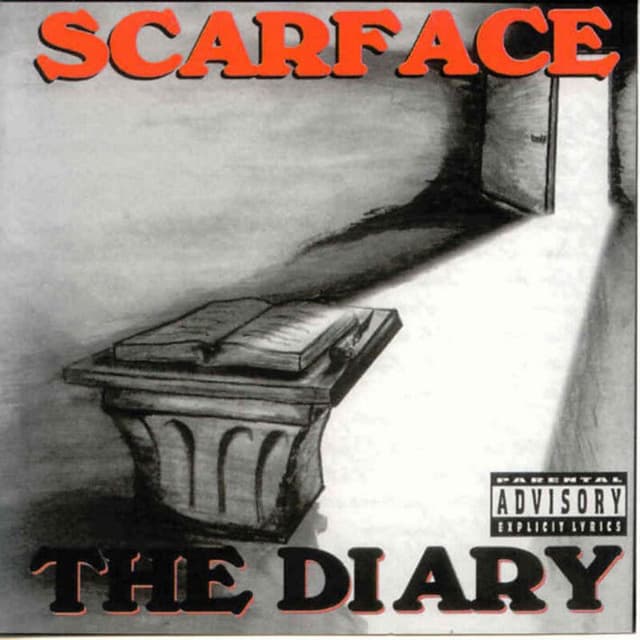
His 1991 solo debut Mr. Scarface Is Back established his individual voice while maintaining Geto Boys' confrontational energy. But it was The World Is Yours (1993) that revealed his artistic ambitions, expanding sonic palette and narrative scope. Then came The Diary in 1994, the creative peak that cemented his legacy. Featuring production from N.O. Joe, Crazy C, Mike Dean, and Scarface himself, the album moved between street narratives, political commentary, and psychological confession with novelistic depth. Tracks like "I Seen a Man Die" rendered mortality with devastating specificity, while "Hand of the Dead Body" explored survivor's guilt and spiritual reckoning. The album earned widespread critical acclaim and demonstrated Southern rap's capacity for artistic sophistication, achieving both street credibility and intellectual respect—a balance many rappers chase but few achieve.
Throughout the late 1990s and 2000s, Scarface maintained consistent output while expanding his influence as a mentor and label executive. The Untouchable (1997) went platinum, proving commercial viability didn't require softening his approach. The Fix (2002), featuring production from Kanye West, The Neptunes, and Nottz, bridged generational gaps, introducing his work to younger audiences while maintaining artistic integrity. The Kanye-produced "Guess Who's Back" became an unlikely radio presence, Scarface's grim realism somehow fitting beside contemporary chart sounds.
His later albums—My Homies (1998), The Last of a Dying Breed (2000), Balls and My Word (2003), and Made (2007)—maintained quality without chasing trends. Scarface understood his role: keeper of a certain flame, representative of an approach to rap that valued substance and craft over viral moments. His 2015 album Deeply Rooted won a Grammy nomination, proving his relevance decades after his commercial peak. He continued balancing solo work with Geto Boys reunions, mentoring younger Houston artists, and serving as Def Jam South president in the mid-2000s.
Beyond albums, Scarface's guest verses became events—his appearance elevated projects, lending gravitas to collaborations with everyone from Tupac to Jay-Z to Kendrick Lamar. His 16 bars on Jay-Z's "This Can't Be Life" matched Hov's emotional intensity, two veterans acknowledging life's weight. His work with Tupac on "Smile" captured weary resilience. These collaborations positioned him as hip-hop's elder statesman, the voice you called when the subject matter required depth and authenticity.
The Blueprint for Introspective Street Rap
Scarface's influence operates across multiple dimensions. Technically, he provided a template for introspective gangster rap that nearly every subsequent Southern rapper has borrowed from. UGK, Ludacris, T.I., Killer Mike, and countless others built on foundations he laid—the idea that Southern artists could be both regionally rooted and lyrically sophisticated, that slower tempos allowed for greater narrative complexity, that vulnerability enhanced rather than undermined street credibility. His production aesthetic influenced the sample-heavy, soul-infused sound that became synonymous with Southern hip-hop during its 1990s and 2000s ascendance.
Culturally, Scarface legitimized Southern rap in the eyes of East Coast purists and mainstream critics who initially dismissed the region. His technical skill, narrative depth, and thematic ambition made it impossible to claim Southern hip-hop lacked substance. He didn't compromise regional identity to achieve this—his Houston roots remained audible—but he proved Southern rappers could stand alongside anyone in terms of artistry and intellect. This opened doors commercially and creatively, helping establish the South's eventual commercial dominance in hip-hop.
His willingness to discuss mental health, depression, and psychological struggle within street contexts predated the current generation's openness about such topics by decades. Tracks exploring paranoia, suicidal ideation, and emotional damage normalized conversations many rappers avoided. This honesty influenced artists like Kendrick Lamar, who has cited Scarface as a primary influence, and you can trace a direct line from Scarface's psychological realism to Kendrick's own examination of trauma, survivor's guilt, and internal conflict. The confessional dimension of contemporary rap—the understanding that strength includes acknowledging weakness—owes significant debt to Scarface's example.
Today, he occupies an almost mythic status: the rapper's rapper, the artist younger generations study for craft lessons, the Houston legend whose influence spread far beyond regional boundaries. His catalog remains a reference point for anyone attempting to balance street content with artistic ambition, commercial viability with uncompromising honesty. Scarface proved that hip-hop could be simultaneously hardcore and heartfelt, Southern and universal, street-certified and critically acclaimed—and in doing so, expanded what the entire genre could articulate about American life.