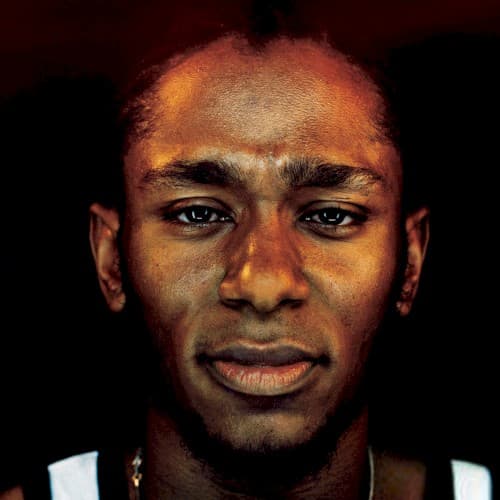
Brooklyn's Poet-Philosopher: Mos Def's Rise in Late '90s Hip-Hop
Dante Terrell Smith emerged from Brooklyn's thriving underground scene in the mid-'90s under the name Mos Def, carrying a lyrical sensibility that balanced street wisdom with philosophical inquiry. While his peers chased commercial formulas, he refined an approach that treated rap as literary craft—precise wordplay layered over jazz-inflected production, delivered with a conversational ease that disguised technical mastery. His collaborations with Talib Kweli as Black Star established him as a torchbearer for conscious hip-hop, but the term never quite captured his range: he could pivot from social commentary to braggadocio, from abstract metaphor to narrative storytelling, all within the same sixteen bars.
By the time he released Black on Both Sides in 1999, Mos Def had positioned himself as hip-hop's renaissance figure—an artist equally comfortable on Broadway stages and underground cyphers, bridging the gap between boom-bap traditionalists and the emerging neo-soul movement. His Brooklyn roots ran deep through Bedford-Stuyvesant, where he absorbed the borough's rich cultural lineage while developing a voice distinct from his East Coast contemporaries. Where others pursued singular identities, he embraced multiplicity: actor, activist, MC, and cultural critic rolled into one, refusing the industry's pressure to choose a lane.
Jazz-Infused Consciousness: Mos Def's Sonic Identity and Lyrical Craft
Mos Def's production choices consistently favored live instrumentation over sample loops, creating soundscapes where upright bass walked alongside drum breaks and horn sections punctuated verses. His collaborators—DJ Premier, Hi-Tek, Ayatollah—understood his preference for organic textures, building tracks that breathed with the spontaneity of jazz while maintaining hip-hop's rhythmic foundation. This approach gave his music a warmth often missing from late-'90s rap, where digital production was hardening into rigid templates. He rapped over these canvases with a flow that emphasized pocket and phrasing over pure speed, letting syllables hang in space before snapping back into time.
Lyrically, he operated in multiple registers simultaneously. A single verse might contain Afrocentric philosophy, pop culture references, street corner observations, and abstract wordplay, all woven together through internal rhyme schemes that rewarded close listening. His voice carried a natural charisma—conversational but commanding, capable of shifting from playful charm to urgent intensity within a bar. Unlike many conscious rappers who sacrificed musicality for message, Mos Def understood that the delivery mattered as much as the content. His best performances felt effortless, as if he were simply speaking elevated truths over immaculate beats, though the craft behind that ease was meticulous.
The Brooklyn MC's approach to hooks demonstrated particular sophistication. Rather than relying on sung choruses or simple repetition, he constructed refrains that functioned as thematic anchors—melodic without pandering, memorable without dumbing down. This balance between accessibility and complexity became his signature, allowing him to reach beyond underground purists without compromising artistic integrity.
From Underground Cipher to Cultural Institution: Mos Def's Career Trajectory
Mos Def's early years unfolded in Brooklyn's Native Tongues-influenced scene, where he connected with De La Soul's Posdnuos and began appearing on underground compilations throughout the mid-'90s. His verse on De La Soul's "Big Brother Beat" hinted at the technical prowess he would later showcase, but it was the 1998 Black Star collaboration with Talib Kweli that announced his arrival as a major voice. That album's "Definition" and "Respiration" became underground anthems, establishing the duo as standard-bearers for substantive hip-hop at a moment when mainstream rap was moving toward shinier, more commercial territory.
Black on Both Sides arrived in October 1999 as a definitive artistic statement, capturing Mos Def at the peak of his creative powers. The album opened with "Fear Not of Man," where his doubled vocals created a call-and-response with himself over minimal production, immediately signaling this would be no ordinary rap record. "Ms. Fat Booty" became an unexpected hit—a narrative track that told a relationship story with literary detail and genuine humor, proving conscious rappers could craft compelling story-songs without preachiness. "Mathematics" demonstrated his ability to weave social statistics into memorable verses, while "Umi Says" closed the album with neo-soul introspection, featuring his own singing over Q-Tip's production.
The album's success positioned him for mainstream crossover, but Mos Def consistently chose artistic autonomy over commercial calculation. His acting career expanded throughout the 2000s—roles in Monster's Ball, The Italian Job, and the HBO series Dexter—while his musical output became more sporadic and experimental. The New Danger in 2004 incorporated rock elements that alienated some hip-hop purists, though it reflected his refusal to repeat himself. True Magic arrived in 2006 with minimal promotion, followed by The Ecstatic in 2009, which many considered a return to form with its global sonic palette and focused lyricism.
By 2011, he announced plans to retire the Mos Def name and perform exclusively as Yasiin Bey, signaling a broader spiritual and artistic evolution. His later years saw increasing political engagement—he became vocal about American foreign policy, performed in protest of Guantanamo Bay detention practices, and eventually relocated abroad. Musical releases became even more irregular, with projects like the collaborative December 99th with Ferrari Sheppard existing in limited circulation. This trajectory from underground sensation to cultural nomad reflected his consistent rejection of industry expectations: he built a career on his own terms, even when those terms meant stepping away from the spotlight entirely.
His influence on subsequent generations remained undeniable regardless of output frequency. The entire wave of conscious rappers in the 2000s—from Lupe Fiasco to Kendrick Lamar—operated in territory he helped map. His proof that substantive content could coexist with musical sophistication provided a blueprint that countless artists would follow, while his multidisciplinary approach presaged hip-hop's current era of cross-platform creatives.
The Mos Def Effect: Redefining Intelligence and Accessibility in Hip-Hop
Mos Def's lasting impact extends beyond his discography into hip-hop's evolving relationship with intellectualism and cultural responsibility. He emerged during an era when conscious rap risked ghettoization as a niche market, yet he demonstrated that thoughtful content didn't require sacrificing musicality or street credibility. His success gave permission to a generation of artists who refused the binary choice between commercial appeal and artistic integrity. When Kendrick Lamar balances radio hits with dense thematic albums, or when J. Cole builds a career on introspective lyricism, they walk paths Mos Def helped clear.
His model of the artist as multidisciplinary figure—equally legitimate as actor, activist, and MC—anticipated hip-hop's current ecosystem where genre boundaries dissolve and artists build empires across multiple platforms. Tyler, the Creator's creative polymath approach or Childish Gambino's genre-hopping career reflect possibilities Mos Def normalized decades earlier. He proved that hip-hop credibility could survive and even strengthen through engagement with other art forms, challenging the genre's historically rigid gatekeeping around authenticity.
The Brooklyn MC's influence on hip-hop's sonic palette remains audible in how contemporary artists approach production. The preference for live instrumentation, the jazz and soul influences, the emphasis on organic textures over synthetic sheen—these choices trace back to the template he established. Artists like Robert Glasper, Kamasi Washington, and Terrace Martin building careers at the jazz-hip-hop intersection owe debt to Mos Def's insistence that these traditions belonged in conversation, not isolation. His work demonstrated that hip-hop's future didn't require abandoning its past, that innovation could emerge from deeper engagement with Black musical lineage rather than rejection of it.