Style & Context
Influences
Documentary photography, forensic imagery, political poster art, Black Panther visual language
Location
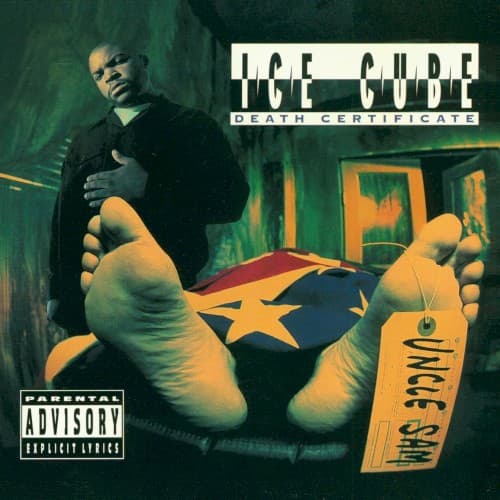
South Central Los Angeles emerges through the forensic lens, where bodies pile up as statistics in America's war zones.
Visual Language
The clinical staging and harsh overhead lighting borrow from crime scene documentation to indict rather than simply document.
Symbols
Feet with toe tag
The viewer becomes the deceased, forcing identification with Black death in America's violent landscape.
American flag as shroud
The nation itself becomes complicit in Black death, transforming patriotic symbolism into a burial cloth.
Morgue perspective
The overhead angle mimics forensic photography, clinicalizing the human cost of systemic violence and neglect.
Where Sound Meets Image
The dual-sided album structure mirrors the cover's duality—the flag represents both the nation that kills and the one worth saving. Songs like 'The Wrong Nigga to Fuck Wit' and 'Black Korea' channel the raw anger visible in Cube's expression, while tracks addressing systemic issues align with the clinical, documentary approach. The morgue setting perfectly frames an album split between 'Death Side' and 'Life Side,' with the cover representing the death of old America and Black complacency alike.
This cover established a template for politically confrontational hip-hop artwork that prioritized message over marketability. Its influence echoes through decades of conscious rap visuals that refuse to comfort white audiences or sanitize Black reality. The morgue aesthetic and forced-perspective technique became reference points for artists addressing police violence and systemic racism, from Public Enemy to Kendrick Lamar's later work.