The Architect of Dense Imagery: Aesop Rock's Place in Underground Hip-Hop
Ian Bavitz, known professionally as Aesop Rock, occupies a singular position in hip-hop's landscape — a space where linguistic density meets uncompromising artistic vision. Emerging from New York's underground scene in the late 1990s, he built a career on vocabulary that academic studies have measured as the most expansive in hip-hop history, a statistic that only begins to capture what makes his work compelling. Where mainstream rap pursued radio accessibility, Aesop Rock committed to an aesthetic of deliberate obscurity, crafting narratives that unfold like puzzle boxes, rewarding listeners willing to meet him halfway.
His approach challenged the notion that complexity alienates audiences. Albums like Labor Days proved underground hip-hop could sustain commercial viability without sacrificing artistic integrity. He never chased trends or adjusted his vision for market demands. Instead, he carved out dedicated listenership that understood his music as something closer to literature set to beats — dense, layered, requiring active engagement rather than passive consumption. His influence extends beyond direct stylistic imitation into a broader permission structure: he demonstrated that hip-hop could accommodate voices prioritizing craft over accessibility, depth over immediate impact.
What sets Aesop Rock apart isn't just vocabulary size but how he deploys language. His verses operate through associative logic rather than linear storytelling, building meaning through accumulated imagery rather than explicit statement. This makes his work divisive — some hear genius-level wordplay and emotional resonance buried in abstraction, others perceive impenetrability as affectation. Both responses miss the essential point: his music functions as invitation into a specific headspace, a way of processing experience through fragmented observation and surreal juxtaposition.
Labyrinthine Wordplay: Deconstructing Aesop Rock's Lyrical Architecture
Aesop Rock's lyrical approach resembles stream-of-consciousness writing pushed through a filter of meticulous revision. He constructs verses from concrete details — hand tools, childhood memories, urban decay, personal anxiety — that accumulate into emotional landscapes rather than explicit narratives. Internal rhyme schemes stretch across multiple bars, creating rhythmic texture that operates independently from the beat while remaining locked to it. His flow shifts between staccato bursts and extended phrases, voice delivery flat and conversational, refusing theatrical emphasis. This creates cognitive dissonance: playful language delivered with workman-like seriousness.
Production choices throughout his catalog favor sample-based beats with analog warmth — dusty drums, obscure soul loops, lo-fi textures that complement rather than compete with vocal density. His longtime collaboration with producer Blockhead yielded signature sound: melancholic instrumental beds providing emotional counterweight to lyrical abstraction. Where many rappers use production as hype mechanism, Aesop Rock's beats function as ambient space for contemplation. The music feels interior, designed for headphone listening rather than club play, which perfectly suits content focused on isolation, creative struggle, and everyday alienation.
Vocabulary expansion serves thematic purpose beyond showcasing erudition. By avoiding hip-hop's established lexicon, he forces listeners into unfamiliar linguistic territory that mirrors the alienation his content explores. When he references "tugboat operation" or "feral cat colonies," these aren't random flexes but deliberate estrangement techniques. His music asks: what happens when hip-hop abandons its communal language for private dialect? The answer is both limitation and liberation — smaller audience, deeper connection with those who commit.
From DIY Cassettes to Underground Institution: Tracing Aesop Rock's Career Arc
Aesop Rock's entry into hip-hop came through New York's late-90s underground, releasing Music for Earthworms in 1997 while still studying at Boston University. That early work established core aesthetics but lacked the refinement that would define his mature output. He connected with Mush Records and the broader underground network orbiting around labels like Def Jux, positioning himself within a scene that valued experimentation over commercial viability. His second album, Float (2000), expanded his approach but still felt like developmental work, an artist figuring out how far he could push language before meaning collapsed entirely.
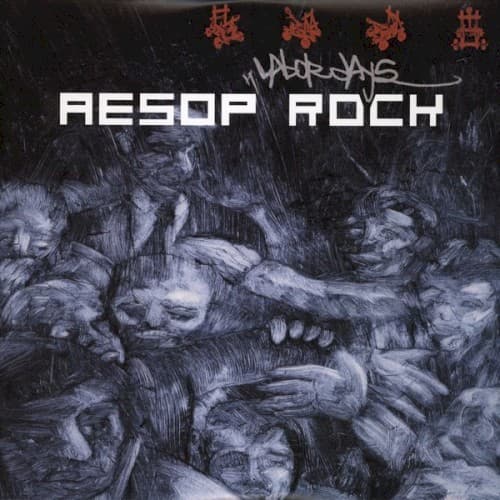
Labor Days (2001) marked his breakthrough. The album combined his most accessible production with thematic focus on work, creative frustration, and the grind of underground hip-hop as unglamorous labor. Our review awarded it 9.2/10, recognizing how it balanced lyrical complexity with emotional clarity. Tracks like "Daylight" became underground anthems, proof that density and resonance weren't mutually exclusive. The album's success came entirely through word-of-mouth and independent distribution, demonstrating sustainable model outside major label infrastructure. It established him as figurehead for a particular strain of hip-hop — intellectual without being academic, personal without confessional transparency.
Subsequent releases deepened rather than broadened his approach. Bazooka Tooth (2002) leaned into abrasive production and even more abstract lyricism, alienating some fans while cementing his reputation for uncompromising vision. None Shall Pass (2007) brought more melodic production and guest features, his most outward-facing work to that point. The album cycle revealed tension in his career: pressure to grow audience versus commitment to artistic purity. He consistently chose the latter, accepting ceiling on commercial potential in exchange for complete creative control.
His partnership with producer Blockhead became defining relationship in his discography. Their collaborative chemistry — Blockhead's warmth offsetting Aesop's coldness — created signature sound that made his abstraction more palatable. The Impossible Kid (2016) marked late-career peak, his most personal and arguably most accessible album. Moving from New York to the West Coast had shifted his perspective, introducing vulnerability and direct emotional statement previously buried under layers of metaphor. It proved he could evolve without abandoning core identity, addressing themes of depression, aging, and creative sustainability with unusual directness for an artist known for obscurity.
Recent work continues this trajectory toward measured accessibility. Spirit World Field Guide (2020) and Integrated Tech Solutions (2023, with Blockhead) show artist comfortable in his lane, no longer pushing boundaries but refining established approach. This shift from revolutionary to institutional figure reflects broader underground hip-hop evolution — what was once radical became tradition requiring preservation. His influence now manifests in younger artists who take lyrical complexity as given rather than aberration, inheriting permission structure he helped establish.
Vocabulary as Worldview: Aesop Rock's Influence on Independent Hip-Hop
Aesop Rock's legacy resides in proving hip-hop could sustain careers built entirely on artistic integrity. He never scored radio hits, never compromised for crossover appeal, yet maintained relevance across three decades. This blueprint matters more than his stylistic influence, though that exists too. Artists like billy woods, Open Mike Eagle, and Armand Hammer operate in territory he helped map — hip-hop prioritizing craft and intellectual engagement over accessibility. He demonstrated that underground didn't mean amateur, that independent distribution could support sustainable career, that small devoted audience beats chasing mass appeal on industry terms.
His measured vocabulary — various studies crowned him hip-hop's most lexically diverse artist — became both calling card and limitation. The statistic attracted attention but reduced complex artistic vision to trivia. His actual contribution runs deeper: he expanded what hip-hop language could sound like, proving the genre could accommodate voices from outside its traditional cultural boundaries without those voices diluting hip-hop's essence. This opened doors for artists who didn't fit conventional molds, who approached rap as literary exercise rather than street documentation or party soundtrack.
Culturally, Aesop Rock represents particular strand of hip-hop fandom: predominantly white, college-educated, drawn to underground aesthetics as identity marker. This demographic reality complicates his legacy — does he expand hip-hop's reach or gentrify its space? The question lacks clean answer. His music never appropriated Black culture or pretended street credibility he didn't possess. He carved separate lane, building audience that might never engage deeply with hip-hop otherwise. Whether that constitutes contribution or dilution depends on how you value hip-hop's cultural gatekeeping versus its artistic expansion. What's inarguable: he changed conversations about what hip-hop could be and who could participate in its evolution.