The Architect of Technical Excellence in Hip-Hop
Antonio Hardy emerged from Brooklyn's Bed-Stuy neighborhood in 1987 as Big Daddy Kane, a name that would become synonymous with lyrical sophistication during hip-hop's golden era. While his peers were establishing the foundations of East Coast rap, Kane was reconstructing them entirely — introducing a level of technical precision, multisyllabic rhyme schemes, and verbal dexterity that elevated what MC'ing could be. His arrival wasn't just timely; it was transformative.
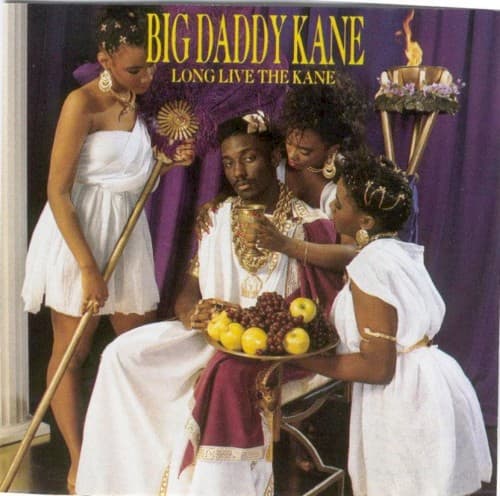
Before Kane, most rappers operated within relatively straightforward rhyme patterns and delivery systems. Kane brought jazz-influenced complexity to his flows, weaving internal rhymes, alliteration, and syncopated rhythms into verses that demanded repeated listening. His debut album Long Live the Kane arrived in 1988 as a masterclass in controlled aggression and intellectual swagger, establishing him as the premier lyricist of his generation. The Marley Marl-produced project wasn't just another rap record — it was a technical blueprint that countless artists would study and attempt to replicate.
What separated Kane from his contemporaries wasn't just skill; it was presentation. He understood hip-hop as performance art, blending the verbal gymnastics of battle rap with the stage presence of James Brown and the smooth confidence of a Harlem Renaissance poet. This synthesis of street credibility and showmanship created a template that would influence everyone from Jay-Z to Nas, proving that intelligence and entertainment weren't mutually exclusive in rap music.
Multisyllabic Mastery and the Science of Flow
Kane's sonic signature rests on an almost scientific approach to rhythm and rhyme structure. His flow operates like a precision instrument — syllables land exactly where they need to, internal rhymes create hidden pockets of complexity, and his voice modulates between smooth conversational tones and explosive battle-rap intensity. Listen to "Ain't No Half-Steppin'" and you hear a rapper who treats the beat as a canvas for linguistic architecture, constructing verse patterns that seem impossible to replicate until you realize they follow their own internal logic.
The production backdrop Kane chose reflected his commitment to musical sophistication. Working primarily with Marley Marl during his peak years, Kane operated over sample-heavy beats that drew from soul, funk, and R&B — the sonic palette of hip-hop's golden age. But where some rappers rode the beat, Kane dissected it, finding pockets and syncopations that other artists missed entirely. His delivery could shift mid-verse from rapid-fire technical displays to slower, more deliberate passages that emphasized wordplay over speed.
What makes Kane's style endure is its adaptability. He could deliver smooth, ladies-oriented tracks like "Smooth Operator" without sacrificing technical prowess, then turn around and destroy opponents on battle records with the same effortless command. This versatility came from understanding that flow isn't just about speed or complexity — it's about control, knowing when to accelerate and when to let the words breathe. That understanding remains relevant decades later, as contemporary lyricists still mine Kane's catalog for flow patterns and rhyme techniques.
From Juice Crew Wordsmith to Hip-Hop Icon
Kane's entry into hip-hop came through the legendary Juice Crew, the collective centered around producer Marley Marl and radio personality Mr. Magic. Before stepping into the spotlight himself, Kane worked as a ghostwriter and songwriter, crafting verses for other artists and developing the technical skills that would define his solo career. This apprenticeship period was crucial — it allowed him to refine his craft away from public scrutiny, building a lyrical arsenal that would prove devastating once unleashed.
Long Live the Kane arrived in June 1988 as a near-perfect debut, showcasing not just Kane's lyrical abilities but his understanding of album construction. "Raw" became an instant classic, its minimalist Marley Marl production providing the perfect backdrop for Kane's verbal assault. "Ain't No Half-Steppin'" demonstrated his ability to ride a groove while maintaining technical complexity. The album didn't just announce Kane's arrival; it shifted expectations for what a rap album could achieve artistically. His subsequent releases — It's a Big Daddy Thing (1989) and Taste of Chocolate (1990) — maintained this standard, with the former producing "Smooth Operator" and proving Kane could dominate both street records and radio-friendly material.
The early '90s saw Kane continuing to release solid material, though the changing landscape of hip-hop began to shift around him. As gangsta rap dominated the commercial conversation and production styles evolved toward harder, darker sounds, Kane's smooth, jazz-influenced approach represented a different era. Albums like Prince of Darkness (1991) and Looks Like a Job For... (1993) contained moments of brilliance but didn't capture the cultural moment the way his earlier work had. This wasn't a failure of talent — Kane remained technically superior to most of his peers — but rather a shift in what audiences demanded from rap music.
Throughout the mid-to-late '90s and into the 2000s, Kane stepped back from consistent album releases, appearing on guest verses and maintaining his reputation through live performances rather than chasing commercial trends. This decision preserved his legacy rather than diluted it. When he did appear — whether on tribute tracks, in documentaries about hip-hop's golden age, or on carefully selected features — Kane reminded listeners why he mattered. His influence became more apparent through the artists who cited him than through chart positions.
Kane's career arc represents a particular phenomenon in hip-hop: the pioneering artist whose innovations become so thoroughly absorbed into the culture that their revolutionary nature becomes invisible. The technical approaches Kane introduced — complex internal rhyme schemes, multisyllabic patterns, flow modulation — are now standard tools in any skilled rapper's arsenal. What seemed impossibly advanced in 1988 became foundational technique by the mid-'90s, largely because Kane and his contemporaries raised the bar so dramatically.
The Foundational Influence on Modern Lyricism
Big Daddy Kane's impact on hip-hop extends far beyond his own discography. He established a technical standard that forced every subsequent lyricist to level up or be left behind. When Jay-Z talks about studying Kane's rhyme patterns, when Nas references Kane's influence on his own development, when Eminem dissects Kane's flow structures — these aren't casual nods to an elder statesman. They're acknowledgments of a direct lineage, recognition that the technical sophistication that defines modern rap has roots in Kane's late-'80s innovations.
Kane's influence operates on multiple levels. Technically, he proved that complexity and accessibility weren't opposites — you could craft intricate rhyme schemes while still making music that moved crowds. Culturally, he demonstrated that rappers could be intellectuals and entertainers simultaneously, that swagger and substance could coexist. His stage presence, his fashion sense, his understanding of hip-hop as complete aesthetic experience — all of these elements influenced how artists approached their careers beyond just making records.
The Brooklyn MC also represents a crucial bridge in hip-hop history. He emerged when the culture was transitioning from its foundational era into its golden age, and his approach helped define what that golden age would sound like. His emphasis on technical excellence, on treating rap as a craft requiring study and refinement, helped establish standards that persist today. In an era where many pioneers are forgotten or reduced to nostalgia acts, Kane remains essential — not just as a historical figure, but as an active reference point for what lyrical mastery looks like. His work reminds us that innovation in hip-hop isn't just about what's new; it's about how deeply you can explore the possibilities already present in the form.