Chicago's Independent Visionary Who Redefined Hip-Hop Distribution
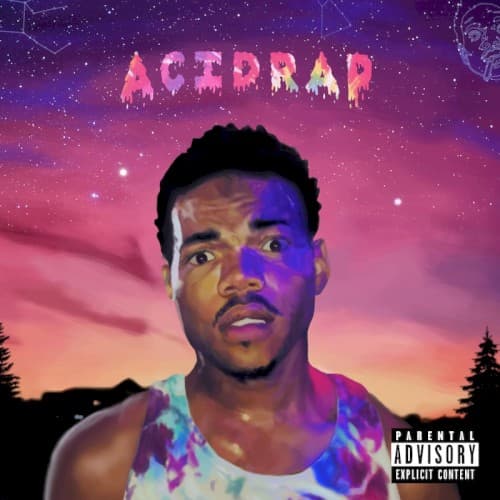
Chance the Rapper emerged from Chicago's South Side in the early 2010s with a radical proposition: what if a hip-hop artist never signed a record deal and still became one of the decade's most influential voices? Born Chancellor Bennett in 1993, he built his career entirely outside the traditional label system, distributing his work as free mixtapes while simultaneously winning three Grammy Awards and collaborating with Kanye West, Childish Gambino, and Francis and the Lights. His breakthrough project Acid Rap arrived in 2013 as a kaleidoscopic statement of intent—equal parts psychedelic experimentation, soul-sampling maximalism, and streetwise Chicago storytelling.
What set Chance apart wasn't just his business model but his musical identity: a voice that toggled between adenoidal singsongy melodies and rapid-fire bars, production that fused gospel choirs with acid jazz and trap percussion, and an earnest optimism that felt revolutionary in an era dominated by nihilistic flexing. He represented a generational shift in how hip-hop artists approached both creative freedom and spiritual expression. By the mid-2010s, he'd become the face of independent hip-hop's commercial viability, proving streaming platforms could sustain a career without iTunes sales or physical distribution.
His influence extends beyond music into activism, philanthropy, and Chicago's cultural infrastructure. He donated millions to Chicago Public Schools, organized community festivals, and used his platform to address gun violence and educational inequality. This combination of artistic innovation and civic engagement made him a uniquely positioned figure—part of hip-hop's lineage of socially conscious artists while operating in an entirely new economic paradigm.
Gospel-Infused Soul Sampling Meets Elastic Vocal Experimentation
Chance the Rapper's sonic signature revolves around maximalist production layered with live instrumentation, prominent gospel choirs, and samples pulled from soul, jazz, and R&B archives. His approach rejects minimalism in favor of dense arrangements where horns, strings, pianos, and vocal harmonies compete for space. This creates a warm, celebratory atmosphere even when addressing darker subject matter. Producers like Nate Fox, Peter Cottontale, and the Social Experiment collective built tracks that feel more like live band performances than traditional hip-hop beats, incorporating extended instrumental passages and dynamic shifts that mirror jam session energy.
Vocally, Chance operates outside conventional flow patterns. His delivery alternates between melodic singing, spoken-word cadences, and percussive rapping, often within the same verse. He stretches syllables into exaggerated melodies, punctuates bars with ad-libs that function as rhythmic instruments, and isn't afraid to let his voice crack or strain for emotional effect. This elastic approach draws comparisons to Andre 3000's freewheeling experimentation and Lil Wayne's melodic risk-taking, but Chance adds a spiritual dimension through his frequent incorporation of church choir aesthetics and gospel call-and-response structures.
The psychedelic elements in his work—particularly evident on Acid Rap—manifest through warped samples, pitch-shifted vocals, and production that shifts unexpectedly between tempos and moods. Tracks might begin with a hazy jazz sample before erupting into uptempo trap drums, then dissolving into an a cappella gospel outro. This refusal to settle into predictable patterns became his creative trademark, making each project feel unpredictable and ambitious even when execution didn't always match intention.
From 10 Day Suspension to Grammy-Winning Independence
Chance the Rapper's origin story carries the mythology every independent artist dreams about: a high school suspension that became the catalyst for his debut project. In 2011, while serving a ten-day suspension from Jones College Prep, he recorded 10 Day, a mixtape that introduced his voice to Chicago's underground scene. The project showcased his early potential but operated in a relatively conventional mixtape framework—promising but unpolished, with glimpses of the distinctive style that would fully crystallize two years later.
Acid Rap arrived in April 2013 and immediately repositioned him from local curiosity to national phenomenon. The mixtape earned a 9.2 rating on this site for good reason: it captured lightning in a bottle, balancing psychedelic production with introspective lyricism and infectious energy. Tracks like "Cocoa Butter Kisses," "Juice," and "Everybody's Something" demonstrated his ability to craft actual songs rather than just verses over beats. Features from Twista, Ab-Soul, and Childish Gambino positioned him within a broader hip-hop conversation while his production choices—courtesy of the Social Experiment collective—gave the project a timeless quality that avoided sounding dated to 2013's trends. The mixtape operated as both a coming-of-age document and a stylistic mission statement, establishing the gospel-soul fusion that would define his career.
The three-year gap between Acid Rap and his next major project, Coloring Book, saw Chance become hip-hop's most visible independent artist. He performed at festivals, appeared on tracks with Kanye West and Macklemore, and built anticipation through strategic feature verses that kept his name circulating. When Coloring Book finally dropped in May 2016 as an Apple Music exclusive before wider release, it arrived as an explicitly gospel-driven project that doubled down on the spiritual elements hinted at in his earlier work. The mixtape featured Kirk Franklin, featured more prominent church choir arrangements, and grappled with faith, fatherhood, and gratitude as primary themes.
Coloring Book became the first streaming-only project to win a Grammy, taking home Best Rap Album in 2017 alongside awards for Best New Artist and Best Rap Performance. This validation from the Recording Academy for a project never sold through traditional channels represented a seismic shift in how the industry acknowledged new distribution models. His Grammy performance featured a gospel choir and positioned him as hip-hop's spiritual optimist in an era when that stance felt radical.
The commercial peak came with complications. His 2019 debut studio album The Big Day arrived after enormous anticipation and a high-profile marriage. The project leaned heavily into its wedding celebration theme but received mixed critical reception, with some longtime fans feeling the balance between earnest positivity and artistic risk had tipped too far toward safe, family-friendly content. The album struggled to match the cultural impact of his mixtapes, raising questions about whether his independent model could sustain album rollouts with the same effectiveness as surprise mixtape drops. Features from Nicki Minaj, Megan Thee Stallion, and John Legend couldn't overcome a sense that the project lacked the cohesive vision that made Acid Rap and Coloring Book feel essential.
Since The Big Day, Chance has remained active through collaborations, community work, and occasional singles, but hasn't released another full-length project. His creative output has shifted toward mentorship, producing for younger Chicago artists, and continuing his philanthropic initiatives. The question of what comes next artistically remains open—whether he'll recapture the experimental energy of his mixtape era or continue refining the gospel-centered approach that defined Coloring Book.
The Independent Artist Who Proved Streaming Could Replace Record Deals
Chance the Rapper's most indelible contribution to hip-hop isn't a single album—it's the business model he legitimized. Before him, independent artists existed on the margins, fighting for mainstream recognition while labels controlled access to resources, distribution, and industry validation. Chance proved an artist could remain unsigned, distribute work for free, generate income through touring and merchandise, and still win the industry's highest honors. His Grammy wins forced the Recording Academy to change eligibility rules to accommodate streaming-only releases, fundamentally altering how the institution recognized contemporary music.
This blueprint influenced countless artists who followed, particularly in the SoundCloud era where young rappers watched Chance succeed without compromising ownership or creative control. His model became aspirational, showing that viral momentum combined with strategic partnerships could replace traditional A&R development and label infrastructure. Artists like Tyler, the Creator, who built Odd Future independently before selective label deals, or Isaiah Rashad and Smino, who maintained creative autonomy within smaller imprints, all benefited from the path Chance cleared. The entire conversation around artist rights, streaming economics, and creative ownership shifted because he demonstrated financial viability outside the system.
Musically, his gospel-rap fusion opened space for spiritual expression that felt contemporary rather than preachy. Where earlier conscious rap sometimes lectured, Chance celebrated, turning church aesthetics into party music without diminishing their sacred origins. This approach influenced how younger artists incorporated faith into their work—not as proselytizing but as authentic cultural expression. His willingness to be earnestly positive in hip-hop's often cynical landscape gave permission for emotional vulnerability that didn't rely on trauma or street credibility as authenticating mechanisms. The joy in his best work feels earned rather than naive, grounded in Chicago's complicated reality while refusing to let that reality define him completely.