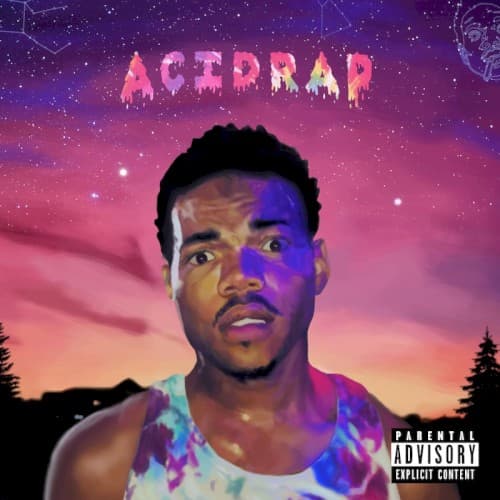
Chance the Rapper Acid Rap — The Blueprint for Refusing the Machine
Remove the major label system from hip-hop and most careers collapse before they start. Studios cost money, distribution requires infrastructure, radio spins demand favors nobody gives for free. Independent rap in 2013 meant selling CDs out of backpacks and praying a blog noticed.
Then a nineteen-year-old kid from Chicago uploaded a psychedelic gospel-rap fever dream to the internet and proved the entire model obsolete. No advance, no marketing budget, no physical copies. Just seventy minutes of kaleidoscope production and a voice that sounded like it learned to rap in a church basement during an acid trip. The album climbed to number three on iTunes without a single traditional industry co-sign, moved half a million downloads in six months, and turned Chance into the poster child for a generation that would rather own their masters than chase platinum plaques.
The timing mattered. Chicago drill had national attention but radio feared its violence. Blog rap was dying. Kendrick Lamar had just opened the door for conscious rap with a major label push.
And here came this kid refusing every deal on the table, singing about family and faith over beats that sounded like Kanye West producing a children's show on mushrooms. What made executives nervous was not the music — it was the proof that you could skip them entirely and still win. Could an industry built on gatekeeping survive when the gates no longer mattered?
Church Choirs Meet Drum Machines in the Basement
The production here refuses genre. Peter CottonTale, Cam O'bi, J. Cole, Jake One, and a roster of Chicago beatmakers built a sonic palette that pulls equally from gospel organs, jazz horns, boom-bap drums, and the kind of stoner synths that belonged on a Madlib record. Chance wanted it psychedelic but not alienating, accessible but not pop. The result sounds like someone remixing Sunday service through a karaoke machine after staying up for thirty-six hours.
The drum programming stays loose and off-kilter, kicks landing just behind the beat, snares cracking through reverb tails. Samples flip without warning — a Sufjan Stevens loop here, a Donnie Trumpet horn section there. The whole thing feels unpolished in the best way, like the final mix was the first take and nobody wanted to ruin the energy by going back.
Lyrically this thing splits time between two poles: street realism and spiritual optimism. Chance raps about watching friends catch bullets and selling drugs to classmates, then pivots into hymns about gratitude and family without flinching. The collision should feel forced but it mirrors the South Side experience — violence and faith occupying the same block, sometimes the same household.
His delivery carries the entire experiment.
The voice sits high in the mix, ad-libs stretching into full melodies, every punchline punctuated with a yelp or a cackle. He sings more than most rappers and raps better than most singers. The flows stay conversational even when the wordplay gets dense, like he is telling you a story at a party that keeps spiraling into tangents that somehow all connect.
Where the album stumbles is pacing. The middle stretch sags under the weight of its own ambition, a few tracks stretching past five minutes without enough momentum to justify the runtime. Some of the spiritual positivity tips into earnestness that feels unearned from a teenager. But even the weaker moments carry enough production innovation and vocal charisma to stay interesting — so why does the project still feel essential despite its obvious flaws?
The Listening Journey Feels Like a Church Service on Acid
The opening stretch establishes the thesis in three moves: the mission statement, the duality, the anthem. By the time the horns fade on Cocoa Butter Kisses you know exactly what kind of project this is and whether you are staying for the ride.
The sequencing here does not follow traditional album logic. No clean three-act structure, no commercial single placed at track four. Instead it moves in emotional waves, moments of chaos followed by moments of grace, party tracks bleeding into confessionals without warning.
The middle section tests patience. The runtime stretches, the thematic repetition starts to show, and a few interludes overstay their welcome.
But the back half redeems everything. The final run builds toward catharsis, each song peeling back another layer of Chance's internal world until Everything's Good (Good Ass Outro) delivers exactly the emotional payoff the entire journey promised.
What makes the sequencing work despite its flaws is tonal consistency. Every track feels like it belongs to the same fever dream even when the production or subject matter shifts. The threads that connect everything — the ad-libs, the horn arrangements, the gospel undertones — create enough cohesion to let Chance experiment without losing the listener. This is not an album you skip around — you press play at the top and let it wash over you, stumbles included.
The Album That Killed the Advance
This sits at number one in Chance's catalog and it is not particularly close. Everything that came after — the Grammy wins, the arena shows, the label courtship and rejection — stemmed from this moment. The Big Day tried to recapture this energy with a bigger budget and failed precisely because it had a bigger budget. Coloring Book refined the gospel-rap fusion but lost the raw spontaneity that made this feel dangerous.
Fans looking for an entry point into Chance's world start here or they miss the entire foundation. New listeners expecting pop-rap accessibility might struggle with the runtime and the lo-fi mixing. But anyone willing to sit with the weirdness will find one of the most ambitious independent projects of the 2010s.
The album aged beautifully because it never chased trends. The production choices that sounded left-field in 2013 still sound left-field today, which means they never went out of style. The influence shows up everywhere now — rappers singing without Auto-Tune, gospel choirs over trap drums, teenagers uploading projects to SoundCloud and skipping the label meetings entirely. Every artist who turned down a deal and built their own lane owes something to this blueprint.
Essential tracks to start with: the opener for the mission statement, the second track for the duality, the third track for the accessibility. Similar albums worth exploring: Kanye West's Graduation for the optimistic rap energy, Kendrick Lamar's Section.80 for the independent breakout, and Noname's Telefone for the Chicago jazz-rap lineage.
The long-term legacy is already written. This is the album that proved independence was not just possible but preferable, that mixtapes could compete with major label releases, that you could build a career without selling your publishing. Chance never signed a deal and he never had to.
Track Listing
Good Ass Intro
▲The entire thesis delivered in two minutes. Chance opens by announcing his refusal to sign a deal over a beat that sounds like a marching band playing in a cathedral. The horns swell, the drums skip, and his voice rides the pocket with the confidence of someone who already knows this thing will change his life. The wordplay stays playful — references to smoking, to Chicago, to the pressure of following up a breakout project — but the underlying message is dead serious. He is doing this his way or not at all. The ad-libs punctuate every bar, turning the track into a call-and-response with himself. By the time the horns fade you either believe in the vision or you check out. Most people believed.
Pusha Man
▲Two songs stitched into one six-minute epic that captures the entire duality of South Side life. The first half rides a hypnotic loop while Chance raps about watching friends turn into dealers, violence as routine, the numbness that sets in when tragedy becomes background noise. His voice stays calm, almost detached, like he is reading someone else's diary. Then the beat switches. The second half explodes into paranoia, the production turning claustrophobic, Chance's flow accelerating into breathless panic as he describes the psychological toll of living in a war zone. The transition between the two halves is abrupt and perfect — no warning, no fade, just a hard cut from resignation to terror. Nate Fox and Cam O'bi built a beat that mirrors the emotional arc, starting sparse and hypnotic before collapsing into chaos. The structure is ambitious for a mixtape track and it earns every second of its runtime.
Cocoa Butter Kisses
▲The crossover moment disguised as a nostalgia trip. Chance, Vic Mensa, and Twista trade verses about childhood vices over a Restoration-era sample that sounds like it came from a period drama soundtrack. The hook is sing-along ready, the verses balance humor and reflection, and the whole thing feels like a Saturday morning cartoon theme song remixed for stoners. Twista's guest verse is the track's secret weapon — his double-time flow against the slow-crawling beat creates tension that should not work but absolutely does. The production from Cam O'bi and Peter CottonTale keeps the mood light even when the lyrics turn dark, references to cigarette addiction and fake IDs undercut by the sheer joy in Chance's delivery. This was the song that convinced casual listeners to stick around. Radio-friendly without chasing radio. Accessible without dumbing down. A perfect distillation of everything that made the project special.
Juice
▲Nate Fox built a beat that sounds like a juice commercial from 1987 and Chance turned it into a mission statement about staying independent. The hook is absurdly catchy, the verses overflow with braggadocio, and the whole track radiates the kind of confidence that only comes from knowing you are about to win. The wordplay here is some of Chance's sharpest — double entendres about staying liquid, maintaining freedom, refusing to get boxed in by industry expectations. The ad-libs turn into full melodies, his voice stretching the syllables until the rapping and singing become indistinguishable. The beat stays bright and buoyant, horns bouncing over live drums, the whole thing moving with the energy of a block party in June. This is the kind of track that sounds better every time you hear it, the hooks burrowing into your brain until you are humming them in the shower three weeks later.
Lost
●Noname Gypsy (now just Noname) makes her first appearance and immediately steals the track. Chance raps about aimlessness, about wandering through adolescence without a map, but Noname's verse cuts deeper — her voice calm and measured, the wordplay intricate, every bar landing with the precision of someone who has been writing poetry since childhood. The production from Cam O'bi and Peter CottonTale stays minimal, a simple guitar loop and light percussion, giving both rappers space to breathe. The track meanders intentionally, mimicking the feeling of being lost, the structure loose and unhurried. It drags slightly in the second half, the runtime stretching past necessary, but the chemistry between Chance and Noname makes up for the pacing issues. This was the track that introduced most listeners to Noname, launching a career that would eventually produce Telefone and Room 25.
Everybody's Something
●The most introspective moment on the first half. Chance reflects on identity, on the pressure to represent Chicago while also being himself, on the tension between artistic ambition and street credibility. Saba and BJ the Chicago Kid both contribute verses, each adding their own perspective on the same theme. The production stays understated, a muted piano loop and soft drums, the mix leaving space for the voices to carry the weight. The hook is gentle and affirming, a rare moment of quiet on a project that usually operates at full volume. It works as a breather, a chance to reset before the chaos returns. But it also feels slightly redundant thematically — the same ideas Chance explores elsewhere, just with less urgency. Solid but not essential.
Interlude (That's Love)
▲The album's only true interlude and it earns its place. Chance's grandmother's voice opens the track, offering wisdom about love and family over a simple organ chord. Her words are direct and unpolished, no script, just a grandmother talking to her grandson. Then the instrumental swells — horns, strings, a choir humming in the background — and the whole thing becomes a hymn. It lasts barely over a minute but it shifts the emotional temperature of the entire project. Everything before this moment was chaos and ambition. Everything after carries a different weight. The sequencing choice is perfect, placing the most overtly spiritual moment at the album's exact center, a pivot point that recontextualizes everything that came before and everything that follows.
Favorite Song
●Childish Gambino shows up and the two trade verses about creative validation over a beat that flips between playful and aggressive. Chance opens with some of his most quotable bars, references to religion and rap mixed with the kind of wordplay that only works if you are willing to rewind three times. Gambino matches the energy, his verse dense with internal rhymes and pop culture references, the two playing off each other like they recorded in the same room even though they did not. The production from Peter CottonTale feels like a puzzle — drums that stop and start, sample chops that refuse to stay in one place, the whole thing held together by sheer momentum. The hook is minimalist, just the two of them repeating the title until it becomes a mantra. The track is fun, technically impressive, and ultimately a bit forgettable compared to the heavier moments surrounding it.
NaNa
●Action Bronson's verse is the most polarizing guest spot on the entire project. Some fans consider it a highlight. Others argue it disrupts the album's tonal consistency. The truth sits somewhere in the middle. Bronson raps about food, sex, and New York with his usual charisma, but his presence feels like it belongs on a different album entirely. The beat from Nate Fox and Cam O'bi is gorgeous — a flipped sample that sounds like it came from a 1970s soul record, drums knocking hard enough to rattle car speakers. Chance's verse is strong, his flow weaving through the beat's pockets with ease, but the track never quite coheres into something greater than its parts. It works as a moment of energy late in the tracklist but it also feels like Chance chasing a co-sign he did not actually need.
Smoke Again
●Ab-Soul joins for what should be a posse cut but instead becomes a meditation on escape. Both rappers use weed as a metaphor for avoiding reality, for numbing the weight of growing up too fast in environments that do not forgive mistakes. The production from Cam O'bi and Peter CottonTale stays hazy and slow, the beat drifting like smoke, the bass hitting just hard enough to keep you grounded. Ab-Soul's verse is reflective, his delivery subdued, a stark contrast to his usual rapid-fire aggression. Chance matches the mood, his voice softer than usual, the ad-libs turned down in the mix. The track meanders without much urgency, which fits the theme but makes it one of the project's less memorable moments. It works as mood-setting but does not demand repeat listens.
Acid Rain
▲The emotional centerpiece. Chance raps about death, about losing friends to violence and watching his city collapse under the weight of its own trauma. The production is stark — a simple piano progression, no drums until the final verse, rain sound effects that never feel gimmicky. His voice cracks in places, the pain audible, the performance raw in a way that feels almost uncomfortable to witness. This is not a song designed for playlists or parties. It is a confession, a eulogy, a moment of complete vulnerability from an artist who spends most of the project hiding behind charisma and wordplay. The final verse brings in live drums and the track builds to a cathartic climax, Chance's voice rising over the instrumentation, the ad-libs turning into full-throated screams. It is the kind of track that makes you sit in silence when it ends. Essential listening for anyone who thinks Chance is just a gospel-rap optimist.
Chain Smoker
●The penultimate track arrives like an exhale. Chance reflects on the habits that define him, the cycles he cannot break, the self-awareness that comes with acknowledging your own patterns. The production stays minimal, a looped guitar riff and soft percussion, the beat drifting without much momentum. It works as a come-down after the intensity of the previous track but it also feels redundant. The themes here — addiction as metaphor, self-destruction as routine — have been covered more effectively earlier in the tracklist. The track is not bad, just unnecessary. It fills space without adding much beyond mood.
Everything's Good (Good Ass outro)
▲The closer brings the entire journey full circle, mirroring the opener's energy while adding the weight of everything that came between. Chance reflects on the project itself, on what he accomplished, on the independence that defined the entire process. The production is triumphant without being bombastic, horns swelling over a simple drum pattern, the whole thing feeling like a curtain call. His voice is confident again, the vulnerability from earlier tracks replaced by the certainty that he just created something that would outlast him. The ad-libs return in full force, the energy building until the final bars fade into silence. It is not the most adventurous closer but it does exactly what it needs to do — leave the listener satisfied and already planning to press play again.