From Blue Slide Park to Transcendent Introspection: Mac Miller's Artistic Journey
Malcolm James McCormick arrived in hip-hop as Mac Miller, a teenage rapper from Pittsburgh's Point Breeze neighborhood whose early work captured the carefree energy of suburban adolescence. What began in 2010 as party anthems and stoner humor evolved into one of the most compelling artistic transformations in modern rap — a journey from commercial accessibility to dense introspection, from borrowed aesthetics to singular vision. By the time of his death in September 2018 at age 26, Mac Miller had documented a decade-long evolution that mirrored the coming-of-age experience for an entire generation.
His commercial breakthrough came almost immediately. Blue Slide Park debuted at number one on the Billboard 200 in 2011, making him the first independent artist to top the chart since 1995. Critics dismissed it as lightweight fare designed for college dorm rooms, and they weren't entirely wrong — but they missed the larger story developing beneath the surface. Mac Miller treated every project as a learning exercise, absorbing production techniques from jazz, soul, funk, and electronic music while gradually stripping away the performative elements that defined his early persona. He became obsessed with the craft itself, spending years learning to produce, play multiple instruments, and construct albums as cohesive artistic statements rather than collections of singles. Pittsburgh gave him a working-class ethos and distance from industry pressure, allowing him to develop at his own pace without the constant scrutiny faced by artists in coastal markets.
Musical Architect: Mac Miller's Production Philosophy and Sonic Palette
Mac Miller's sound transformed so dramatically across his career that early and late-period tracks feel like different artists entirely. The progression moved from sample-heavy boom bap and party rap toward expansive, self-produced compositions built on live instrumentation, jazz harmony, and textural experimentation. His work under the Larry Fisherman production alias revealed his true musical identity — a student of vintage soul and psychedelic funk who understood how Dilla-influenced swing, Rhodes piano voicings, and tape saturation could create emotional depth.
His vocal delivery evolved in parallel with his production aesthetic. The breathless double-time flows and punchline-focused bars of his mixtape era gave way to a conversational, almost confessional approach where rhythm served the message rather than showcasing technical ability. He developed comfort with singing, using his untrained voice as an instrument of vulnerability rather than polish. By Swimming and Circles, he had abandoned conventional rap structures entirely on many tracks, opting instead for impressionistic song forms that prioritized mood and atmosphere over hooks and verses. The influence of artists like Pharrell Williams, Flying Lotus, and J Dilla became apparent not through imitation but through shared values — a belief that hip-hop could absorb any musical tradition and that emotional honesty mattered more than perceived credibility.
What distinguished his production work was the willingness to leave space, to let a bass line breathe or allow a drum break to drop out entirely. He favored warmth over crispness, organic sounds over digital perfection, and human imperfection over quantized precision. His best work felt like midnight studio sessions captured in real time, complete with the hiss of analog gear and the loose timing of live performance.
The Arc of Growth: Mac Miller's Decade-Long Transformation Through Mixtapes and Albums
Mac Miller built his early reputation through a relentless mixtape campaign that showcased both his work ethic and his willingness to experiment. The K.I.D.S. mixtape in 2010 established his template — nostalgic samples, youthful exuberance, and an accessibility that connected with listeners who felt underserved by the darker tones dominating mainstream rap. Best Day Ever followed in 2011, refining the formula and expanding his audience beyond Pittsburgh. These projects operated in the space between Wiz Khalifa's smoke-filled optimism and the collegiate storytelling of early Asher Roth, carving out territory for suburban narratives without apologizing for their perspective.
Blue Slide Park represented both triumph and limitation. The commercial success validated his independent approach and proved his fanbase could move units, but the critical response stung. The album captured a moment in his development without suggesting where he might go next. Rather than doubling down on the formula, he used the criticism as fuel for reinvention. Watching Movies with the Sound Off in 2013 marked the beginning of his serious artistic phase. He enlisted Earl Sweatshirt, Ab-Soul, and Action Bronson for features while diving deeper into production himself. The album sounded murkier, more anxious, and more chemically altered than anything he had released — a conscious rejection of his party-rap image.
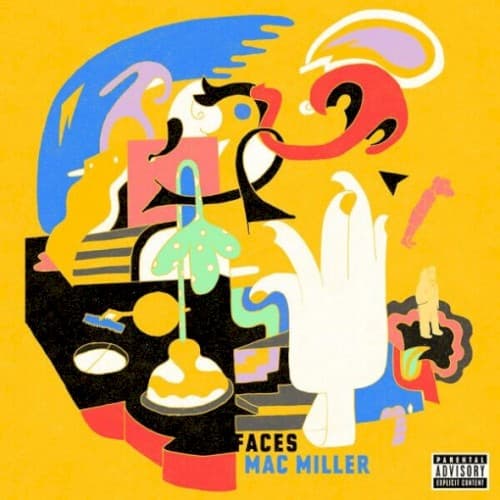
Faces arrived in 2014 as a free mixtape and immediately established itself as his defining statement. Across 24 tracks and 90 minutes, Mac Miller documented a psychological unraveling with unflinching honesty, confronting mortality, substance abuse, and depression without offering easy resolutions. The production drew from Madlib's abstract sample manipulation and the narcotic haze of Memphis rap, creating sonic landscapes that felt both expansive and claustrophobic. Our review praised its willingness to sit with discomfort, noting how the mixtape "captures an artist wrestling with demons in real time, refusing to provide comfort or redemption." Faces became a cultural touchstone, particularly after his death, when its themes of premonition and struggle took on devastating new weight. The project represented Mac Miller at his most fearless, using the mixtape format's freedom to create without commercial compromise.
GO:OD AM in 2015 attempted to balance artistic ambition with accessibility, resulting in his most polished major label release. The album featured his most refined production work to date alongside features from Miguel, Chief Keef, and Lil B, but it never quite achieved the lightning-in-a-bottle intensity of Faces. The Divine Feminine in 2016 took another sharp turn, positioning itself as a concept album about love and relationships that incorporated live instrumentation and guest vocalists like Anderson .Paak, Bilal, and Kendrick Lamar. Critics were divided, but the project demonstrated his refusal to repeat himself.
Swimming arrived in August 2018, just weeks before his death, as perhaps his most musically sophisticated work. Self-produced under his own name, the album eschewed features almost entirely and leaned into jazz fusion, neo-soul, and atmospheric production. Tracks like "Self Care" and "2009" showcased an artist who had finally synthesized all his influences into a coherent personal sound. The posthumous release of Circles in 2020 — conceived as a companion piece to Swimming and completed by producer Jon Brion — revealed his trajectory toward full musicianship, with Mac playing most instruments himself and singing more than rapping. Together, the two albums represented the culmination of a decade spent learning his craft and finding his voice.
The Enduring Influence: How Mac Miller Redefined Artistic Authenticity in Hip-Hop
Mac Miller's death at 26 cut short a career that was still ascending artistically. The outpouring of grief from peers across genre boundaries — from Chance the Rapper to John Mayer to SZA — revealed the depth of his influence within the music community. He had become an artist's artist, someone whose work ethic and creative fearlessness inspired others to take risks. His willingness to document struggle without glamorizing it opened space for a generation of rappers to address mental health, addiction, and vulnerability without compromising their credibility.
His legacy rests on three pillars: the artistic evolution itself, the music he left behind, and the model he provided for independence and creative control. The transformation from party rapper to introspective auteur proved that artists could outgrow their initial audience and survive, that growth wasn't betrayal but the entire point. Projects like Faces and Swimming continue to resonate because they capture specific emotional states with unusual precision — the dissociative fog of depression, the fragile hope of recovery, the weight of fame encountered too young.
The Mac Miller estate's decision to officially release Faces on streaming platforms in 2021 introduced his most challenging work to a new audience and reignited conversations about his artistic peak. Contemporary artists from Vince Staples to Thundercat to .Paak cite him as an influence not just musically but philosophically — someone who treated every project as an opportunity to learn rather than a product to monetize. In Pittsburgh, he remains a hometown hero whose memory is preserved through community programs and tributes. The posthumous recognition, Grammy nominations, and continued streaming growth suggest his work will outlive the initial wave of grief to become part of the permanent canon — not as a cautionary tale but as a document of someone who used music to make sense of being alive.