The scorecard
6.6/10 · Good
- Writing25%
- 6.5
- Production25%
- 7.0
- Delivery15%
- 6.5
- Cohesion15%
- 6.5
- Originality10%
- 6.0
- Replay value10%
- 6.5
Peep's habit of setting banal complaints beside blunt thoughts of dying keeps the better songs conversational, but the same few images of isolation, drugs and a lover who leaves get recycled through the second half, and that repetition holds the writing to merely good.
Smokeasac and IIVI build a warm, reverb-soaked guitar sound that suits Peep's close, dry vocal, but the finishing errs toward smoothness, the single template makes songs blur together, and the abrasion of the earlier tapes is missing.
The flat, sung-rapped voice makes the hooks feel unforced, but it barely changes register across eleven songs and gives little contrast.
The first five songs set a firm mood, while the tempo and guitar figures blur together through the middle before a pop-punk turn near the end.
Pulling the trap drums back for guitar-led emo rap is a clear stylistic choice, but it refines an existing template instead of extending it, and the album offers no detours, so the strengths and weaknesses roughly cancel out.
As a projection, the mood will hold its audience, yet the uniformity means fewer individual songs will pull listeners back.
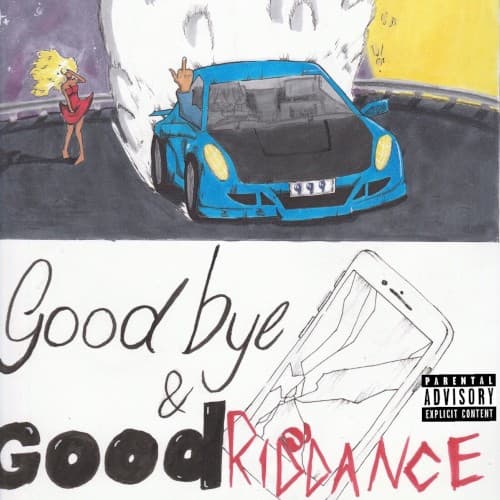
Lil Peep Come Over When You're Sober, Pt. 2: The Elegy That Plays It Safe
The best case for Come Over When You're Sober, Pt. 2 is how little of it depends on the story around it. Set aside that this is Lil Peep's first posthumous release and what remains is eleven songs about wanting out, sung by a voice that sounds worn down rather than theatrical. That plainness is the real subject of the record, and it is why the album holds up better than most projects assembled after an artist has died.
The thesis here is narrower than the tribute-album consensus. This is a good record because it is restrained, and a slightly lesser one because the restraint was applied by other hands. Peep left behind GarageBand demos, many of them recorded in the same period as the first Come Over When You're Sober; Smokeasac and George Astasio of IIVI finished them. Their work is tasteful, but it pulls a restless artist toward a single template, mid-tempo minor-key guitar under thick reverb, and a few songs end up sounding like drafts of each other.
The stakes are bigger than one tracklist. A posthumous album can easily become a memorial that nobody is allowed to criticize, and that would be a disservice to a writer whose best habit was candor. Peep's deadpan is built for scrutiny: he puts a joke next to a confession and lets the listener decide which one is lying. Judged as music, the album has a clear spine in its first half, a sag in the middle, and a closing stretch that recovers just enough.
It also lands at an interesting moment for the genre. Emo rap had already proven it could chart, and this record shows what the style sounds like when the trap drums recede and the guitars take the lead. It is less abrasive than what came before, and in a streaming economy that rewards one steady mood across a playlist, that softness is both its selling point and its limit. The sections below argue that the sound is a real achievement and that the sameness is a real cost.
Guitars, Reverb and a Voice That Never Raises Itself
The album's sound is built from a small set of materials: clean and slightly distorted alternative-rock guitar, four-note minor-key figures, low-pass filtered drums, and backing vocals that moan more than they harmonize. Smokeasac sits behind every song, with IIVI credited on most and 66swords and Stalfors each appearing once. The result is the most unified palette Peep has been given, and it suits him. Trap hi-hats would fight the dry, close quality of his voice; guitars let it sit in the foreground like a confession made across a table.
The writing is where the record earns its keep. Peep's method is to place banalities next to devastating lines, so a complaint about money sits beside a thought about dying and neither is dressed up. On the better songs the effect is conversational: he sounds like someone talking himself out of a bad night and failing. The recurring subjects are heartbreak, cocaine, people who stayed around only for the good times, and his own death, which he returns to with an almost administrative calm. That calm is more unsettling than any amount of screaming would be, but by the second half it is also a little repetitive, because the same few images of isolation, drugs and a lover who does not stay get recycled with minimal variation, and the album rarely finds a new angle on them.
Delivery follows the same logic. Peep sings and raps in a flat register that rises only slightly on hooks, and his melodies are simple enough to lodge in the head after one pass. The strength is that the hooks never feel manufactured. The weakness is that a voice this even offers little contrast when the beats also stay inside one tempo band. A song like Hate Me, which leans toward pop punk, shows how much a change of energy helps, and it also exposes how rarely the album permits one.
Then there is the question of authorship. Because the producers completed unfinished demos, some choices are unknowable from the outside: how much of the polish is Peep and how much is the finishing team. The estate later issued an original version built from the raw sessions, which suggests that even the people closest to the project saw the question as open. What can be judged is the final mix, and it errs on the side of smoothness. The vocals are well placed, the guitars are warm, and the low end rarely intrudes. What is missing is the abrasion and unpredictability that made his earlier tapes feel as if they might fall apart mid-song.
The honest weakness, then, is not the material but the uniformity. There are no stylistic detours of the kind that made his earlier work feel like a collage, and no guest on the standard tracklist to change the temperature. The album commits to one emotional register and delivers it competently, which makes it a strong mood record and a merely good album.
A Strong First Half and a Middle That Drifts
As a sequence, the album front-loads its argument. The opening stretch moves from a slow, atmospheric entrance into three songs that each find a different angle on loneliness, and by the fifth track the record has established everything it has to say about sound and subject. That is a confident run, and it is the reason casual listeners come away convinced.
The difficulty is what happens after. The tempo barely moves, the guitar figures begin to resemble each other, and the vocal approach stays almost identical from track to track. 16 Lines, at just over four minutes, is the longest song after the opener and has the least momentum, which is a bad trade in the part of the record that most needs a lift. The middle of the album does not collapse, but it drifts, and a listener shuffling the songs would not notice the join.
Recovery arrives in the last third, where a burst of pop-punk energy and a more direct, almost conversational hook restore some contrast. The record then ends on a short, bare song rather than a grand statement, which is the right instinct for an album that has spent its whole length refusing to perform.
At roughly thirty-eight minutes and eleven songs, the length is mostly earned. Trimming one mid-album track would help more than any addition could, because the weakest stretch is the one where the sound stops developing, not the one where the writing runs out. In playlist terms, the album functions as an environment: you can start anywhere and stay in the same room. That is a virtue for a mood and a limit for an album, and the sequencing makes no real attempt to disguise it.
A Good Elegy That Wants One More Surprise
No other Lil Peep albums are rated on this site yet, so the ranking is a judgment rather than a table: this is a good, consistent record that stops short of great, and the gap is variety. It is a cleaner and less abrasive record than its predecessors, and that clarity helps the writing land. It also removes some of the danger that made the earlier material feel urgent.
It is for listeners who already respond to emo rap and want the guitar-forward version, for people who like their rap sung rather than spat, and for anyone trying to understand why this scene mattered to a generation of young listeners, a point critics at the time stressed alongside XXXTentacion's parallel story. Pitchfork's 7.2 and a Metacritic average of 79 put the consensus in the same neighborhood as the scores here. Skip it if you want technical rapping, shifting tempos, or guests who change the room, because none of those are on offer.
On aging, the album is likely to keep its audience because it is a mood record, and mood records age slowly. The risk is that the sameness wears down repeat value for listeners who want specific songs to return to rather than an atmosphere. The subject matter will also stay heavy: it is blunt about addiction and death and offers no consolation.
Start with Cry Alone, the most direct song and the one that shows the sound at its most economical, then Runaway for its hook, and Life Is Beautiful for the dry humor that gets closest to the center of Peep's writing. After that, hear the original version assembled from the raw GarageBand exports to judge the finishing team's work for yourself, and go back to the first Come Over When You're Sober for the harsher edge this record sands off.
The closer is barely three minutes long and says it will not last long, which is the most economical thing on the record.
Track by track
Track Listing
Broken Smile (My All)
StandoutA slow, reverb-heavy opener that sets the terms: ghostly keys, alternative-rock guitar and a voice describing emptiness without raising itself. The intro borrows from a Peep feature on another artist's song, and the track runs longest on the album, which lets the mood settle before any hook arrives. It is more atmosphere than song, and a few minutes of the same figure are enough, but as a statement of intent it works. Peep's flat delivery makes the sadness feel unperformed, which is the album's central trick, and this track plays it more slowly than any other.
Runaway
StandoutThe hook is the case for the whole record. Peep returns again and again to the same plain statement that he was dying while no one was around, and the repetition turns an accusation into a chant over dark, guitar-driven production. The song is about fake people who showed up for the good times, and it avoids self-pity by keeping the tone almost conversational. The guitar line is simple and sticks, the mix gives the voice space, and at just over three minutes it does not overstay. One of the few places where the formula produces a real song instead of a mood.
Sex With My Ex
StandoutPeep alternates aggressive lines with tender ones, so the song plays like a real conversation with a former partner in which neither side is steady. The melody is light and the groove has a little more bounce than the opener. It is not a new idea for him, but the mixed temperature keeps it from becoming one more breakup song.
Cry Alone
StandoutThe shortest song of the first half and probably the cleanest piece of writing. Peep sounds ambivalent about his hometown over a grunge-style chord progression, and the economy helps: there is one idea, one riff and one hook, and none of it is padded. The guitar leans toward a gritty rock tone more than the surrounding songs, which gives the record a little edge it needs here. It is also the single that introduced the album, and it is easy to hear why, since it shows the sound in compact form. If you play one song to find out whether this record is for you, this is the one.
Leanin’
SolidThe song addresses a suicide attempt and Peep's indifference to having survived it. The subject is as heavy as the album gets, and the performance wisely stays flat rather than reaching for drama. Musically it sits in the same mid-tempo space as its neighbors, so the writing carries the weight while the production holds back. It is affecting because the delivery is so level, and it is also the point where the record's one-note arrangement starts to cost it, since a subject this stark deserves a sharper sonic turn than the guitars provide.
16 Lines
SolidA long, slow account of dependency on cocaine, with a title that doubles as a pun on writing and using. The writing is honest, and the plea for someone to hear him is one of the album's more direct moments. The problem is momentum: at over four minutes with little change in the arrangement, it is the clearest example of the middle stretch drifting.
Life Is Beautiful
StandoutOriginally an older Peep song, remixed here by the finishing team, and it carries the album's driest humor. The lyrics move through hardship, illness and police brutality, with a wry sense of irony that undercuts the sentimentality of the title. Peep's flat delivery turns the jokes into something closer to survival, and the remixed backing is warm without being heavy. The song is more varied in subject than most of the record and benefits from it. Its relative lightness also makes it a useful reset in the middle of a long stretch of similar tempos.
Hate Me
StandoutThe pop-punk song, driven by feelings of inadequacy and a faster, brighter guitar than anything before it. It is the clearest change of energy on the tracklist and reminds you how much the album gains when it moves. The hook is direct and a little blunt, and the song is the best argument for more variety.
Idgaf
SolidThis one sounds closest to Peep's older, rougher material, with a guitar lick that recalls heavy metal. The attitude is more defiant than the surrounding songs, and the track has some bite. It is solid rather than special, a decent return to the earlier sound that does not add much to the album's argument.
White Girl
WeakA song about sex with someone who does not return his feelings, with continued references to cocaine. It repeats the album's themes without adding anything, and the vocal feels the most repetitive of the set. This is the weakest song, and it is easy to hear why it drew criticism: it covers ground the rest of the album has already handled better.
Fingers
StandoutThe closer mixes synthesizer and guitar and ends on a line about not lasting long. It is short and bare, a quiet way to finish, and the restraint feels earned after a record that has avoided big statements. It does not add a new idea, but the ending lands softly and works as a final image.
Frequently Asked Questions
Is Come Over When You're Sober, Pt. 2 a good album?
Was Come Over When You're Sober, Pt. 2 finished after Lil Peep died?
How does Pt. 2 compare to Pt. 1?
Styles