The scorecard
6.6/10 · Good
- Writing25%
- 6.0
- Production25%
- 7.5
- Delivery15%
- 7.0
- Cohesion15%
- 5.5
- Originality10%
- 6.5
- Replay value10%
- 7.0
The heartbreak imagery is vivid and the emotional honesty is real, but the same confessional mode repeats across fifteen tracks with little variation in thought or approach.
Nick Mira's melodic loops are effective and consistent, with enough texture changes across Benny Blanco, Cardo and Ghost Loft's contributions to keep the sound from flattening completely.
The sung-rap cadences handle pain convincingly and the melodies stick, but the limited dynamic range means the hooks blur together by the back half.
Two skits and sixteen songs make for a runtime that sags in the middle, with several tracks serving the same emotional function without advancing the arc.
It applies emo and pop-punk's confessional vulnerability to melodic rap with more directness than most 2018 peers, though the sound itself leans on established SoundCloud aesthetics.
The singles hold up and the production textures reward repeat listens, but the album's one-note emotional palette makes full playthroughs feel longer each time.
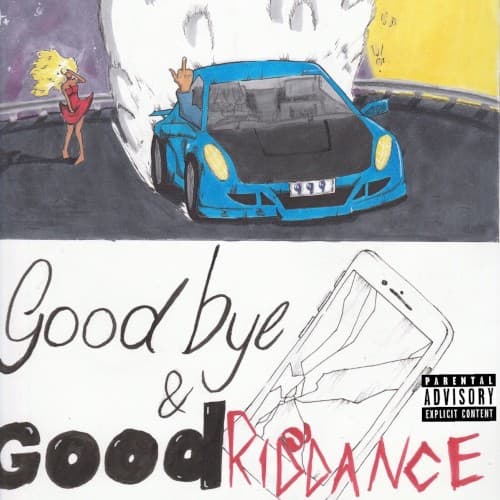
Juice WRLD Goodbye & Good Riddance — When the Breakup Became the Brand
This album lives in the weeks after a relationship ends when every song on shuffle reminds you of the person who left. That is both its strength and its limitation. Juice WRLD turned that recursive emotional state into a sound: melodic loops that never quite resolve, sung-rap cadences that land somewhere between confession and complaint, and production that wraps pain in enough sugar to make it go down easy. The thesis of Goodbye & Good Riddance is that heartbreak at nineteen feels total and that making it public might make it bearable. The album earned platinum certifications and spent nearly six years on the Billboard 200 because it named feelings that millions of listeners recognized and few mainstream rap records were willing to center.
The cost of that single-mindedness shows up in the runtime. Across fifteen original tracks and two skits, the album returns to the same emotional register over and over: the girl left, substances numb the feeling, the pain stays anyway. The writing is direct and often moving, but it does not develop.
By the time the album reaches its second half, the confessions start to feel like product rather than catharsis. The production, anchored by Nick Mira's ear for sticky melodic phrases, does more to create variation than the lyrics do. Mira's loops shift textures enough to keep individual songs distinct even when the subject matter blurs together. What the album does well it does from the first three tracks. What it lacks becomes clear by track ten.
Melodic Loops and Sung Confessions
Nick Mira produced nine of the fifteen original tracks and his hand is audible throughout: bright, melodic loops built from guitars, pianos and synths, mixed clean and given enough space for the vocals to sit on top without fighting for room. The best moments come when the production finds a texture that matches the emotional claim. The guitar loop on All Girls Are the Same has a circular, unresolved quality that mirrors the song's fixation on betrayal. The piano on Lucid Dreams, interpolating Sting's Shape of My Heart, gives the hook a wistful undertow that the lyrics about waking up from love earn. Lean Wit Me pairs a brighter, more uptempo beat with lyrics about using codeine to forget, and the contrast between the sound and the subject matter lands harder than the album's more straightforward sad songs.
The producers outside Mira's orbit add needed variety. Ghost Loft's instrumental on Scared of Love brings a dreamier, more textured feel that pulls the album briefly out of its SoundCloud-native aesthetic. Benny Blanco and Cashmere Cat's work on Black & White introduces a pop structure and vocal layering that make the track feel like it could exist outside the album's ecosystem. Cardo's beat on Long Gone has more knock than most of the record, a reminder that Juice WRLD's melodies could work over harder production if the album had chosen to explore that direction more often.
The writing commits fully to emotional exposure with almost no metaphor or distance. Juice WRLD describes panic attacks, substance abuse and suicidal thoughts in plain language, and the lack of filter is the point. The problem is that the emotional vocabulary does not expand. The same images recur: pills, lean, heartbreak as fatal injury, love as betrayal.
By Used To and Hurt Me, the confessions start to feel like exercises rather than revelations. The album's emotional honesty is real, but honesty alone does not make fifteen tracks necessary. The two skits, Betrayal and Karma, sample Billie Eilish and Khalid's Lovely and add brief vocal interludes that gesture toward narrative structure without providing it. They break up the tracklist without giving the album a shape.
When the Loop Becomes the Trap
The album front-loads its strongest material. The first five tracks establish the sound, deliver the two biggest singles, and make the emotional case as clearly as it will be made. After the opening stretch, the record begins to repeat itself.
The middle section reworks the same melodic ideas and lyrical territory without adding new information. The back half contains solid individual songs but no peaks that justify the extended runtime. The closing run returns to the same note the album opened with, which would work if the middle had earned the return. Instead, it feels like the album simply ran out of things to say before it ran out of songs.
The sequencing does not build or release tension; it sustains a single emotional frequency for forty minutes. That works for playlist consumption, which is how most listeners encountered these tracks, but it makes the album as an album feel longer than it is. The skits gesture toward breaks in the mood but do not actually provide them. A tighter tracklist that cut four or five of the mid-album repetitions would have made the case more forcefully and left less room for the sound to start feeling like formula.
The Debut That Defined a Lane and Its Limits
Goodbye & Good Riddance is the strongest version of one idea: melodic rap as emotional exorcism, sung directly and produced cleanly enough to reach listeners who do not care about bars. It ranks as the foundational statement of Juice WRLD's catalog because it is the album where he found the sound and proved it could move units. The raw confessional energy and Nick Mira's melodic instincts make it essential for anyone interested in how emo rap became a commercial force in 2018. For casual listeners, the singles tell most of the story. Lucid Dreams and All Girls Are the Same remain the two most complete expressions of what this album does well. Lean Wit Me and Wasted show the sound working at a slightly higher tempo without losing its melancholy core.
The album is not for listeners who need writing that develops its ideas or sequencing that builds toward something. It does one thing convincingly for three or four tracks and then does that thing ten more times with diminishing returns. It has aged as a document of a specific moment in streaming-era rap when emotional vulnerability and melodic accessibility could chart without traditional rap credibility.
Fans of Lil Peep, Trippie Redd and the more melodic work of Lil Uzi Vert will find common ground here, though none of those artists made albums this single-minded. If you are starting with Juice WRLD, play the first five tracks in order and then decide if you need the rest. If you want to hear where he took this sound next, the posthumous releases show more range but less focus. Goodbye & Good Riddance is the purest version of the formula, which makes it both the easiest to recommend and the hardest to sit through in full.
Track by track
Track Listing
Intro
SolidA brief scene-setter built on a Don Rob beat that samples Billie Eilish's Lovely, establishing the album's melancholy tone without overstaying its welcome.
All Girls Are the Same
StandoutThe circular guitar loop from Nick Mira gives the song a hypnotic, unresolved feel that matches the lyric's fixation on romantic betrayal. Juice WRLD's melodic phrasing on the hook is direct and sticky, turning a broad generalization into something that sounds like a specific grudge. The writing leans on the title's sweeping claim without earning it through detail, but the vocal performance sells the bitterness convincingly enough to make the song work. It remains one of the album's most complete statements, where the production and the emotional posture align without needing much lyrical complexity.
Lucid Dreams
StandoutThe Sting interpolation gives the track a wistful, pop-accessible foundation that elevates Juice WRLD's vocal melody into something genuinely affecting. The hook about waking up from love and finding the person still in his head is the album's most resonant lyrical moment, specific enough to land without overexplaining. Mira's production keeps the arrangement clean and lets the vocal carry the emotional weight. The song's success is deserved; it is the rare moment on the record where the confessional mode and the melodic craft meet at the same level. It remains the best argument for what this album does well and the ceiling for where this sound could go.
Lean Wit Me
StandoutThe brighter, slightly faster beat creates a tension with the lyrics about using codeine to numb heartbreak, and that contrast gives the song more dimension than the album's slower, more straightforward sad tracks. The vocal melody on the hook is one of Mira's strongest, and Juice WRLD rides it with enough variation in cadence to keep the repetition from flattening. The writing does not go deeper than the surface of substance abuse as coping mechanism, but the song does not need depth to function. It works as a melodic exercise and a mood piece, which is enough to make it one of the album's more replayable moments.
Wasted
StandoutLil Uzi Vert's feature adds a different vocal texture and energy level that the album needed more of. CBMix's production has more bounce than most of the record, and both artists sound engaged in a way that makes the track feel less like confessional therapy and more like an actual song. The back-and-forth dynamic between the two voices gives the track structure that most of the album lacks. It is one of the few moments where the album breaks out of its singular emotional mode without abandoning the melodic approach that defines the project.
I’m Still
SolidAnother Nick Mira loop, another confession about pain and pills. The song is competent but adds nothing new to the album's emotional or sonic vocabulary. By this point in the tracklist, the melodic approach is starting to blur into formula.
Betrayal (skit)
SolidA brief interlude with uncredited vocals that gestures toward narrative structure without providing it. It breaks up the tracklist but does not give the album a shape.
Candles
SolidMira and Taz Taylor's production has a slightly darker tone than the tracks immediately before it, but the song covers the same lyrical ground about heartbreak and emotional numbness. It is well-executed within the album's narrow parameters but does not justify its place in a fifteen-track runtime.
Scared of Love
StandoutGhost Loft's instrumental brings a dreamier, more textured production style that briefly pulls the album out of its established sound. The track has a more atmospheric, less loop-dependent feel, and the shift in production approach is welcome. Lyrically it stays in the same confessional mode, but the change in sonic palette makes it one of the more distinct moments on the back half.
Used To
SolidAnother Mira production, another meditation on how love turned into pain. The melody is solid and the vocal performance is committed, but the song does not offer new information or a new angle. It is the point in the album where the one-note emotional approach starts to feel less like honesty and more like product.
Karma (skit)
SolidA second skit sampling Lovely. It adds a minute to the runtime without adding anything to the album.
Hurt Me
SolidSidePce's production is sparse and minimal, giving the track a stripped-down feel that works for the vocal melody. It is one of the shorter songs on the album and it benefits from the brevity. The writing does not go anywhere new, but the song does not overstay.
Black & White
StandoutBenny Blanco and Cashmere Cat bring a more polished, pop-leaning production style that makes the track feel like it could exist outside the album's SoundCloud ecosystem. The vocal layering is more complex than most of the record, and the beat has more structure and dynamic movement. It is one of the album's more sonically ambitious moments, even if the lyrics stay in the same emotional lane. The production carries it.
Long Gone
StandoutCardo's beat has more knock and a harder edge than most of the album, and it shows that Juice WRLD's melodic approach could work over less delicate production. The track has more energy than the surrounding songs and it benefits from the change in tempo and texture. It is one of the few moments where the album feels like it could have explored a different direction.
End of the Road
SolidA Mira production that returns to the album's core sound for the final stretch. The melody is serviceable and the confessional lyrics are consistent with the rest of the project, but the track does not build toward anything or offer a sense of closure. It simply continues.
I’ll Be Fine
SolidThe album closer, produced by Mira and JR Hitmaker, offers a tentative note of hope in its title but does not meaningfully shift the emotional register. The production has a slightly more uplifting melodic contour, but the lyrics remain in the same space of pain and coping. It ends the album on the same note it opened with, which would feel circular if the middle had earned the return. Instead it just feels like the album ran out of songs.