The scorecard
6.8/10 · Good
- Writing25%
- 6.5
- Production25%
- 7.0
- Delivery15%
- 6.5
- Cohesion15%
- 6.5
- Originality10%
- 7.5
- Replay value10%
- 7.0
Titles like We Think Too Much and Walk Away As the Door Slams signal a narrow subject of loneliness and breakups, handled with plain directness but little variation in image or angle.
Sixteen tracks are built on samples pulled from emo, post-hardcore, indie folk and Aphex Twin, and they are matched to trap drums with real taste, especially on Hellboy and OMFG.
Peep's sung-rapped voice is melodic and unguarded, and the Lil Tracy and Horse Head guest turns suit it, but the pitch and cadence stay narrow across the tape.
The mood holds for sixteen songs, yet a clutter of short sketches and one interlude make the sequence feel like a collection of demos.
Flipping guitar-band and indie sources into rap instrumentals was rare in 2016, and the later emo rap wave leans on this tape's template.
The best songs hold up and the short runtimes encourage replays, though the weaker tracks tire quickly.
Lil Peep Hellboy: The Mixtape That Turned Emo Samples Into a Rap Template
The strongest thing about Hellboy is not a verse or a hook but a habit. Lil Peep took songs by bands that rap listeners were not supposed to love, from Underoath to Modest Mouse to Bright Eyes, and rebuilt them as the floor under trap drums. The result is a mixtape that sounds like a bedroom playlist of sad guitar music finally given a bass line.
The thesis is that Hellboy is a better blueprint than it is a record. Its ideas about sound are ahead of their moment and have been copied widely since, but the tape itself is loose, uneven and padded with sketches that never become songs. Sixteen tracks is too many for material this narrow, and at least a third of them are interchangeable. What survives is a handful of songs where the sample choice and the melody click.
The stakes are about where emo rap actually started to sound like itself. Plenty of writers treat the later, higher-budget records as the genre's peak, and they are cleaner and more polished. This tape is the one that proved the premise, and it does so with almost no resources. Judged on invention, it is among the most important releases of Peep's short career; judged as an album, it is merely good.
It also matters because the tape has lived on. Pitchfork later placed it on its list of the best albums of the 2010s, and it was re-released to streaming in 2020 after sample clearance forced one track to be rebuilt. That second life says more about the music's staying power than any first-week number could. A mixtape was never meant to be this durable, and part of the interest is hearing why it is.
Sad Guitars, Trap Drums and a Voice With Nothing to Prove
Production is the reason to hear this tape, and it is credited to a crowd. Smokeasac, NEDARB, Horse Head, Yung Cortex, Charlie Shuffler and several others each handle a portion, yet the sound stays consistent because the samples all come from the same emotional neighborhood. Acoustic guitars, ringing post-hardcore chords and indie folk textures sit under programmed drums, and the contrast does most of the work. The ear hears something familiar and unexpected at once, which is a powerful trick for a style that was still being named.
The sample choices are smarter than they first look. Pulling from an Aphex Twin piece in one place and an Avenged Sevenfold song in another shows a taste that crosses scenes without ranking them, and it gave the tape a range of moods inside a single palette. Some flips are nearly untouched loops and some are chopped hard, and the better ones leave space for the voice. A sample that is too busy would drown Peep, and the best songs here know that.
Peep's delivery is the other pillar. He sings and raps in a flat, direct register, rarely straining, and the plainness gives the hooks their pull. Guests such as Lil Tracy, Horse Head and Xavier Wulf add color without changing the temperature, which fits the tape's closed, private feel. The voice is the album's most reliable instrument.
The writing is the weaker half. The subjects, as the titles show, are loneliness, breakups and a dulled sense of self, and they are treated with sincerity but not much surprise. Few lines or images stand apart from the mood, and over sixteen songs the same emotional beats recur without escalating. A tape this reliant on atmosphere needs sharper detail to carry the thin stretches, and it rarely has it.
There is also a roughness that is partly charm and partly limitation. The mixes are lo-fi, some hooks are only half-built, and several songs end almost before they begin. That is in character for a self-released project made quickly, and it is part of why the music feels so personal. It is also why the weakest tracks sound like demos that never got another pass. The ambition is in the sound design; the discipline is in only a few of the songs.
Sixteen Tracks, One Mood, Too Many Sketches
As a sequence, Hellboy starts well. The opening run establishes the sound quickly, mixes up the guests, and spaces out the tempos enough that each song registers as its own event. By the fourth or fifth track, a listener knows exactly what the tape wants to be, and it is a confident, coherent entrance.
The middle is where the length starts to cost it. Several songs run well under three minutes and end before developing, and a long mid-tape breather breaks the flow instead of resetting it. The sequence falls into a sleepy plateau where the guitar loops blur together and the vocal approach stops changing. A shorter tape would hide this, and with sixteen tracks it cannot.
The strongest recovery comes late, with Girls, the longest song and the one that Billboard singled out after Peep's death. It earns its four minutes with a more patient arrangement and a hook that finally gets room to breathe, and it is the clearest sign of where his writing was heading. After it, the final run is a pile of short, melancholy closers that feel more like a fade than a finish.
The length is not earned. Cutting four or five tracks would produce a tighter, stronger tape without losing anything essential, because the missing songs are the ones where the sample is the only idea. In streaming terms, this reads as a playlist more than a statement, which is both its charm and its limit, and the sequencing does little to argue otherwise.
Better as a Blueprint Than as a Finished Record
No other Lil Peep albums are rated on this site yet, so the ranking is a judgment: Hellboy is a good, historically important tape that is a few edits away from great. It is the clearest statement of his sound before polish arrived, and it sits near the top of his early work for that reason. Its flaws are the flaws of speed, not of vision.
It is for listeners who want to understand how emo rap was assembled, for anyone who grew up on the guitar bands being sampled, and for people who like their rap sung and sad. The Pitchfork ranking in the best-of-the-decade list shows how seriously critics took it after the fact. Skip it if you want dense lyricism or polished studio mixes, because neither is on offer and the tape is not trying to supply them.
On aging, the music has held up better than most of its peers. The sample-driven sound still feels distinct, and the 2020 re-release with a rebuilt sample shows that the estate considered it worth preserving. What has not aged as well is the sameness, which is easier to forgive in a mixtape than it would be in a retail album.
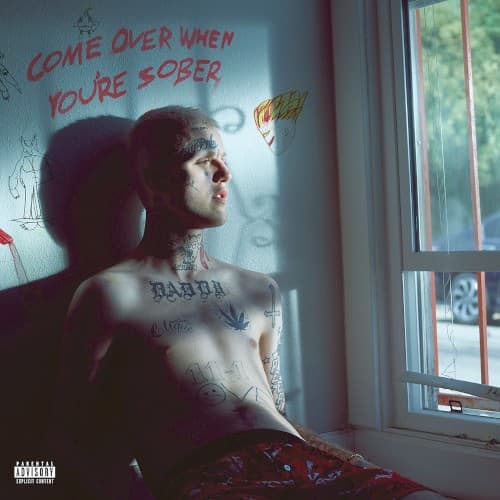
Start with OMFG, which the New Yorker called a standout, then Hellboy for the title-track sound, and Girls for the song that most clearly points toward his later records. After that, hear Come Over When You're Sober, Pt. 2, which finishes some of the same ideas with a more polished guitar sound, and Lil Tracy's own work if the guest verses caught your ear.
The best compliment for this tape is that its weakest songs still sound like they belong to a world someone had to invent.
Track by track
Track Listing
Hellboy
StandoutThe title track opens the tape by flipping an Underoath song into a bed for trap drums, and the combination announces the whole project in under three minutes. Smokeasac and Yung Cortex give the sample room, so the hook lands on top instead of fighting it. Peep's voice sits flat and close, which makes the heavier guitar source feel more intimate than loud. It is the clearest demonstration of the formula the tape sells, and it is also one of its more complete songs, with a start, a build and a finish.
Drive By
SolidA NEDARB production with Xavier Wulf, built over the intro of a Kyle Dixon piece that was replaced in the 2020 re-release. The guest verse brings a rougher, colder texture than Peep usually uses, and it breaks up the tape's softness nicely. The beat is atmospheric more than hooky, so this track is better as mood than as a song.
OMFG
StandoutOne of the clear standouts, and the song that The New Yorker singled out in its piece on sad rap. NEDARB builds it around a sample from The Microphones, and the delicate, folk-leaning source gives the track an exposed, nearly fragile feel. Peep leans into the melody and lets the hook carry the emotion instead of pushing the delivery, which is where his instincts are strongest. The arrangement is spare, the drums are restrained, and nothing is wasted. It is a good example of how little the formula needs when the sample and the voice agree.
The Song They Played [When I Crashed Into the Wall]
StandoutSmokeasac builds this around an acoustic performance by Tom DeLonge, and Lil Tracy joins as a guest. The pairing works because both voices share a bruised, melodic tone, and the acoustic source gives the track a campfire quality. At just over two minutes it is brief, but the sample and the pairing leave a distinct impression.
Fucked Up
SolidHorse Head flips a Toe song into a shimmering, math-rock-leaning loop, which is one of the more unusual sample choices on the tape. The sound is bright and airy against a blunt title, and Peep keeps the delivery loose. It is a good change of texture, if not a major song.
Cobain
SolidA second Smokeasac production with Lil Tracy, this time lifting from an Owen song. The guest and host trade melodic passages in a way that feels like a conversation, and the track's mood is soft and a little resigned. The song is pleasant and consistent, but it sits close to its neighbors in tempo and tone and does not add much that the opening stretch has not already established. It is a solid, well-made entry that benefits from being heard in context.
Gucci Mane
SolidCharlie Shuffler supplies a loop from Minor2Go, and the result is hazy, repetitive and short. The title promises a rap-leaning track, and the sound stays in the tape's melancholy lane instead. It is a sketch more than a song.
Interlude
WeakBrobak produces a piece built on the ending of a Modest Mouse song, and it runs more than three minutes, longer than most of the songs around it. For an interlude that is a lot of time, and it stalls the momentum the tape was building. Filler, though the sample is pretty.
Worlds Away
SolidHorse Head works from a Bright Eyes sample and keeps it brief at barely over two minutes. The indie-folk source suits Peep's voice, and the track is gentle and pleasant. It is a minor song that serves the mood without leaving a mark.
Red Drop Shawty
WeakCharlie Shuffler returns with another Minor2Go loop, and KirbLaGoop joins on the track. The guest adds a different voice, but the beat is thin and the song does little beyond marking time in the middle of the sequence. One of the tape's forgettable stretches.
Girls
StandoutThe longest song on the tape at four minutes, produced by Dirty Vans with Horse Head as a guest, and the one that Billboard pointed to as among Peep's best after his death. The extra time lets the arrangement breathe, with a hook that develops instead of repeating and a mood that deepens as it goes. Peep's delivery is at its most open here, and the guest works as a counterweight instead of a distraction. It points forward to the more finished records he would make, and it is the song most worth playing for a newcomer. The patient pacing is exactly what many of the shorter tracks lack.
Nose Ring
StandoutCian P builds the track from a From Autumn to Ashes sample, which brings a post-hardcore edge that the tape has used sparingly. It has some energy and a clear hook, and it is a welcome change of gear after the long middle. A solid, quick track.
We Think Too Much
SolidNEDARB flips an Aphex Twin piece, which is the most unexpected source on the tape and gives the song a drifting, ambient cast. The sample is delicate and electronic, and it suits Peep's introspective tone, though the song is closer to a mood piece than a hook. It shows the breadth of the tape's taste, even if the track is more interesting as an idea than as a song.
The Last Thing I Wanna Do
SolidSmokeasac samples the intro of a The Story So Far song and builds a compact, pop-punk-flavored track. The source brings brightness that contrasts with the title, and the song is quick and melodic. It is a decent, small piece that fits the tape's late stretch.
Walk Away As the Door Slams
StandoutYung Cortex produces over an acoustic +44 sample, with Lil Tracy again on the guest spot. The pairing returns to the soft, bruised sound that worked earlier, and the title sums up the tape's emotional register. It is a graceful, if familiar, late highlight, though it covers territory that the earlier Lil Tracy songs already staked out. The sound is warm and unhurried, and it earns its place in the closing run.
Move On, Be Strong
SolidSmokeasac, Yung Cortex and Peep himself share the production, working from an Avenged Sevenfold sample, and the track closes the tape in just over two minutes. It ends on a short, tense note without a big gesture, which suits the tape, though the finish is abrupt and unresolved.