The scorecard
6.1/10 · Mixed
- Writing25%
- 5.0
- Production25%
- 7.0
- Delivery15%
- 6.0
- Cohesion15%
- 6.5
- Originality10%
- 5.5
- Replay value10%
- 6.5
The confessional streak lands in the hooks, but verses on lovers, drinking and fame lean on stock images, which is the lyrical gap Wall of Sound pointed out.
Travis Barker's live drums and compressed guitars give every song a sharp, radio-ready punch, and the mix keeps MGK's voice on top without flattening the band.
MGK sings rather than raps here, with a nasal, strained tone that suits the genre, though the range is narrow and the guests mostly follow his lead.
Most songs run between two and three minutes and two short interludes break the pace, so the record moves quickly with very little dead weight.
Inside pop-punk the sound is close to a Blink-182 template, and its real novelty is the cultural crossover rather than the songwriting.
The short, hook-heavy songs invite repeat plays and the album has held an audience, though the sameness of the verses limits how much it rewards close listening.
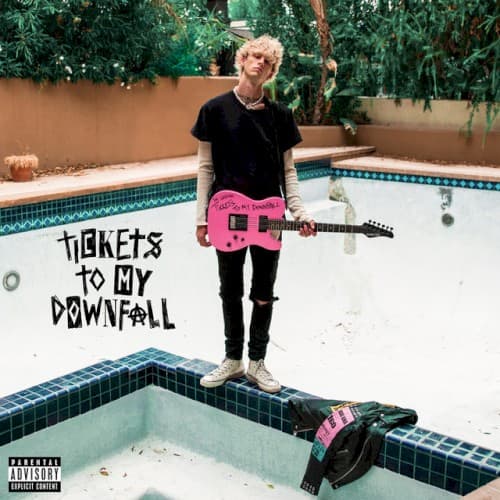
Machine Gun Kelly Tickets to My Downfall: The Rapper Who Walked Out of Rap
Tickets to My Downfall is not a rap album, and that is the most interesting fact about it for anyone who cares about hip-hop history. Machine Gun Kelly spent the 2010s as a rapper fighting for a place in the genre. Then, on his fifth album, he walked out of it and took a large part of the audience with him. The record is a pop-punk album built around Travis Barker's drumming, and it debuted at number one on the Billboard 200, which none of his rap albums had managed.
The thesis here is that the album matters more as a cultural bridge than as a piece of songwriting. The Evening Standard credited it with closing the gap between the modern pop-punk scene and the mainstream interest created by emo rap, and that is the right way to hear it. A generation raised on melodic, miserable, guitar-adjacent rap by artists who came up in the SoundCloud era suddenly had a record that used the same emotional language with actual live drums. In that sense the album is the logical endpoint of what rap had been learning from rock for a decade, and it answers a question the genre kept dodging: what happens when the emo-rap hook finally gets a band?
The criticism is also fair. Sputnikmusic called it a copy-paste of the Blink-182 sound and compared it to Greta Van Fleet's imitations of Led Zeppelin. That is too harsh about the execution, because the songs are sharp and the hooks are built to last, but it is accurate about the source. Nothing here sounds newer than 2003. The only genuinely new thing is who is singing it, and where he came from.
So the question for a hip-hop reader is not whether the album is good punk. It is whether the album is a good record, and whether it earns its place in the story. On the first count, mostly yes: it is short, fast and well-made. On the second, absolutely. This is the record where a rapper's crossover ambition stopped sounding like a gimmick and started sounding like a movement.
Live Drums, Open-Diary Hooks, and a Template Borrowed in Plain Sight
Travis Barker produced the whole album and drums on it, and his presence is the album's most important fact. Nearly every song runs under three minutes, with the drums locked tight, guitars compressed to a bright wall and hooks placed early. Omer Fedi co-produces many of the songs, and the result is a uniform sound that feels like one band wrote one record. That consistency is the production's real achievement. Nothing is wasted, nothing is muddy, and MGK's voice sits where it should: just above the instruments, slightly rough, easy to follow.
His delivery has changed completely. He no longer raps in any traditional sense, and the guest list reflects that. Halsey, Trippie Redd, Blackbear and Iann Dior all come from the melodic end of rap and pop, and none of them disturb the mood. MGK's voice is nasal and strained, which suits the genre, and the melodies are simple enough to feel instant. The range is narrow. He rarely moves outside one emotional register, but the register is well chosen, and the choruses land because he commits to them.
The writing is the weak link, and the critical split was mostly about this. Wall of Sound praised the album's infectious melodies while saying it lacks lyrical substance, and Kerrang! argued the opposite, praising what it called open-diary honesty. Both are partly right.
The confessional frame is clear: drinking, failed relationships, the cost of fame, the fear of being forgotten. The album title itself rests on an idea about audiences who want to watch a rising figure crash. But the verses rely on stock imagery, and the same scenes of parties, ex-lovers and self-destruction recur. Honesty is not the same as specificity, and the album mostly delivers the first.
The originality question deserves a direct answer. Within pop-punk, the album sounds like a loving tribute to the early-2000s radio sound, and the Blink-182 comparison is not an insult so much as a description. A younger listener would not find that familiar, but a longtime fan of the genre will recognize every move. What saves the record from being a pastiche is conviction. MGK did not try to modernize the formula so much as inhabit it, and he sounds genuinely thrilled to be there. That enthusiasm is audible and it is infectious.
The interludes show the limits of the concept. They are short and slightly awkward, a way to catch your breath rather than to build a world. They work as pacing devices, not as ideas. The album is stronger when it trusts its choruses than when it tries to be conceptual.
In total the album is a very efficient piece of pop engineering with a clear emotional core and a limited lyrical vocabulary. It succeeds because the songs are short, the drums are great, and the singer means it.
Thirty-Six Minutes at Full Speed
The sequencing of Tickets to My Downfall is built on speed. The album opens at full volume, hits its first big hook within minutes and rarely lets the tempo drop for long. Songs are short enough that the record feels like a single, continuous push, which suits the pop-punk template: the genre has always valued momentum over development, and this album respects that.
The peak comes early. The opening run puts the loudest hooks together, with the title track setting the tone and the singles arriving in a cluster that gives the first half real force. The two interludes, one near the center and one near the end, serve as breathing spaces, and they are placed well enough to reset the pace without killing it. The weakest stretch is the middle, where several songs share a tempo and a lyrical theme and start to blur. Nothing is bad, but nothing sticks out, and the album briefly loses the sharpness of its first half.
The closing stretch recovers. The last few songs move toward a more reflective register, and the final track ends on a quieter, more personal note than the rest of the album. It is a smart choice because it gives the record an emotional destination. A louder finale would have been easier, and the quieter one feels more honest.
The length is earned. At about thirty-six minutes the album is shorter than most rap records of the same era, and that brevity is a strength. It leaves little room for filler and gives the singles enough space to land. If anything it could use one more distinctive song in the middle, something strange or ambitious to break the pattern. As it stands it is a very tidy record, a little too tidy, built so that every song feels like a possible single and none of them feels like a risk.
The Crossover That Rewrote the Rap-Rock Map
In Machine Gun Kelly's catalog, Tickets to My Downfall is the turning point. It is the record that changed what he was, and it is easily his most successful: a number-one debut on the Billboard 200 with 126,000 units, roughly triple the opening of Hotel Diablo, and a long run as a top rock album. It also changed the conversation around the whole emo-rap-to-pop-punk crossover. Whether it is his best album depends on the listener, but it is his most important one.
As a pure listening experience, it is a good, slightly better-than-good record. The production is strong, the hooks work and the length is right. The weaknesses are the lyrics, which stay on the surface, and the originality, which is limited by how closely it follows a known template. Metacritic's average of 72 from six reviews seems about right.
Who should start here? Anyone who likes pop-punk, anyone curious about the rap-to-rock crossover, and anyone who wants a short, fast record with strong choruses. Who should skip it? Rap listeners who want verses, wordplay or technical flow. The album does not offer them, and it makes no apology.
It has aged well as a cultural marker and moderately well as a set of songs. The pop-punk revival that followed in the early 2020s makes it feel like a starting point, and that gives it a durable place even if the songs themselves are not all timeless.
For three songs to start with, play bloody valentine, my ex’s best friend and concert for aliens. Those are the three that show the album's drums, hooks and crossover appeal most clearly. For what to hear next, go back to Hotel Diablo to hear the rap-rock hybrid in its earlier, rougher form, and to General Admission to hear where the melodic, miserable side of his voice first appeared. Of the two, Hotel Diablo is the more useful, because it contains the single that led directly to this album.
Tickets to My Downfall is the sound of a rapper discovering that the loudest door out of the genre was a pair of drumsticks.
Track by track
Track Listing
title track
StandoutA fast, loud opener produced by Barker, MGK and Omer Fedi that announces the album's terms in under three minutes. The drums drive the song, the guitar is bright and the hook arrives immediately. It is a clear mission statement: this is a rock record now. Effective, if not especially deep.
kiss kiss
SolidA brisk follow-up that keeps the energy high without adding much. The hook is catchy and the drums are crisp, but the song is more a continuation of the opener than a new idea. Solid pop-punk filler.
drunk face
SolidA song about the bad habits that hide the pain, with a tight beat and a chorus built to be shouted. It later received a music video with the deluxe release. The writing is typical of the album's themes of drinking and regret, and it works because the hook is simple.
bloody valentine
StandoutThe first formal single and the song that started the entire collaboration with Barker. It is the clearest example of what the album can do: a driving beat, a melodic chorus and a dark romantic hook that sticks after one listen. The production is clean and Barker's drumming is the engine. The lyrics are conventional, but the song is built so well that it hardly matters. It is also the track that best explains why the album worked, because it takes the language of emo rap and puts it on a live kit. The best song on the record.
forget me too
StandoutHalsey joins MGK for a duet about a broken relationship, and the two voices trade lines over a mid-tempo punk arrangement. Halsey's tone adds contrast and the chorus is strong. It is one of the more emotionally direct songs, and one of the best features on the album.
all I know
StandoutTrippie Redd brings his melodic style to a short song that interpolates an Operation Ivy track. It is one of the shortest full songs on the album, and the brevity works in its favor. A light, catchy diversion with a nice nod to punk's roots.
lonely
SolidA slower, more exposed song that leans on isolation. MGK and Barker produce it, and the arrangement is simpler than most of the album, giving the vocal more room. The sentiment is genuine but the writing is thin. Pleasant, but forgettable beside the singles.
WWIII
SolidA brief burst under a minute long that works as a palate cleanser. It is more a sketch than a song, and it moves too quickly to leave an impression.
kevin and barracuda (interlude)
SolidA short spoken-style interlude that gives the album a pause. It has a quirky tone and a little humor but no musical weight. Skippable.
concert for aliens
StandoutThe second single, debuted on national television, is a high-energy, tongue-in-cheek song about feeling like an outsider performing for a crowd that does not understand. Barker's drums push it forward and the chorus is built for live shows, which suits the song's idea. The video's alien audience matches the song's playful tone. It is one of the album's best examples of how the pop-punk formula can be fun, and it shows MGK's personality better than most of the more serious songs.
my ex’s best friend
StandoutBlackbear joins for the third single, a more modern take on pop-punk than the classic sound elsewhere on the record. It is the album's biggest commercial hit and it shows: the hook is sleek, the production is polished and the pairing of two melodic voices is smooth. The writing is simple and a little petty, and it is the most obviously radio-ready song here. It works because it commits to the hook.
jawbreaker
SolidA quick, punchy track under two minutes that keeps the momentum going. Barker's drumming dominates and the song makes its point fast, though it leaves little lasting impression.
nothing inside
SolidIann Dior adds a melodic guest verse to a song about emptiness behind the success. The beat is solid and the chorus has some weight, though the song sounds close to others in the album's back half. Competent, and a clear example of the crossover guest model.
banyan tree (interlude)
SolidA short, atmospheric interlude that shifts the album toward its quieter finish. It works as a transition and nothing more.
play this when i’m gone
StandoutThe closer is the album's most personal song, a slower, reflective track that turns the record's themes toward mortality and legacy. Barker and Scharff share production, and the arrangement leaves room for the vocal to carry the emotion. It lacks the speed of the earlier songs, which is exactly the point, and it gives the album an honest, quieter landing. It is more effective than a louder finale would have been, and a high point of the album's back half.
Frequently Asked Questions
Is Tickets to My Downfall a rap album?
Is Tickets to My Downfall good?
How well did Tickets to My Downfall do on the charts?
Styles