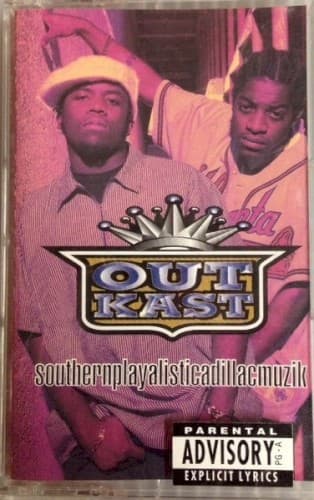
OutKast Southernplayalisticadillacmuzik — The Single That Announced Atlanta Before the Album Could
The South had been making hip-hop for years before anyone in New York or Los Angeles bothered to listen. This single landed in the summer of 1994 like a transmission from a parallel universe where funk never died and rappers still cared about making you move. Two teenagers from East Point had something to say about their city, their cars, and the music coming out of their speakers, and they said it over production so thick you could spread it on toast. The title alone was a declaration of independence — a mouthful of syllables that refused to apologize for where it came from or how it sounded.
What separated this from every other regional single trying to break through was the confidence. Andre Benjamin and Antwan Patton were not asking for permission to exist in the same conversation as the coasts. They were building their own lane with live instruments, southern slang, and a groove that owed more to Parliament-Funkadelic than Pete Rock. The Organized Noize production team understood that Atlanta had its own sonic fingerprint, and they pressed it all over this record like a stamp on a passport.
Why does a single release with four remixes and an instrumental still matter three decades later? Because it represents the exact moment when Southern hip-hop stopped waiting for validation and started writing its own rules. Before Dungeon Family became a movement, before OutKast became the most important rap group of their generation, there was this — five versions of the same song, each one refusing to sound like anything coming out of New York basements or California lowriders.
The album version became a foundation. The remixes became proof that the South could flip its own material without outside help. This is not the full album that would define 1994. This is the warning shot.
The Groove That Refused to Apologize
The album version of Southernplayalisticadillacmuzik sounds like it was recorded in a room where someone had just burned incense and unpacked a crate of Funkadelic records. Organized Noize built the track around live bass, rolling percussion, and a vocal sample that floats through the mix like smoke. The production philosophy here is anti-New York — no boom bap, no jazz loops, no sample flips that sound like they came from a dusty record bin in Brooklyn. This is Southern funk given a 1990s update, slowed down just enough to let the bass breathe, sped up just enough to keep heads nodding.
Andre and Big Boi trade verses with the ease of two people who have been finishing each other's sentences since middle school. Andre's delivery is looser, more melodic, riding the pocket like he has all day to get where he is going. Big Boi is tighter, more percussive, hitting syllables like a drummer working the hi-hat.
The contrast works because neither one is trying to outshine the other. They are building something together, and the chemistry is already clear even this early in their career.
The lyrical content is regionalism as identity. They name-check the South, claim their city, and describe the music playing in their cars with the kind of specificity that only comes from lived experience. There is no political grandstanding here, no conscious rap posturing.
This is music about place and sound and the pride that comes from representing somewhere that the rest of hip-hop had ignored for too long. The hook is simple, repetitive, hypnotic — a chant that works better the longer it goes.
But does the single format expose a weakness? Five tracks with minimal variation means the novelty wears thin by the third remix. The instrumental version only underscores how much the song relies on the voices to carry it. Strip away Andre and Big Boi, and you are left with a great groove that does not quite justify its own existence as a standalone track.
Five Versions of the Same Argument
The listening journey here is less about emotional progression and more about watching a single idea get stretched across different arrangements. The album version establishes the template. The Organized extended remix adds length without adding much substance.
The Diamond remix introduces new production flourishes that feel like lateral moves rather than improvements. By the time you reach the Organized edit remix, you are hearing the same vocal performances in a cleaner package, and the impact has dulled.
The sequencing exposes the limitations of the single format. Hearing the same hook five times in a row tests even the most devoted listener's patience. The remixes do not build on each other or offer contrasting moods. They exist in parallel, each one making a slightly different case for the same song.
The momentum does not shift because there is nowhere for it to shift to. You are locked into one groove for the entire runtime, and that groove either works for you immediately or it does not.
What saves the experience from feeling redundant is the production quality. Each version sounds distinct enough to justify its inclusion, even if the differences are subtle. The extended remix breathes more. The Diamond remix tightens the low end.
The clean edit sacrifices some edge for radio play but retains the essential character. The instrumental reveals how much work Organized Noize put into the foundation, even if it does not stand alone as a listening experience. This is a single release designed for DJs, remixers, and completists, not casual fans looking for variety.
The Foundation Before the Empire
In OutKast's discography, this single sits at the very beginning of a journey that would take them from regional underdogs to global icons. It is not their best work, but it is their first public argument for why the South deserved a seat at the table. The album that would follow this single is the one that truly matters, but this release set the tone and introduced the aesthetic that would define Dungeon Family for years to come.
Who should listen to this? OutKast completists who want to hear where it all started. Fans of Organized Noize production who appreciate the funk foundation that Atlanta hip-hop was built on. Listeners interested in the regional battles of 1990s rap and how the South carved out its own identity.
Who might skip it? Anyone looking for the full artistic statement that OutKast would deliver on their album. Casual fans who only need one version of a song to get the point. People who prefer the more experimental, psychedelic direction OutKast would take later in their career.
The album has aged as a historical document more than a listening experience. It sounds like 1994 in the best and worst ways. The production still knocks, but the format feels like a relic from an era when singles were packaged for maximum utility rather than artistic vision. You can hear the influence this had on every Southern rap record that followed, but you can also hear the limitations of two young rappers still finding their voices.
Essential tracks to try: the album version is all you really need. Similar albums: Goodie Mob's Soul Food captures the same Organized Noize aesthetic with more thematic ambition. UGK's Super Tight shows what Texas was doing with Southern funk around the same time. Long-term influence: this single opened the door for Outkast to build an empire, and that empire changed hip-hop forever.
The South had something to say, and this was the first time anyone outside the region bothered to listen.
Track Listing
Southernplayalisticadillacmuzik (album version) (dirty)
▲This is the blueprint. Organized Noize layers live bass, hand percussion, and a vocal loop that sounds like it was lifted from a 1970s soul record that never got famous. The groove sits so deep in the pocket it nearly disappears, but that is the point — this is music designed for car stereos with the bass turned all the way up, not headphone scrutiny. Andre opens with a verse that establishes his melodic flow, riding syllables like a singer who happens to be rapping. Big Boi follows with a tighter, more rhythmic approach that locks into the drum pattern like a kick drum. The hook is hypnotic repetition, the kind of chant that works better the longer it runs. The production never rushes, never shows off, never tries to prove anything to anyone outside the South. It just exists in its own lane, confident that the groove is enough. The only flaw is that the song does not build or evolve. It stays in the same emotional space from the first bar to the last, which makes it feel more like a mood than a fully developed composition. But as an introduction to what Atlanta hip-hop could sound like, it is undeniable.
Southernplayalisticadillacmuzik (Organized extended remix) (dirty)
●The extended remix adds two minutes of runtime without adding much new information. The vocal performances are identical. The structure is the same. What changes is the breathing room — the instrumental sections stretch out, the groove gets more space to unfold, and the track starts to feel less like a single and more like a vibe you put on when you have nowhere to be. Organized Noize uses the extra time to let the bass walk a little further, to let the percussion patterns develop more complexity, to give the sample more moments to echo through the mix. It works if you are already sold on the original version and just want more of it. It does not work if you are hoping for a reimagined take or a radically different perspective. This is the version DJs reach for when they need to let a crowd settle into a groove for longer than three minutes. It is the version that makes sense in a club or a car but feels redundant on headphones.
Southernplayalisticadillacmuzik (Diamond remix) (dirty)
●The Diamond remix tightens the low end and sharpens the drum programming, giving the track a cleaner, more polished feel. The funk is still there, but it has been scrubbed of some of its rough edges. The vocals sit higher in the mix, which makes Andre and Big Boi sound more present but also strips away some of the hazy, smoky atmosphere that made the album version feel so lived-in. The remix introduces new percussion flourishes — hand claps, shakers, a snare hit that cuts through the mix like a knife. It is a more radio-friendly version, designed to fit into playlists that might not have room for the album version's unpolished funk. The problem is that in making the song cleaner, the remix also makes it less distinctive. You lose some of the regional character, some of the sense that this music could only come from one place. It is a lateral move that will appeal to some listeners and leave others longing for the original's grit.
Southernplayalisticadillacmuzik (Organized edit remix) (clean)
●The clean edit does what it needs to do and nothing more. The explicit content is removed, the runtime is shortened, and the track becomes safe for radio play. Organized Noize does not try to reinvent the song or add new elements. They just strip it down to its most essential components and let it breathe. For most listeners, this version will feel like a compromised experience. The language edits are noticeable, and the shorter runtime means less time to sink into the groove. But the edit also reveals how strong the song's foundation is. Even with pieces removed, the core remains intact. The hook still works. The chemistry between Andre and Big Boi still registers. The production still has enough weight to move a room. This is the version you put on when someone's parents are in the car or when you need to play the song in a context where explicit content is not an option. It is functional, not essential.
Southernplayalisticadillacmuzik (instrumental) (album version)
●The instrumental exposes both the strength and the limitation of Organized Noize's production. On one hand, the groove is undeniable. The bass line walks with authority. The percussion stays in the pocket without ever feeling stiff. The vocal sample floats through the mix like a ghost, adding texture without demanding attention. On the other hand, the track does not quite justify its existence without the voices. Hip-hop instrumentals work best when the production is complex enough to hold interest on its own, and this one is just a little too sparse to carry the full weight. It is a great loop, a strong foundation, a vibe that works in the background. But as a standalone listening experience, it falls short. DJs and producers will find value here. Beat heads who want to study the architecture of Southern hip-hop will appreciate how clean the mix is and how much space the instruments are given. Everyone else will likely press skip and return to one of the vocal versions.