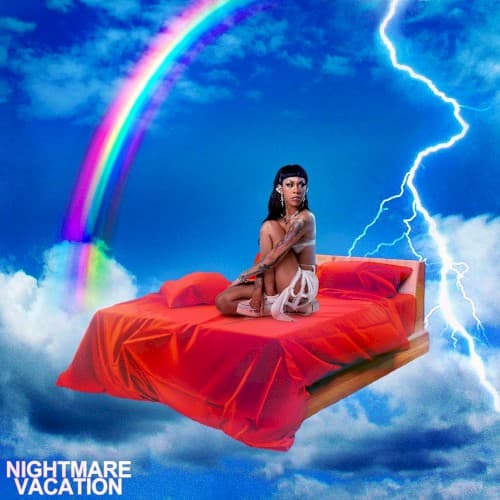
Rico Nasty Nightmare Vacation — The Rage Girl Who Wouldn't Compromise
You cannot sanitize rage and expect it to still burn. Atlantic Records signed Rico Nasty because she screamed over distorted 808s and made teenage girls in Hot Topic parking lots feel invincible, then spent two years trying to figure out how to package that fury for playlist algorithms. The label kept pushing release dates. They commissioned pop remixes.
They brought in outside writers for songs she'd already finished. By the time Nightmare Vacation finally arrived, the discourse had shifted from when it would drop to whether major label machinery had already crushed what made her dangerous. The project exists in that uncomfortable space between artistic vision and corporate compromise — sixteen tracks that toggle between unfiltered aggression and calculated accessibility, between the Sugar Trap mixtapes that built her cult following and the streaming-era expectations of a label that spent seven figures on her signature. What does it mean when the industry tries to monetize the very rebellion it fears?
Rico refused to choose between punk and pop, between the mosh pit and the makeup tutorial, between screaming her throat raw and singing melodies. She forced both worlds to coexist on the same tracklist, demanded that listeners hold space for a Black woman who wanted to be pretty and violent in the same breath. That shouldn't be revolutionary in 2020, but hip-hop still struggles with women who won't perform one-dimensional femininity. The girls who rage get called aggressive.
The girls who sing get called soft, but Rico did both and dared anyone to tell her she was doing it wrong.
Sugar and Glass — The Sound of Refusing to Pick a Lane
Dylan Brady and 100 gecs collaborator Nic Nasty handle the majority of production, layering hyperpop glitch with trap aggression in ways that feel genuinely experimental rather than focus-grouped. Brady's work on the opening stretch uses blown-out bass and candy-coated synths that sound like a rave colliding with a riot. The production philosophy borrows from SoundCloud rap's disregard for traditional mixing — everything hits the red, distortion becomes texture, and Rico's voice fights for space against beats that refuse to give her room. When she screams, the production screams back.
When she sings, the melodies curdle into something acidic.
Lyrically, the album operates in two registers. The rage tracks deal in threats, flex, and the specific violence of a woman who grew up having to prove she belonged in spaces that didn't want her. The pop-leaning cuts explore relationship dysfunction and emotional vulnerability without abandoning the edge — she's not asking for empathy, just acknowledging that anger comes from somewhere. Her vocal delivery toggles between melodic trap singing, guttural screaming, and a conversational flow that sounds like she's texting mid-verse.
The transitions feel abrupt sometimes, like she's switching moods without warning.
The album's biggest weakness is its length. Sixteen tracks when twelve would hit harder. The back half includes both the original version of a song and its remix, a choice that feels like label-mandated padding rather than artistic intention. Some cuts blend together, victims of a production aesthetic that works best in short bursts.
The sequencing doesn't build momentum so much as alternate between modes — aggression, melody, aggression, melody — until the pattern becomes predictable. But even the weaker moments refuse to sound like anything else in mainstream rap. This is what happens when a woman who grew up on punk and riot grrrl gets a major label budget and refuses to code-switch. So what if not everyone wanted to hear it?
Chaos Theory — The Architecture of Controlled Disorder
The opening stretch establishes the album's core tension immediately. The first three songs function as a mission statement — this is who Rico Nasty is, this is what she sounds like, and if you're here for something polite you're in the wrong place. The production stays caustic, the melodies stay sharp, and Rico sounds like she's been waiting years to prove herself on this scale. The energy feels urgent, like she recorded these songs knowing the label might try to bury them.
The middle section pulls back slightly, introducing the melodic palette that will define the album's more vulnerable moments. These aren't ballads — Rico's version of softness still has teeth — but they create breathing room in an otherwise relentless listen. The sequencing here works because she earns the emotional gear shifts. You believe the vulnerability because you've already heard the armor.
The back half loses focus. By the time the album reaches its final stretch, the constant toggling between aggression and melody starts to feel like a formula rather than a conversation. The inclusion of both versions of the same song disrupts the momentum, turning what should be a victory lap into a reminder that Atlantic didn't trust the original vision. The album doesn't end so much as exhaust itself, which feels fitting for a project about refusing to compromise until you're too tired to fight.
The Cost of Not Breaking — What Happens After the Rage
In Rico Nasty's discography, Nightmare Vacation sits as the messy, necessary document of what happens when an uncompromising artist meets major label expectations. It's not as cohesive as Anger Management or as feral as the early Sugar Trap tapes, but it captures something those projects couldn't — the full range of who she is when she's not performing for a niche audience. The pop experiments won't satisfy purists who wanted sixteen versions of her hardest material, but they prove she can occupy multiple spaces without diluting either.
This album works best for listeners who grew up feeling too aggressive for pop and too feminine for punk, who understand that rage and vulnerability aren't opposites but different expressions of the same survival instinct. If you need linear sequencing and thematic consistency, this will frustrate you. If you can handle an artist arguing with herself for forty-five minutes, this feels honest.
The album aged better than its initial reception suggested. In 2020, critics wanted to debate whether Rico had sold out or stayed true. By 2024, that binary feels reductive. She did both.
She compromised and refused to compromise in the same album, and the result sounds like an artist who knew exactly what the label wanted and gave them just enough to keep the lights on while smuggling her real vision into the margins. Nightmare Vacation isn't the album that defines Rico Nasty's legacy. It's the one that proved she could survive the major label machine without becoming unrecognizable, which might matter more.
Track Listing
Candy
▲Dylan Brady's production opens with glitching synths and a bass hit that sounds like a system malfunction. Rico comes in screaming before the beat fully establishes itself, her voice layered and distorted until it becomes another instrument. The hook is nursery-rhyme simple — "candy, candy, candy" — delivered with the same energy as a threat. The juxtaposition between the saccharine imagery and the caustic delivery establishes the album's entire aesthetic in under two minutes: pretty things delivered violently, violence wrapped in pink. The production stays maximalist throughout, every element fighting for space until the song feels like it might collapse under its own weight. It doesn't. Instead it ends abruptly, mid-thought, like she got bored and moved on. Perfect opening statement for an artist who refuses to resolve tension cleanly.
Don't Like Me
▲Emo guitar riffs collide with trap hi-hats over a bassline that sounds like it's been run through a trash compactor. Rico's flow here is more conversational than aggressive, detailing the specific ways people misread her energy and motives. The pre-chorus builds tension without releasing it — she just keeps listing grievances until the beat drops out entirely and comes back heavier. Producer 100 gecs brings the hyperpop chaos, treating the instrumental like a collage that's been xeroxed until the edges blur. The song works because Rico sounds genuinely unbothered rather than defensive, like she's cataloging observations rather than processing hurt. The hook is simple repetition that becomes mantra. This is the sound of someone who's spent years being told to be more palatable and finally stopped listening.
Check Me Out
▲The beat switches three times in three minutes, each version more unhinged than the last. Rico matches the production's instability with a vocal performance that toggles between singing, rapping, and something that sounds like she's yelling across a crowded room. The lyrics flex wealth and status but undercut the brag with self-awareness — she knows what she's doing sounds ridiculous, and that's the point. The production feels intentionally cheap, like a hyperpop experiment that forgot to add the polish. The hook is grating on purpose, designed to annoy anyone who came here expecting smooth radio-ready material. By the time the song ends with another abrupt cut, it's clear Rico is having more fun making listeners uncomfortable than trying to win them over. The chaos is the selling point.
iPhone
▲Kenny Beats shows up with a cleaner, more traditional trap beat — still aggressive but structured in ways the opening tracks refused to be. Rico's flow settles into a pocket, letting the 808s do more work while she coasts on the melody. The subject matter is relationship dysfunction filtered through technology metaphors: missed calls, blocked numbers, the specific cruelty of being left on read. The hook has genuine melodic appeal without sacrificing edge. This is the first moment on the album where she sounds like she's working within genre conventions rather than detonating them. The song would fit on mainstream rap radio, which is both a strength and a risk — it proves she can do accessible, but it also reveals what gets lost when she sands down the rough edges. Still hits hard enough to justify its place in the sequencing.
STFU
▲Back to full aggression. The beat is minimal — just bass, snares, and Rico's voice triple-tracked into a wall of sound. No melody, no hooks, just two minutes of telling everyone to shut up and let her talk. The simplicity works because the delivery is so committed. She sounds genuinely pissed, not performing anger for effect. The production stays out of her way, giving her room to dominate the space without fighting the instrumental. This is the Rico that built her early cult following, the version that made teenage girls feel invincible in mosh pits. The song doesn't try to be more than what it is — a blunt instrument wielded with precision. No wasted bars, no unnecessary embellishment. Just rage delivered clearly enough that you can't misinterpret the message.
Back & Forth
●Emo rap influence creeps in with minor-key guitar loops and a drum pattern that sounds like it was programmed by someone who grew up on pop-punk. Rico sings more than raps, her voice treated with reverb that makes her sound farther away than usual. The lyrics detail a toxic relationship cycle — fighting, reconciling, fighting again — without offering resolution or growth. The hook is genuinely catchy, the kind of melody that sticks immediately. This is Rico at her most vulnerable, which still means she's threatening to key someone's car by the second verse. The song works because she refuses to perform softness the way female artists are usually expected to — she's not asking for sympathy, just documenting dysfunction. The production stays lo-fi throughout, embracing the bedroom pop aesthetic that would dominate SoundCloud a year later.
Girl Scouts
▲Bizarre concept executed perfectly. Rico raps over a minimal beat about selling drugs using Girl Scout cookie metaphors, flipping wholesomeness into menace. The production is sparse — just bass hits and her voice — which forces you to focus on the wordplay. The humor is dark and the delivery is deadpan, like she's daring you to take it seriously. This is the kind of song that only works if the artist commits completely, and Rico never breaks character. The hook is the title repeated until it stops sounding innocent. By the end you forget you're listening to a song about Thin Mints and just hear the threat underneath. Short, weird, effective. Proof that Rico's best material often comes when she follows impulses that don't make commercial sense.
Let It Out
●Another melodic detour, this time with cleaner production and actual chord progressions. Rico sings about emotional release and processing trauma, the closest she comes to a traditional therapy-rap moment. The beat is almost pretty — synth pads, minimal drums, space between elements. Her vocal performance is restrained, letting the melody do the work instead of overwhelming it with attitude. The song feels like a concession to label pressure, the kind of track executives point to when they want to prove she can be accessible. It's not bad, just toothless compared to everything around it. The hook is functional. The lyrics are earnest without being cloying. But it disappears the moment it ends, a palate cleanser nobody asked for in the middle of a meal that was already plenty diverse.
Loser
▲Hyperpop chaos returns with distorted bass and glitching vocals that make Rico sound like she's transmitting from another dimension. The song is about owning the parts of yourself that don't fit mainstream expectations, delivered with the kind of feral energy that made her early tapes essential listening. The production never settles into a groove — just when you think you've figured out the pattern, it switches. Rico matches the instability with a vocal performance that feels genuinely unhinged, laughing mid-verse and cutting herself off before finishing thoughts. This is the sound of someone who grew up being called weird and decided to make that her superpower. The song is abrasive, difficult, and exactly what the album needs after the previous track's detour into accessibility. Not for everyone, which is the entire point.
No Debate
●Trippie Redd shows up for a feature that exposes the album's vulnerability to outside influence. His melodic style doesn't mesh with Rico's energy — they sound like they recorded their verses in different studios without hearing each other's takes. The beat is clean trap with emo undertones, more Trippie's lane than Rico's. She holds her own on her sections, but the collaboration feels forced, like the label wanted a recognizable name to boost streaming numbers. The song isn't bad, just unnecessary. Nothing here couldn't have been accomplished without splitting the spotlight. By the time it ends, you mostly remember wishing Rico had kept the entire track for herself and pushed the sound further into her own territory rather than meeting a collaborator halfway.
Pussy Poppin
●This is the one that got her dragged on Twitter. Dylan Brady's production is pure club bounce, and Rico leans into sexually explicit lyrics with the same aggression she brings to everything else. The hook is chant-ready, designed for parties and viral TikTok clips. Lyrically it's unsubtle, which is the point — female rappers get policed for the same content male rappers have been celebrated for since the genre's inception, and Rico refuses to code-switch or soften the message. The song isn't particularly deep, but it's effective at what it attempts. The production is glossy enough for mainstream playlists while still sounding like Rico, which is the compromise the entire album has been negotiating. Whether you find it empowering or pandering depends entirely on your tolerance for explicit club music.
OHFR?
▲Rage music perfected. The beat is minimal industrial noise — just bass hits, distorted synths, and space for Rico to destroy everything in her path. She's screaming again, voice shredded and raw, every bar delivered like a physical confrontation. The lyrics are threats and flexes with no metaphor, no wordplay, just blunt force. The hook is the title repeated until it becomes incantation. This is the sound that built her reputation, the version of Rico Nasty that makes mosh pits erupt and teenagers feel invincible. The production stays out of her way, understanding that the aggression in her voice is the selling point. No melody, no compromise, no concern for accessibility. Just two minutes of uncut fury that reminds you why she got signed in the first place. Essential.
10Fo
▲Beat switch halfway through catches you off guard — starts as minimal trap, becomes hyperpop chaos. Rico flows over both versions without adjusting her energy, treating the instrumental changes as background noise she'll dominate regardless. The lyrics are standard flex material elevated by delivery that makes every bar feel urgent. The production is busy without being cluttered, layering sounds that shouldn't work together until they do. This is Rico at her most technically skilled as a rapper — the flow is intricate, the pocket is tight, and she rides the beat switches without missing a step. The song doesn't reinvent anything, but it executes a specific sound with enough precision to justify its inclusion. Solid album track that rewards repeat listens as you catch details you missed the first time through.
Own It
●The album's most straightforward pop-rap moment. Clean production, simple hook, radio-ready structure. Rico sings more than raps, her voice treated with enough polish that she sounds almost conventional. The lyrics are about self-confidence and ownership, delivered without the edge that defines her best work. This is the sound of an artist trying to prove she can operate in multiple lanes, which is admirable in theory but bland in execution. The song isn't offensive, just forgettable. Nothing here sounds bad, but nothing demands attention either. By this point in the tracklist, the constant toggle between aggression and accessibility has worn thin. You can hear the label's influence most clearly here — the push toward something digestible at the cost of what made her dangerous. Functional but unnecessary.
Smack a Bitch (remix)
●Including both the remix and the original exposes the album's length problem clearly. This version features additional production flourishes and a slightly cleaner mix, but the changes are cosmetic rather than substantive. Rico's performance is identical across both versions. The remix feels like label padding, a way to boost the track count and streaming numbers without adding new material. The song itself is solid — aggressive, catchy, built for virality — but having two versions back-to-back makes the sequencing feel like a Spotify playlist rather than a curated album. The decision undermines the listening experience, turning what should be a climactic moment into a reminder that Atlantic didn't trust the original vision enough to let it stand alone.
Smack a Bitch
▲The original version, rawer and more immediate than the remix. The beat is minimal — just bass and Rico's voice, which is all it needs. She's threatening violence with the same casual energy as reading a grocery list, the juxtaposition making the threats land harder. The hook is instantly memorable, the kind of phrase that gets yelled at concerts and quoted in Instagram captions. This was already a fan favorite before the album dropped, and it doesn't lose power in the context of the full project. The production stays sparse, understanding that overproduction would dilute the impact. Rico sounds hungry here, like she recorded this knowing it could define her career. It mostly has. Strong closer if you ignore the remix's existence, frustrating inclusion if you don't.