Scorecard: 7.1/10 · Good
How we score- Writing(25%)
- 5.5
Lyrics reduce to slogans and chants with minimal imagery; "JumpOutTheHouse" repeats one phrase over fifty times and "Vamp Anthem" trades substance for shock value, though "F33l Lik3 Dyin" and "Punk Monk" show brief vulnerability.
- Production(25%)
- 8.5
F1lthy and Art Dealer build serrated, distorted soundscapes that weaponize 808s and synthesizers; the Bach chop on "Vamp Anthem", the minimalist Pi'erre beat on "Place", and the hyperpop swerves throughout create a visceral, abrasive world.
- Delivery(15%)
- 8.0
Carti's raspy screams, falsetto shrieks, and guttural ad-libs treat his voice as an instrument; the staccato bursts on "Stop Breathing" and the manic energy on "Rockstar Made" redefine what flow can be, even when guests like West and Future sound listless.
- Cohesion(15%)
- 5.0
Twenty-four tracks in an hour with at least five songs that repeat ideas already executed better elsewhere; "New N3on" and "Over" are redundant, and the sequencing lurches between aggression and melodic detours without earning the bloat.
- Originality(10%)
- 9.0
The rage blueprint was scattered across SoundCloud in 2020; Carti fused it into a number-one album that anticipated the next half-decade of underground rap and made punk-trap crossover commercially viable.
- Replay value(10%)
- 7.0
The novelty of the screams and distortion fades quickly on filler cuts, but the standouts remain visceral; tracks like "On That Time" and "Sky" hold up while weaker moments like "Vamp Anthem" lose their shock value after the first encounter.
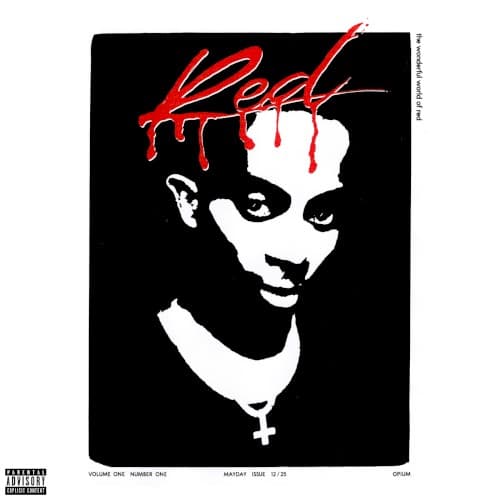
Playboi Carti Whole Lotta Red — The Album That Built Rage from the Wreckage
Whole Lotta Red arrived on Christmas 2020 with the reception reserved for records that ask too much. Fans who wanted Die Lit part two heard Carti screaming over distorted 808s and assumed sabotage. Critics called it unfinished.
A year later it was showing up on best-of-2021 lists, and by 2024 Pitchfork ranked it second among albums of the decade so far. The turnaround was not a critical correction but confirmation that the album did what Carti said it would: define a sound that did not yet exist in the mainstream. Whole Lotta Red is the first rage album to debut at number one, the record that turned SoundCloud chaos into a commercial format and made the next five years of underground rap possible.
It is also bloated, repetitive, and often more interested in texture than content. The question is whether those weaknesses disqualify the album or are baked into the experiment.
Carti recorded most of Whole Lotta Red in late 2018 and 2019 in Atlanta, working primarily with F1lthy and Art Dealer after Pi'erre Bourne stepped back. He added sixteen more songs during sessions with Kanye West in Wyoming and Calabasas in late 2020, then released all twenty-four on Christmas Day. The album is built on chaotic synthesizers, blown-out bass, and Carti's voice pushed to extremes: rasping, shrieking, ad-libbing until the vocal becomes indistinguishable from the beat. West executive-produced, and the Yeezus comparisons were immediate and mostly accurate. The thesis is that Carti treated the album as a live-performance vehicle first and a listening experience second, prioritizing mosh-pit energy over song craft, and the sequencing and the filler prove it. What separates Whole Lotta Red from a collection of provocations is the production, which is among the best and most cohesive work in trap of the early 2020s, and the fact that the sound Carti was chasing became the dominant template in underground rap within two years.
Distortion as Architecture, Repetition as Religion
The production on Whole Lotta Red is serrated, abrasive, and meticulously constructed. F1lthy, who handled six tracks including the opener and several of the hardest cuts, builds beats that sound like machinery malfunctioning at high speed. Rockstar Made opens the album with distorted basslines and guitar-like synthesizers that Paul A. Thompson of Pitchfork described as bright and serrated; the 808s are blown out to the point of distortion, and the mix leaves space for Carti's voice to cut through without softening the edges. Art Dealer, who produced seven tracks including Sky and Not PLaying, works in a similar register but with more melodic content; his beats retain the distortion but add layered synthesizers that give tracks like Sky a dizzying, hyperpop sheen. The contrast between F1lthy's scaffolding and Art Dealer's neon textures is the album's sonic backbone, and the sequencing toggles between the two modes with enough variation to keep the aggression from flattening.
Carti's vocal performances are the second pillar. He uses his voice as an instrument, layering ad-libs until they become part of the percussion and pushing his raspy scream high enough that it reads as falsetto on tracks like Stop Breathing. The staccato delivery on that song, paired with bells and 808 drums, turns a simple line about thinking about homicide into a chant. On M3tamorphosis he repeats the title seven times mid-verse and layers goblin-like ad-libs underneath; the effect is more texture than narrative. The baby voice from Die Lit appears intermittently, most clearly on Place and ILoveUIHateU, but it is no longer the default. The rasp and the scream are the new center, and Carti commits to them fully enough that they become the album's signature rather than a gimmick.
The writing is where the album thins out. Lyrics reduce to slogans, chants, and declarations of excess with minimal imagery or development. JumpOutTheHouse repeats one phrase over fifty times in under two minutes; Richie Souf's beat is sinister and the performance has a manic humor, but there is no second idea.
Vamp Anthem chops Bach's Toccata and Fugue in D Minor and pairs it with Carti laying vocals in a black cape, and once the shock value fades the song is just repetitive. Teen X with Future and Go2DaMoon with Kanye West were both criticized as lackluster; the guests sound disengaged and their verses do not match Carti's energy. The album's best writing appears on Punk Monk, where Carti raps about exhaustion with unreliable people, and on the closer F33l Lik3 Dyin, which samples Bon Iver and includes melodic singing about his relationship with his mother. Those moments are exceptions. Most of the album operates in a lyrical register closer to punk sloganeering than rap storytelling, and the trade-off is that the songs with weaker beats have nothing to fall back on.
Production from Pi'erre Bourne appears on only two tracks, Place and ILoveUIHateU, and both stand out for their minimalism and restraint. Place features elongated synthesizers and subdued 808 drums, and the contrast with the rest of the album is stark enough that Kyann-Sian Williams of NME called it nostalgic and compared it to the mellow sound of earlier Carti singles. The choice to limit Pi'erre's involvement was deliberate and it reshapes the album's identity, but it also means Whole Lotta Red lacks the melodic trap that made Die Lit accessible. This is a harder, less patient record, and the weaknesses are harder to ignore when the sound is this unrelenting.
An Hour of Aggression with Too Many Redundancies
Whole Lotta Red is sixty-two minutes and twenty-four tracks, and at least five of those tracks are redundant or undercooked. The album's structure is less a sequenced arc than a pile of individual moments, some of which work and some of which repeat ideas already executed better elsewhere. The first half front-loads the hardest material, establishing the aggression and the vampire persona in the first twenty minutes. The pacing sags in the middle with cuts that Mimi Kenny of Beats Per Minute described as dully competent but tedious.
A hyperpop love song interrupts the chaos mid-album, and the tonal shift is jarring enough that it reads as a sketch rather than a pivot. The back half rebounds with three consecutive tracks that sustain the energy without repeating the same trick, but by that point the album has already asked for more patience than it has earned.
The sequencing makes sense as a setlist for a tour, which is how Carti said he conceived it, but as an album it lacks the cohesion that would justify the length. Several critics noted that Whole Lotta Red abandons traditional verse-chorus structures in favor of chants and ad-libs, and that choice works on individual tracks but creates monotony across an hour. The moments where the album breaks from the formula are the ones that linger: Place for its melodic restraint, F33l Lik3 Dyin for its vulnerability, and the closing stretch for its punk energy. The problem is that those moments are surrounded by filler that adds runtime without adding dimension. An album this confrontational and this long needs to earn both qualities, and Whole Lotta Red earns the confrontation but not the bloat.
The Blueprint That Rewrote the Underground, Bloat and All
Whole Lotta Red is Carti's best album and his most frustrating. It ranks above Die Lit for ambition and influence and above MUSIC for cohesion of vision, but it is also the least consistent of the three. Die Lit is the more accessible entry point and the safer recommendation for casual listeners; Whole Lotta Red is the album for fans who want to hear Carti push his sound past the breaking point and do not mind the wreckage.
The production is among the best in trap of the early 2020s, the vocal performances redefine what delivery can be in the genre, and the album's influence on the next five years of underground rap is clear. Rolling Stone called it one of the most forward-thinking rap albums since Yeezus, and by 2024 Pitchfork ranked it second among albums of the 2020s so far. Those claims are defensible. The album helped define the rage subgenre and influenced artists including Yeat, Ken Carson, Che, 2Slimey, and the majority of the current underground scene. It proved that a number-one debut could sound this abrasive and still move units, and it built a commercial framework for a sound that had been scattered across SoundCloud.
The weaknesses are real. The album is too long, the guest appearances are lackluster, and the writing rarely rises above slogans. At least five tracks could be cut without losing anything essential, and the sequencing prioritizes live energy over listenability.
Whole Lotta Red is more important than it is enjoyable, and whether that trade-off is worth it depends on how much you care about hearing the blueprint for the next era of underground rap versus hearing a tight, replayable album. For fans of Carti or of experimental trap, this is essential. For everyone else, start with Stop Breathing, On That Time, Sky, and F33l Lik3 Dyin and decide whether the chaos is worth the commitment. If the answer is yes, the full album rewards patience. If not, Die Lit is the safer catalog entry. After Whole Lotta Red, the logical next step is Yeat's Up 2 Me or Ken Carson's A Great Chaos to hear where the sound went, or Kanye West's Yeezus to hear the last time an artist used this much distortion to redefine their lane.
Track Listing
Rockstar Made
▲The opener establishes the album's abrasive aesthetic with distorted basslines, blown-out 808 drums, and guitar-like synthesizers. F1lthy and Abraham build a beat that sounds like machinery overheating, and Carti's raspy delivery announces the vampire persona with mosh-pit energy. The production is serrated and relentless, and the track sets the tone for what follows: aggression as architecture, repetition as religion. It does the work an opener should do, which is to warn you that this album will not meet you halfway.
Go2DaMoon
▼Kanye West's verse sounds rushed and disengaged, and the beat from Wheezy and Outtatown feels scrappy and unfinished. Critics described it as resembling an interlude more than a collaboration, and West's presence adds nothing to Carti's momentum. The track is short enough that it does not derail the album, but it is one of the weaker guest appearances and a missed opportunity.
Stop Breathing
▲One of the album's hardest tracks. F1lthy, Lukrative, and Ssort layer bells and 808 drums underneath Carti's staccato bursts, and the line about thinking about homicide since his brother died is one of the few moments where the writing cuts through the chaos. The production is blown out to the point of distortion, and the vocal performance is aggressive enough to turn a simple lyric into a chant. The track works because the beat and the delivery are locked in, and it is one of the clearest examples of Carti treating his voice as an instrument.
Beno!
▲Outtatown and Lil 88 build a beat with pixelated sounds that Paul A. Thompson described as sounding like an iPhone ringing in heaven. The production is bright and serrated, and Carti includes a brief personal aside about buying his sister a Jeep. The track has melodic DNA from Die Lit but pushes it through the album's distorted filter, and the result is one of the more accessible moments on the front half.
JumpOutTheHouse
●Carti repeats "Jump out the house, jump out that bitch" over fifty times in under two minutes over a Richie Souf beat built on sinister Atlanta trap scaffolding. Thompson described it as something an agitated Gucci Mane might have jumped on in 2008, and the performance has a manic humor that keeps it from flattening into pure repetition. The beat is strong enough to carry the joke, but the song has no second idea and wears out its novelty quickly on repeat listens.
M3tamorphosis
●Kid Cudi's feature is fine but unremarkable, and the real work is done by F1lthy and Gab3's production and Carti's layered ad-libs. Carti chants "Metamorphosis" seven times mid-verse, and the goblin-like sounds underneath turn the word into a mantra. The track is over five minutes, which is too long for the amount of lyrical content, and Semassa Boko of PopMatters called it an overly long duet lacking excitement. The production is ominous and textured, but the length is not earned.
Slay3r
▲Bailey and Juberlee build a jagged, off-balance beat with hiccuping drums and distorted bass. The track is short and aggressive, and it sets up "No Sl33p" with a melodic fragment that gets hummed and echoed on the next song. The sequencing choice is clever, and the production is strong enough to make the track memorable even without much lyrical content.
No Sl33p
▲KP Beatz and Abraham build a beat with ascending synthesizers and distant chirps that Mehan Jayasuriya of Pitchfork described as downright bubbly compared to the album's prevalent darkwave sound. The track sounds like Atlanta trap gone hyperpop, and Carti's boast about potentially joining Slayer aligns with the band's leather-clad showmanship and arena-scale satanism. The production is playful and the performance has energy, and it is one of the moments where the album's chaos feels inventive rather than exhausting.
New Tank
●F1lthy and Abraham return with another blown-out beat built on distorted 808s and rapid-fire percussion. The track is under ninety seconds and functions as an interlude more than a full song. It sustains the aggression without adding much new, and it is one of several moments where the album repeats itself.
Teen X
▼Future's feature is one of the album's weakest guest appearances, and the Maaly Raw production does not compensate. Both Pitchfork and PopMatters noted that Future sounds listless and fails to match Carti's energy, and the track sags in the middle of the album where the pacing is already losing momentum. Filler.
Meh
●Originally released as a single in April 2020, the track features Carti's baby voice over production from Outtatown, Art Dealer, and Star Boy. The beat has hyperpop textures and the performance is frantic, and Uproxx highlighted it alongside "ILoveUIHateU" as skin-tingling trap. In the context of the album it feels slight, but it works as a palette cleanser between harder cuts.
Vamp Anthem
▼KP Beatz and Jasper Harris chop Bach's Toccata and Fugue in D Minor and pair it with Carti's vampire persona. Thompson noted that Carti recorded the track in a black cape and plastic Halloween fangs, and the dramatic organ sample delivers shock value on the first listen. Kyann-Sian Williams described it as merely repetitive once the novelty fades, and that assessment is accurate. The production is clever but the song has nothing underneath the gimmick.
New N3on
▼Maaly Raw's production is competent but tedious, and Mimi Kenny of Beats Per Minute cited the track as an example of dully executed material. It is one of at least three songs that Paul A. Thompson identified as having better-executed counterparts elsewhere on the album, and it adds runtime without adding dimension. Filler.
Control
●A hyperpop love song with production from Outtatown, Art Dealer, and Star Boy. Carti raps vulnerable lines about wanting the best for someone and curing love like a doctor, and the tonal shift is jarring after the aggression of the first half. Kyann-Sian Williams highlighted the track for its melodic softness, but Danny Schwartz of Rolling Stone called the uncredited DJ Akademiks cameo in the opening seconds inexplicable. The track reads as a sketch rather than a fully realized pivot, and the sequencing choice does not help.
Punk Monk
▲F1lthy, Lukrative, and Lucian build one of the album's most textured beats, with heavy distortion and layered percussion. Carti raps about exhaustion with unreliable associates and the line "I gotta worry 'bout me" is one of the few moments where the writing moves past slogans. Robert Christgau highlighted the track alongside "Rockstar Made", and it is one of the stronger cuts on the back half. The production and the performance are both locked in, and the track earns its nearly four-minute runtime.
On That Time
▲F1lthy and Ojivolta build a beat with heavy distortion and punk energy, and Danny Schwartz of Rolling Stone called it a standout. The track is under two minutes and sustains the aggression without repeating the same trick, and the production is among the best on the album. It is one of the moments where the chaos feels purposeful rather than exhausting, and it holds up on repeat listens.
King Vamp
●Art Dealer, Outtatown, and Star Boy build a beat that reinforces Carti's vampire persona, and critics described the track as part of his evolution from pop star to rock star to ruler of the undead. The production is dark and theatrical, and the performance commits fully to the aesthetic. It works as a statement of intent, but the track does not develop the idea beyond the persona.
Place
▲Pi'erre Bourne's production is minimalist and subdued, with elongated synthesizers and restrained 808 drums. Kyann-Sian Williams described the track as nostalgic and compared it to the mellow sound of earlier singles like "Magnolia". The contrast with the rest of the album is stark, and the track is one of the most accessible moments on Whole Lotta Red. It is also under two minutes, which feels like a missed opportunity given how well the sound works.
Sky
▲Art Dealer builds a hyperpop beat with dizzying synthesizers and distorted bass, and the track became one of the album's most popular songs. The music video, directed by Nick Walker, depicts Carti and his crew causing chaos in a grocery store with green-tinted aesthetics and faux security camera footage. The video accumulated over 100 million YouTube views by April 2025. The production is among the best on the album, and the track works as both a standalone single and as part of the sequenced back half. It is one of the clearest examples of Carti fusing melodic trap with the album's abrasive sound, and it holds up on repeat listens.
Over
▼Art Dealer's production is competent but the track is one of at least three songs that critics identified as having better-executed counterparts elsewhere on the album. It adds runtime without adding much new, and the sequencing choice does not help. Filler.
ILoveUIHateU
▲Pi'erre Bourne returns with fluttering production and minimalist 808 drums, and Uproxx highlighted the track alongside "Meh" as frantic and skin-tingling trap. The baby voice is prominent here, and the contrast with the raspy aggression elsewhere on the album makes the track stand out. It is one of the more melodic moments on Whole Lotta Red, and it works as a late-album breather.
Die4Guy
▲Art Dealer, Outtatown, and Star Boy build a beat with jittery synthesizers and distorted percussion. Carti raps about the precariousness of his lifestyle with the line "If I die it's gon' be real sad, so I fuck on my bitch like it's our last, I'm a rockstar so I never can relax", and critics linked the track to the album's distillation of fearful isolation. The production is strong and the performance has energy, and it is one of the better cuts on the back half.
Not PLaying
▲Art Dealer builds a beat with rapid, distorted synthesizer patterns that contribute to what critics described as dizzying neon gyrations. The track sustains the album's aggression without repeating the same trick, and the production is textured enough to keep it from flattening. Solid.
F33l Lik3 Dyin
▲The closer samples Bon Iver and features Bailey and Richie Souf on production. Carti sings melodically about his relationship with his mother, including the lines "My mama always knew I was a star, she gave me the keys to her only car, I took that bitch and I went far". The track is one of the most vulnerable moments on the album, and the production is subdued and textured. It works as a closer because it breaks from the chaos and ends the album on a specific, human note rather than another declaration of excess. It is one of the best songs on Whole Lotta Red and one of the few moments where the writing earns the emotion.