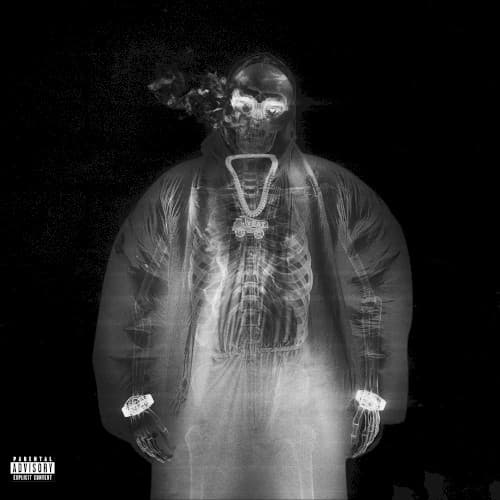
The scorecard
5.3/10 · Weak
- Writing25%
- 4.0
- Production25%
- 6.5
- Delivery15%
- 6.0
- Cohesion15%
- 4.5
- Originality10%
- 5.5
- Replay value10%
- 5.5
Hooks are repeated chants and the themes of money, status and demons barely develop, so few songs offer imagery that survives a second listen.
Bnyx, Dulio and a rotating cast build a consistent world of alarm-like synths and distorted 808s that is identifiable within seconds.
Octave shifts and ad-libs give Yeat a distinctive voice, but the toolkit is narrow and the alter egos read mostly as pitch settings.
Twenty-two songs over about an hour and eight minutes share one tempo and timbre, and the middle stretch blurs together.
The sound sets Yeat apart from imitators, and the guitar-led closing songs show an alternative he barely explores.
As a projection, individual songs will keep working in shuffle, but the full album is unlikely to reward repeated sit-down listens.
Yeat AftërLyfe: A Strong Sound in Search of an Editor
AftërLyfe asks for twenty-two songs of attention from an artist whose method is to make attention optional. That is its problem and, oddly, its argument. Yeat treats the album as a stream of moods rather than a sequence of statements, and the record works best as a long room of bells, bass and pitch-shifted voices that you enter and leave at will. As a playlist it holds together. As an album it sags, and the distance between those two verdicts is the whole review.
The thesis is simple: this is Yeat's most fully formed sound and his least disciplined record. The synth patches are stranger and colder than the rage template he started from, his voice slides up and down in pitch like a second instrument, and the beats come from a rotating cast of producers who all seem to have received the same brief. The result is a strong identity with almost no pacing.
The context matters only briefly. This is his third studio album, it follows the EP Lyfë, and it arrives with a single guest, YoungBoy Never Broke Again, plus two of Yeat's own alter egos credited as features. Before release he said he did not want a pile of features and wanted people hearing him, a promise the album keeps almost too literally. With no star guests to reset the ear, the burden of variety falls on one voice, and that voice has a narrow set of tools.
The stakes are real in streaming terms. Rap albums of this size are built to survive being shuffled, skipped into and left running in the background, and AftërLyfe suits that environment better than most of its neighbors. But the critics who called it monotonous were hearing something true, and the question here is whether the sound is strong enough to carry the length. For about half of it, yes.
Alarm Bells, Distorted Bass and a Voice That Changes Octave
The production is the album's best argument. Bnyx has credits on several of the songs, and Dulio and Lucid appear on a handful more, but the credits matter less than the consistency of the palette: shimmering synth leads that sound half like toy bells and half like alarms, 808s pushed forward until they distort, and drum programming that rushes and stutters without settling into a groove you could two-step to. It is rage music with the cheerfulness removed. Where many peers chased bright, video-game euphoria, these beats go dark and slightly sour, and that choice gives the record a texture you can identify within four seconds. The few moments that borrow from other sounds, including guitar parts late in the sequence, work precisely because they are rare.
Yeat's delivery is where the argument lives. He works with a small kit: a clipped mid-range bark, a high, almost cartoonish register, a low growl he drops into for emphasis, and ad-libs that function as percussion rather than commentary. One critic observed that the main thing breaking up the sameness is Yeat nudging his voice up or down an octave. That is accurate, and it is also a statement about limits. The pitch changes keep a verse from flattening, but they are a mixing trick more than a performance choice.
The writing is the weakest category. Lines are built from repeated phrases and from themes of money, status and dismissing rivals, with demon imagery that the song titles announce again and again. Hooks are chants rather than melodies, which suits clubs and short clips, but few songs reveal anything on a second listen that the first did not. Specific, memorable imagery is rare. What the record offers instead is the rhythm of syllables, a legitimate pleasure that gets thin over this much running time.
The concrete weakness is sameness at the level of the song. Several mid-album tracks share tempo, bell timbre and hook cadence so closely that skipping from one to the next feels like a restart rather than a change. The alter egos, Kranky Kranky and Luh Geeky, are meant to supply contrast, but they read mostly as pitch settings rather than characters. The one place where a second personality changes the temperature is Shmunk, where YoungBoy Never Broke Again brings a melodic, strained delivery, and that only underlines how uniform everything around it is.
The mix deserves a note. Everything is loud. The low end and the high bells compete for the same space, and the vocal sits slightly buried, so words blur into texture. That is plainly intentional and fits a record designed to be felt rather than parsed, but it also removes the dynamics that would let any single verse land as an event.
Twenty-Two Songs, One Long Mood
The sequencing, put plainly, is a playlist export. The record opens with its statement of purpose and then spends twenty-one songs repeating it with small adjustments. There is no arc of escalation, no collapse and no slowdown that lets the energy reset. The shortest songs, many of them under three minutes, are the best because they end before the formula does. The longer ones stretch a single loop past its welcome, and the Luh Geeky collaboration, the longest track at roughly four and a half minutes, does not justify that length.
The strongest stretch is the opening third, where the production is sharpest and the hooks are least recycled, plus a quieter late run where guitar enters and the album briefly stops shouting. The sag is the middle, roughly the ninth through fourteenth songs, where tempo, bell sound and cadence converge so closely that skipping through them changes nothing. A tighter record of twelve to fourteen tracks would keep nearly everything that matters here. The Slant critic's complaint that Yeat needs an editor is the fairest line written about the album, and the sequence is where that complaint lands hardest.
Whether the length is earned depends on how you listen. On a playlist, twenty-two tracks cost nothing, and sameness reads as consistency. A listener who sits down for the full run of about an hour and eight minutes pays for it. The runtime is not earned by the material, but it is not punished by the format either, and that tension is the central difficulty of judging streaming-era albums like this one. The album also never uses its alter egos or its single guest to restructure the pacing, which is the obvious missed opportunity: three or four deliberate changes of mood would have turned the length from an endurance test into a shape.
The Best Forty Minutes Are Buried in an Hour and Eight
Among Yeat's albums, this is an important one for the sound and a flawed one for the shape. No other Yeat records are rated on the site yet, so its place in the catalog is provisional, but the relative order is clear in principle: the EP Lyfë is the shorter version of the idea, the later album 2093 is the more expansive and more varied one, and AftërLyfe is the purest, most undiluted statement of the style at the cost of any editing. It lands just inside the middle of the scale because the sound is genuinely distinctive and the writing and sequencing are not.
It is for listeners who already enjoy rage production and want a full hour of it, and for anyone curious about how a streaming-first rapper builds a world out of texture instead of verses. Skip it if you want lyrical detail, narrative or a record that changes direction. The people who called it one-dimensional were right about the middle stretch, and the people who called Yeat an original in a field of copycats were right about the first few songs.
Start with Shmunk for the one real change of personality, Rav3 p4rty for the cleanest version of the formula, and Hëavyweight for the shortest, tightest run on the record. Then stop whenever you like, because nothing in the second half depends on the first. For the next listen, hear 2093 to see how the same voice sounds with guests and a tighter concept, and the EP Lyfë to hear the same palette without the bloat.
How it has aged is easy to project: the sound will keep working in shuffle, and the album will keep losing arguments as an album. The most specific thing to say about it is that its best forty minutes are buried inside an hour and eight.
Track by track
Track Listing
No morë talk
StandoutA four-minute opener produced by Bnyx that sets out the whole palette: bright synth figures, heavy low end and a voice that flips between registers. It is a confident statement of intent, but it also announces how little the album plans to vary from here.
Shmunk
StandoutThe only guest verse on the record comes from YoungBoy Never Broke Again, and his strained, melodic delivery changes the temperature against Yeat's clipped barking. This is the clearest case on the album for the value of a second voice, and one of the few songs that is memorable for something other than its production. Pink and Bred build a spare beat that leaves room for both rappers.
Bëttr 0ff
SolidBugz Ronin and Leiso supply a dense, bell-heavy beat, and Yeat rides it with a repetitive hook that is more chant than song. It is solid but familiar, and in this position it starts the pattern of interchangeable mid-tempo tracks.
Rav3 p4rty
StandoutKranky Kranky shows up alongside a Dulio beat that makes the most direct club pitch on the record, with a stuttering low end and a hook built for a crowd. The alter-ego voice is mostly a pitch change, but the energy is real. This is the cleanest demonstration of the formula at full speed.
Nun id change
SolidBnyx and Magdamo keep the sound recognizable, and the hook is about refusing to alter course, which is also the album's attitude toward its own method. It is competent and unsurprising.
Woa…!
SolidAt under three minutes, this Dulio and Lucid production wastes nothing. The ad-libs and the short runtime make it one of the more efficient songs, though it is interchangeable with its neighbors.
Now
SolidLuh Geeky appears on a Bnyx and BeautifulMvn beat, and at roughly four and a half minutes it is the longest track on the album. The second voice adds a texture, but the loop does not change enough to earn the extra time.
Slamm
StandoutA short Bnyx and Nuu beat that does one thing at one speed and then leaves. It is brief enough to work, and it is a good example of why the shorter songs outperform the longer ones here.
7 nightz
SolidDulio and Lucid return with another bright, alarm-like loop. The hook is the strongest part, but it follows the same cadence as the songs around it and becomes forgettable in sequence.
Mëan feen
SolidKranky Kranky returns on a Lukovic beat with a lower, more menacing voice. The pitch contrast is the main event, and it is a modest one.
How it go
SolidDream Awake and Sideus produce a slightly more melodic beat, and the hook has a bit more shape than usual. It is pleasant but light.
Sum 2 do
WeakBnyx and BeautifulMvn supply a short, dense loop at about two and a half minutes. It is serviceable filler that fits the middle-album sag.
Back up
WeakRision produces a very short track, barely over two minutes, with a hook that is mostly a command repeated. It is efficient but nearly empty of content.
Split
SolidChaseTheMoney, Synthetic, Aunix and Noa Nalu share the credit, and the beat is busy for its two-minute length. The crowded production does not translate to variety in the delivery.
Bad bënd / DëMON
StandoutYeat produced this one himself, and the double title suggests a shift from one idea to another. It is a rare case of the sequence trying to create a change inside a song, and the slightly darker second half is a welcome change of pace.
Hëavyweight
StandoutWarpstr, AM and Abraham produce one of the shortest and tightest songs, with SeptembersRich on background vocals. The extra voice adds depth to the hook, and the runtime is just right.
Watch
WeakKele's beat is clipped and bare at barely over two minutes. It is quick, forgettable and exactly the kind of track a stricter editor would have trimmed.
Shhhh
SolidDKanee produces a longer, murkier beat that gives the album a brief, hushed moment. The restraint is welcome, though the hook still follows the familiar pattern.
Back homë
StandoutBnyx returns on production and guitar, and the live instrument gives the record an unusual warmth. It is one of the few songs that sound like a different mood, and it works because of that.
Type monëy
SolidLL Clawz, Chef9thegod and Opium Jai produce a bright, bouncy beat for a theme that needs no explanation. It is the album's most straightforward flex and its least imaginative lyric.
Dëmon tied
SolidBnyx and 2AAB return to the demon theme with a dark, short beat. It reinforces the album's concept without developing it.
Mysëlf
StandoutThe closer comes from Bnyx, who also supplies guitar and additional vocals, and it ends the record on a quieter, more personal note than anything before it. At two and a half minutes it is brief, but it is the best argument for what the album could have done with more of this mood.
Frequently Asked Questions
Is Yeat's AftërLyfe worth listening to?
Who is featured on AftërLyfe?
How many songs are on AftërLyfe?
Styles