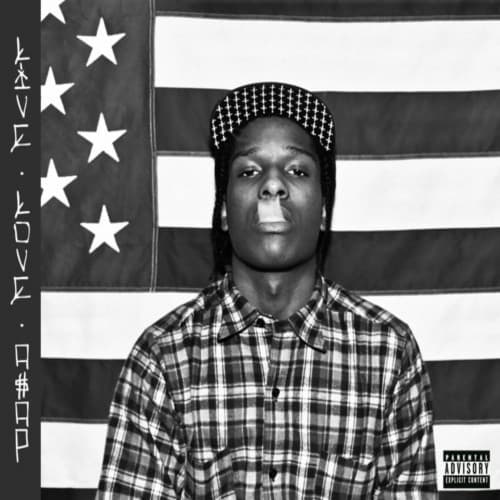
A$AP Rocky LIVE.LOVE.A$AP — When Harlem Went to Houston and Came Back Slowed Down
You cannot separate this tape from the feeling of being seventeen with a laptop full of pirated Screw tapes and a Tumblr dashboard full of fashion week runways. That was the frequency Rocky locked into when he made this. Not Houston rap exactly, not New York boom-bap, not cloud rap in the Lil B sense. Something else.
A warped transmission from a alternate timeline where Houston won the coastal wars and Harlem kids grew up on syrup instead of Dipset. The production here sounds like Clams Casino and A$AP Ty Beats discovered chopped-and-screwed during an Adderall binge and decided to drape it in synthetic purple velvet. Every snare hits late. Every sample floats.
Rocky does not rap fast, does not punch punchlines, does not try to out-technical anyone. He just glides. His voice moves through these beats the way smoke moves through a car with the windows cracked — slow, thick, unbothered. This is the tape that made East Coast rap realize it had been moving too fast for too long.
And it did all of this as a free mixtape with no label, no radio single, no co-sign from an established star. Just Tumblr, Twitter, and kids in dorm rooms pressing repeat on 'Peso' until the bass became a religion. Does any other debut project in the 2010s carry this much influence while sounding this effortlessly detached?
By the time this dropped, New York rap had spent a decade trying to reclaim relevance through authenticity and aggression. Rocky said forget all that. He showed up in tie-dye and gold grills talking about purple drinks and pretty women, and somehow that became the blueprint for the next five years of East Coast rap. This is not the best New York album of the decade. It is the album that rewrote what New York rap could sound like.
The Purple Haze That Rewired East Coast Frequency
The palette here pulls from Houston screw culture but refracted through the lens of a Harlem kid who grew up on Dipset and fashion blogs. Clams Casino handles the majority of production and his work here redefined what cloud rap could be when paired with an actual rapper instead of a cryptic internet persona. His beats do not knock, they hover. Samples get stretched until they lose their original shape.
Drums hit softer than they should but somehow carry more weight because of it. A$AP Ty Beats contributes several tracks and understands the assignment — everything needs to sound like it was recorded underwater in a mansion you cannot afford. The tape borrows Houston's codeine lethargy but strips out the darkness. There is no paranoia here, no mortality anxiety, none of the dread that makes classic screw tapes feel like slow-motion horror films.
Rocky takes the aesthetic and makes it aspirational instead of tragic.
He raps about drugs and women and expensive clothes with the casual confidence of someone who has already won and does not need to prove it anymore. His delivery sits so far back in the pocket it almost sounds disinterested, but that detachment is the entire appeal. He never sounds like he is trying. The references here span decades and coasts without ever feeling like homework.
One bar might nod to Bone Thugs, the next to UGK, the next to some obscure fashion designer. Rocky moves through hip-hop history like someone flipping through a magazine, picking what looks cool and discarding the rest. Lyrically this is not a concept tape or a narrative album. It is a vibe project, a mood board, sixteen tracks of Rocky figuring out what his world sounds like and inviting you to visit.
The weakness is that about four tracks here could disappear and nobody would notice.
The tape is front-loaded with its best material and the back half occasionally feels like variations on ideas already explored. Some beats blend together. Some hooks do not stick. But even the filler tracks maintain the atmosphere, and atmosphere is the entire point of this atmospheric hip-hop project.
The Slow Descent Into Purple Mathematics
The opening stretch establishes one of the best four-track runs in 2010s hip-hop. Each song introduces a different shade of the same purple universe. By the first quarter, Rocky has already established complete control over his own world. The sequencing here does not build toward a climax, it sedates.
This is not a tape that rewards active listening, it rewards zoning out. The energy peaks early and then plateaus into a long drugged glide through the middle section. Certain tracks function more as interludes than full songs, brief transmissions that deepen the trance without demanding your full attention.
The back half loosens its grip slightly. Songs maintain the mood but lack the hooks that made the opening third so immediately addictive. The tape does not sag so much as it diffuses, spreading its atmosphere thinner as it approaches the end.
By the closing run the tape has fully dissolved into ambient territory. Tracks barely qualify as rap songs, they are just Rocky's voice drifting over loops that sound like they are melting in real time. The structure here mirrors the drug experience it soundtracks — initial rush, extended float, slow fade. Whether that makes the back half brilliant or boring depends entirely on your tolerance for repetition in service of vibe.
The Tape That Taught East Coast Rap to Exhale
This sits at number one in Rocky's catalog and it is not particularly close. Everything he made afterward chased bigger budgets and broader audiences, but nothing recaptured the strange alchemy of this moment when he had complete creative freedom and nothing to lose. At Long Last A$AP comes closest, but even that album sounds too polished, too considered. This tape works because it sounds like Rocky made it for himself and accidentally let the rest of us hear it.
Who should listen to this? Anyone who thinks New York rap peaked in the nineties and never evolved. Anyone who loves Clams Casino production. Anyone who wants to understand why 2011 felt like the year the internet finally broke rap radio's grip on the culture.
Who might not enjoy it? Lyrical miracle types who need every bar to hit like a dissertation. People who think Houston influence on East Coast rap was cultural appropriation instead of evolution. Anyone allergic to the word swag used unironically.
This tape aged beautifully because it never chased trends, it created them. Rocky sounds exactly as confident and unbothered in 2026 as he did in 2011, which means the tape exists outside normal time. If you only try three tracks start with the opening, the middle stretch, and the closing run. If you want similar albums try Travis Scott's Days Before Rodeo, SpaceGhostPurrp's Mysterious Phonk, or early Clams Casino instrumentals.
The long-term influence is plain — this tape gave East Coast rap permission to slow down, soften up, and prioritize vibe over bars. Every New York rapper who came after Rocky and started singing or crooning or rapping over ambient production owes something to this project. This is not just a great debut tape. This is the sound of a nineteen-year-old kid rewriting the rules and making it look effortless.
Track Listing
Palace
▲The opening statement sets the entire temperature. Clams Casino flips a Smokey Robinson sample into something that sounds like a lullaby recorded in a spaceship. Rocky's flow here is deliberately minimal, almost monotone, letting the production do most of the emotional work. The hook is barely a hook, just Rocky repeating variations on the same phrase until it becomes hypnotic. What makes this work as an opener is how little it tries to grab you. Most rappers would front-load their debut with their hardest verse and biggest beat. Rocky opens with a song that dares you to turn it off if you are not willing to meet him at his frequency. The confidence required to start a debut project this way cannot be taught. This is not the best song on the tape but it might be the most important because it establishes the rules: everything moves slow here, nothing is aggressive, and Rocky will not raise his voice to get your attention.
Peso
▲Play the first thirty seconds and you immediately understand why this became the breakout single. Clams Casino's production here is otherworldly, a flipped sample that sounds like it is being broadcast from another dimension. The drums shuffle instead of knock. The melody floats. Rocky sounds more awake here than anywhere else on the tape, his flow tighter and more rhythmic without sacrificing the laid-back delivery that defines his style. The hook is simple and sticky, the kind of phrase that burrows into your brain and refuses to leave. What aged so well about this track is how much space it gives Rocky. There are long stretches where the beat just breathes and Rocky lets it, never feeling the need to fill every second with words. The song became synonymous with the entire cloud rap movement even though it is more structured and accessible than most songs in that lane. This is still the best song Rocky ever made. Nothing in his later catalog carries this much effortless cool.
Bass
●A$AP Ty Beats gives Rocky a grimier backdrop here, something closer to traditional New York production but slowed down and stripped of its urgency. Rocky responds with one of his more aggressive vocal performances, his voice pushing forward in the mix instead of sitting back. The bass here is not overwhelming, despite the title, it just rumbles underneath everything like a distant earthquake. Lyrically this is Rocky at his most materialistic, every bar about money or clothes or women, delivered with the casual arrogance of someone who has already decided he won. The track works as a statement of intent after the dreamier opening pair. It shows Rocky can operate in a more traditional rap mode when he chooses to. The hook is weaker than it should be and the song does not quite justify its runtime, but it serves its purpose as a pace-changer early in the tracklist.
Wassup
▲Rocky and Clams Casino lock into a perfect chemical reaction again. The production here is murkier than 'Peso', less melodic, more textured. The drums sound like they were recorded in a stairwell. Rocky's flow gets more playful here, stretching syllables and bending his cadence in ways that should not work but somehow do. The song name-drops half of Harlem and most of Rocky's early influences within the first verse, a roll call delivered with so much nonchalance it barely registers as boasting. What makes this a standout is the balance between accessibility and experimentation. The beat is weird enough to feel fresh but structured enough to nod your head to. Rocky raps just clearly enough to follow but loose enough to sound spontaneous. This is the template for everything that worked about Rocky's early run. The track also features some of the tape's best quotables without ever feeling like it is trying to manufacture viral moments.
Brand New Guy
▲Schoolboy Q shows up and nearly steals the entire tape. His verse here is louder, funnier, more charismatic than anything Rocky does on the track, which says something because Rocky's performance is strong. The chemistry between them is immediate and obvious, two young rappers at the beginning of their runs trading bars with genuine enthusiasm. The beat by SpaceGhostPurrp is one of the tape's most abrasive, a lurching loop that sounds like it is being played on a broken tape deck. Rocky adapts to the harsher production by tightening his delivery and adding more edge to his voice. The hook is simple but effective, just the two of them shouting the title with increasing intensity. This track proved Rocky could share space with another strong personality without disappearing. It also hinted at the A$AP Mob as a movement rather than just one kid from Harlem with a laptop. If you only play one feature verse from this entire tape, make it Q's performance here. He brings an energy that the rest of the project deliberately avoids and the contrast makes both approaches shine.
Purple Swag: Chapter 2
●This is less a full song and more an atmospheric interlude stretched to three minutes. The production from A$AP Ty Beats strips the original 'Purple Swag' down to its skeletal elements, just bass and haze and Rocky's voice drifting through the mix like he is half-asleep. Lyrically this is almost nonsense, a string of purple-related imagery and Houston references delivered with maximum lethargy. The entire track sounds like it is moving at half-speed even though the tempo is not dramatically slowed. What makes this work is commitment. Rocky fully inhabits the drugged-out aesthetic here without winking at the camera or letting you know he is in on the joke. There is no joke. This is just what his world sounds like. The track does not go anywhere, does not build toward anything, just floats for its entire runtime and then ends. Some listeners will find this boring. Others will put it on repeat for an hour. There is no middle ground.
Get Lit
●This is the weakest track in the first half. The production is fine, the flow is fine, everything is fine and nothing stands out. Rocky sounds like he is going through the motions, recycling flows and references from earlier tracks without adding new dimension. The hook is forgettable. The beat does not evolve. The entire song feels like a rough draft that accidentally made the final cut. It is not bad enough to skip but not good enough to remember. In the context of the tape's sequencing it functions as a breather between more ambitious tracks, a brief reset before the energy shifts again. But removed from that context it barely registers. This is the type of song that highlights how strong the rest of the tape is — even the filler maintains a baseline quality that would be a standout on a lesser project.
Trilla
▲Rocky sounds hungrier here than anywhere else on the tape. The production from Beautiful Lou is sparse and menacing, just drums and a looped vocal sample that sounds like a ghost singing. Rocky responds by tightening his flow and leaning into a more aggressive delivery, his voice pushed forward in the mix for once. Lyrically this is Rocky reminding you he can actually rap when he wants to, stringing together internal rhymes and multisyllabic phrases without losing the casual confidence that defines his style. The hook is minimal but effective, just Rocky repeating the title over and over until it becomes a chant. What makes this track age well is how raw it sounds. No excessive polish, no overthinking, just a hard beat and a focused performance. This is Rocky proving he did not need cloud production to stand out. He could have been a traditional New York rapper if he wanted to. He just chose not to.
Keep It G
●This sits in the uncomfortable middle zone where it is too long to be an interlude but too slight to be a full song. The beat is hazy and minimal, Rocky's flow is looser than usual, and the entire track feels like a freestyle that went on thirty seconds too long. There are some good individual bars here but no overarching structure, no momentum, no reason to return after the first listen. It does not kill the tape's flow but it does not enhance it either. Just exists in the space between tracks that matter.
Kissin' Pink
●Rocky gets more melodic here, letting his voice drift into near-singing territory over a syrupy Clams Casino beat. The production is gorgeous, all reverb-drenched samples and brushed drums that barely register as percussion. Rocky uses the space to talk about women and drugs with the same drowsy romanticism that defines his entire aesthetic. The hook is more of a vibe than an actual hook, just Rocky repeating phrases in different tones until they blur together. This track works best in the context of a full listen-through, less as a standalone single and more as a textural shift in the tape's overall mood. Lyrically it is thin but emotionally it lands, capturing a specific feeling of late-night intimacy filtered through codeine goggles. Not essential but not skippable either.
Houston Old Head
▲Rocky pays direct homage to the city that shaped half of this tape's sound. The production from Beautiful Lou and Clams Casino leans harder into screw influences than anywhere else on the project, chopping vocals and dragging the tempo until everything feels submerged. Rocky's flow adapts perfectly, stretching syllables and letting words hang in the air longer than they should. The entire track sounds like it is being played through a broken speaker in a car trunk, distorted and muffled and somehow more compelling because of it. Lyrically Rocky namechecks Houston legends and southern slang with genuine reverence, no irony or appropriation. This is not a New York kid trying to sound country, this is a rapper acknowledging the regional sounds that influenced his own evolution. The track is too niche to be a highlight for casual listeners but essential for anyone trying to understand the tape's DNA.
Acid Drip
●The title is accurate. This is what the inside of an acid trip sounds like if you could bottle it and sell it as a beat tape. Clams Casino goes full experimental here, layering samples on top of samples until the entire track feels like it is dissolving in real time. Rocky barely raps, just lets his voice drift through the chaos like another instrument. The drums are almost nonexistent. The structure is more ambient than hip-hop. This is Rocky and Clams pushing the limits of what a rap song can be while still technically counting as a rap song. It will not work for everyone. Some listeners will hear this as a visionary piece of psychedelic production. Others will hear it as unfinished noodling that should have stayed in the vault. Both are correct.
Leaf
▼This is filler disguised as atmosphere. The beat is fine, Rocky's performance is fine, everything is fine and nothing matters. The track does not add anything new to the tape's sonic palette and does not say anything lyrically that has not been said better on earlier tracks. It is not offensively bad, just unnecessary. In a different context on a different project this might work as a deep cut. Here it just takes up space in an already bloated tracklist. Skip and move on.
Roll One Up
●Rocky goes full stoner anthem mode here. The production from A$AP Ty Beats is light and airy, built around a flipped sample that sounds like it came from a seventies soul record. Rocky's flow is relaxed even by his standards, barely staying on beat, letting entire bars drift by without much urgency. The hook is simple and repetitive, designed for crowd participation rather than lyrical substance. This is not a standout track but it serves its purpose as a late-tape cooldown, a brief moment of levity before the project dissolves into full abstraction. The vibe is immaculate even if the execution is forgettable. Put this on at a party and nobody will complain, but nobody will ask for the name of the song either.
Demons
▲One of the strangest and most beautiful tracks Rocky ever made. The production credit is unclear but sounds like Clams Casino in full ethereal mode, just ambient textures and distant drums that barely qualify as percussion. Rocky does not rap here so much as he chants, his voice layered and drenched in reverb until it becomes part of the instrumental. The lyrics are abstract and impressionistic, less about narrative and more about capturing a mood. The entire track feels like the moment right before you fall asleep when your thoughts start to lose coherence and bleed into dreams. This is not going to be anyone's favorite Rocky song but it is essential to the tape's overall architecture. It proves he was not just making rap songs, he was building an entire sonic world and inviting listeners to get lost in it. Play this at three in the morning with headphones and no distractions. That is the only way it makes sense.
Out of This World
●The tape ends not with a bang but with a slow dissolve into static. This closer barely qualifies as a song, more of a sonic collage that drifts for four minutes without ever resolving into a traditional structure. The production is hazy and fractured, samples layered on top of each other until they lose individual identity. Rocky's voice appears sporadically, more texture than performance. There is no hook, no verse structure, no clear beginning or end. The entire track sounds like the tape is melting in real time, all the purple haze and codeine lethargy finally consuming the music itself. As a closer it is perfect because it refuses to provide catharsis or resolution. The tape just fades into nothingness the same way it emerged from nothingness at the beginning. Some will hear this as pretentious experimentation. Others will hear it as the logical conclusion to everything the tape was building toward. Both are right.