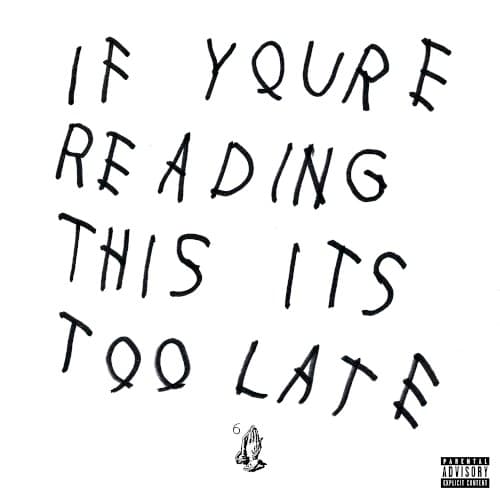
Drake If You're Reading This It's Too Late — The Night Toronto Took Over
This is not a victory lap. It is forty minutes of a man sharpening knives in the dark, reminding everyone that soft does not mean weak. Drake dropped this with no rollout, no press tour, no explanation — just a Thursday night surprise that turned into a Friday morning argument about whether this qualified as an album or a mixtape. The label called it a mixtape.
The fans treated it like a declaration of war. By the time the industry figured out what to call it, Drake had already sold a million copies and shifted the entire conversation about what commercial rap could sound like in 2015. He made this during the ugliest stretch of his career — lawsuits with Cash Money, the Diddy nightclub situation, ghostwriting accusations that had not yet exploded but were already circulating in whispers. The timing felt deliberate.
While his peers chased radio spins and festival slots, Drake locked himself in the studio with 40 and a handful of trusted collaborators and built something that sounded like the opposite of Everything Louder. The beats are sparse, cold, minimal. The hooks are half-mumbled threats. The energy is not celebration — it is consolidation.
How do you dominate a genre that spent years doubting whether you belonged in it? You stop explaining yourself and start burying people without saying their names.
The Sound of Toronto at 3 AM
This album exists in a sonic pocket that 40 had been perfecting since Take Care but never fully committed to until now. The production is skeletal — no live instrumentation, no lush strings, no dramatic sweep. Just drums, bass, synths that hum like refrigerators, and vocal layers stacked so tight they sound like one voice arguing with itself. Boi-1da and Nineteen85 handle most of the heavy lifting alongside 40, but the entire project sounds like it was mixed in the same room at the same hour.
There is no tonal shift between tracks. No guest verses to break the tension. No relief.
The lyrical content operates on two levels simultaneously. On the surface, this is flex rap — money talk, chart dominance, women who want what they cannot have. Dig one layer deeper and it becomes clear that Drake is not celebrating — he is justifying. Every brag contains a defense.
Every flex answers an unspoken accusation. He never names his targets directly, but the subtext is so thick you can feel who he is talking to. The vocal delivery is where the album shows its age in 2025. Drake mumbles, slurs, half-sings his way through entire verses, a style that felt fresh in 2015 but became so overused by 2018 that it lost all impact.
Listening now, the lack of dynamic range becomes exhausting. He sounds bored on tracks where the beat demands urgency. The album is front-loaded with its best material, and the back half sags under the weight of too many slow-tempo confessionals that say the same thing in slightly different ways. There are at least four tracks here that could have been cut without weakening the project.
But even with the filler, the core vision holds. This is Toronto rap as a complete aesthetic — not just a sound, but a mood, a posture, a way of moving through the world. Cold, insular, paranoid, and utterly confident in its own superiority. Does any other project from this era capture that feeling so completely?
The Weight of Winning
The first stretch establishes dominance without ever raising its voice. The album peaks early and knows it. The middle section is where the project starts to meander. The tempos slow down.
The subject matter narrows. Drake spends too much time litigating old grievances that no longer feel urgent. The momentum stalls. A brief moment of levity breaks up the monotony, but it feels like an outlier — a different album's leftover.
The back half attempts to recover by reintroducing some of the swagger that made the opening so compelling. But the emotional pivot arrives too late to justify the runtime. By the time the closing run finishes, the listener has already spent forty minutes inside Drake's head, and the view has not changed enough to warrant the extended stay.
The sequencing is deliberate but unforgiving. There is no build, no climax, no release. Just a steady, grinding assertion of dominance that wears you down through sheer repetition. It works as a statement but does not always work as a listening experience.
The Project That Redefined the Rollout
In Drake's discography, this sits somewhere between Take Care and Nothing Was the Same — not as emotionally expansive as the former, not as polished as the latter, but more focused than almost anything he has released since. It proved that he did not need a traditional album cycle to move units or shift culture. The surprise drop, the ambiguous format, the refusal to play by industry rules — all of it became blueprint for how major artists would release music for the next five years.
For casual listeners, this album is a tough entry point. It lacks the hooks and accessibility of his more commercial work. For fans who wanted to hear Drake at his most insular and uncompromising, this is essential. It aged better than Views, worse than Take Care, and remains the last time Drake sounded truly hungry.
If you enjoyed this, try Kanye West's 808s & Heartbreak for a similar exploration of emotional detachment through minimalist production, or Future's DS2 for another 2015 project that weaponized repetition and mood. The album's long-term influence is clear — every moody, late-night rap project from 2016 onward owes something to the atmosphere 40 created here. It taught a generation of rappers that you do not need to raise your voice to sound dangerous.
Track Listing
Legend
▲The album opens with Drake delivering the thesis statement over a Boi-1da beat that sounds like it was recorded in an empty parking garage. The production is spare — just drums, a distant synth hum, and Drake's voice layered three times over itself. He spends two and a half minutes reminding everyone that he built this from nothing, that Toronto had no lane before he carved one. The hook is not a hook — it is a statement of fact delivered with zero enthusiasm. This is Drake at his most matter-of-fact, and it works because he never oversells it. The first time I heard this, I was in a rental car driving through North York at 2 AM, and the beat hit so hard I had to pull over and restart the track. That moment when the bass drops and Drake says he is "too good to my homies" — that is the entire album in one bar. The sequencing choice to open with this instead of a banger is bold. It sets the tone: this is not a party. This is a reckoning.
Energy
▲This is the sound of Drake deciding he is done explaining himself to people who will never understand. Boi-1da and 40 build the beat around a sample that feels like it is collapsing in on itself — all bass, no melody, just a relentless forward push. Drake's flow here is hungrier than anything on Nothing Was the Same. He is not singing. He is not crooning. He is rapping with the kind of focused aggression that people claimed he could never pull off. The "I got enemies" refrain became a meme within weeks, but in context it is not funny — it is the sound of someone who genuinely believes the world is against him. The second verse is where he starts naming feelings instead of names: "Cause you know that if you ever come around here / You will never see the city how I see it." That is Toronto in one line. Insular, cold, convinced of its own superiority. This track aged perfectly. Play it in 2025 and it still sounds like a threat.
10 Bands
●Boi-1da flips a sample into a hypnotic loop that Drake rides for three minutes without ever changing the pocket. The hook is a flex so absurd it should not work: "50 thousand for the visa / 10 bands for the Mazzy Drizzy." But Drake sells it through sheer repetition. He understands that a flex becomes real when you say it enough times in a row. The verses are standard Drake materialism — money, women, the grind, the distance between where he started and where he is now. Nothing groundbreaking lyrically, but the delivery is what matters. He sounds bored, which makes the flex hit harder. The track functions as a palate cleanser between Energy and Know Yourself, but it does not add much to the album's emotional arc. In a stronger tracklist, this would have been a bonus cut. Still, the production is immaculate, and the hook burrows into your brain whether you want it to or not.
Know Yourself
▲The best beat on the album. Nineteen85 builds it around a sample of Ginuwine's 1996 track "Tell Me Do U Wanna," chopping it into a loop that sounds nothing like the original. The first half is all mood — Drake mumbling about his city, his crew, the block he came from. Then the beat switches at the two-minute mark, and everything changes. The tempo doubles. The bass drops. Drake delivers the "Running through the 6 with my woes" hook, and suddenly this is not just a Toronto anthem — it is the Toronto anthem. The second verse is pure geography: "I was running through the 6 with my woes / Countin' money, you know how it goes." He is not talking to you. He is talking to his city, and you are just overhearing it. I remember hearing this at a Raptors game in 2015, and the entire arena lost it when the beat switched. That is the mark of a classic: it moves beyond the album and becomes a moment. The only flaw is that the track is too short. By the time the beat switch settles in, the song is over. You want another verse, another minute, another drop. Instead, Drake leaves you wanting more, which might be the point.
No Tellin'
●This is where the album starts to sag. The production is fine — another Boi-1da beat with minimal drums and a synth line that feels like it is stuck in place. But Drake sounds like he is on autopilot. The verses are full of lines that could have appeared on any Drake project from 2013 onward: fake friends, real women, money piling up, haters watching from a distance. The hook is half-finished. The flow never shifts. By the time the track ends, you realize you have not retained a single bar. It is not bad. It is just unnecessary. In a tighter album, this would have been cut. But If You're Reading This is bloated by design, and No Tellin' is the first sign that the runtime is going to be a problem.
Madonna
▼Drake spends three minutes listing women he has been with, women he wants to be with, and women he will never commit to. The beat is cold and minimal, with a bassline that sounds like it was recorded underwater. Lyrically, this is Drake at his most objectifying, and not in a way that feels self-aware or clever. He just runs through a catalog of names and situations without adding any emotional weight or narrative arc. The track exists in the same sonic universe as the rest of the album, but it does not contribute anything new. By 2025 standards, the content feels dated — the kind of "women as trophies" rap that dominated the 2010s but has lost most of its cultural cache. Skip this unless you are a completist.
6 God
●Another Boi-1da production, this time built around a flute sample that gives the track a slightly different texture than the rest of the album. Drake is back in flex mode, but the energy is lower than it was on Energy or 10 Bands. The hook is repetitive to the point of hypnosis: "I got a brand new girl, call her Rudolph / She'll probably get it poppin' way before the intro's over." The second verse contains one of the album's best lines: "They lookin' like they got a problem with me / Like they want something from a n**** but they never askin'." That is the paranoia that fuels the entire project — the sense that everyone wants something but no one will say it directly. Solid track, but not essential. It functions as a bridge between the album's first and second acts, but it does not leave a lasting impression.
Star67
▲The best deep cut on the album. Nineteen85 and 40 build a beat that feels like it is dissolving in real time — synths that fade in and out, drums that never fully commit, bass that rumbles just below the mix. Drake uses this as an opportunity to go full villain mode, delivering threats that feel more credible because they are never explicit. "I told you they don't give a **** about what the hell we do," he raps, and you can hear the distance between him and everyone else widening with every bar. The hook is minimal: "When my album drop, n***** act surprised / All this other work, they forgot about it." He is not celebrating the success. He is resenting the fact that people act like it just happened. The track works because it refuses to resolve. The beat never builds to a climax. Drake never gives you the catharsis you are waiting for. He just leaves you in the cold with him, watching the same people from a distance. This is the sound of isolation at the top, and it hits harder than any flex could.
Preach
●PARTYNEXTDOOR appears for the first time, and the energy shifts immediately. The beat is lighter, more melodic, with a bounce that feels out of place next to the album's icy minimalism. Drake and PND trade verses about loyalty, betrayal, women who play both sides, and friends who disappear when the money dries up. It is thematically consistent with the rest of the project, but sonically it feels like it belongs on a different album. The hook is catchy but forgettable. The verses are competent but lack the bite of the album's stronger moments. This is the kind of track that works in a playlist but disrupts the album's flow. By the time it ends, you are ready to get back to the cold, isolated mood that defines the rest of the project.
Wednesday Night Interlude
●PARTYNEXTDOOR delivers a solo track that functions as a breather before the album's second half. The production is lush compared to the rest of the project — live instrumentation, layered vocals, a beat that actually breathes. Lyrically, PND is in his usual lane: late-night confessions, women who do not call back, emotional detachment disguised as cool detachment. It is a solid PND track, but it does not belong here. The interlude label gives it a pass, but in reality, this feels like a favor to a labelmate rather than a necessary piece of the album's narrative. Skip it unless you are a PND fan.
Used To
▲Lil Wayne shows up for the album's only guest verse, and suddenly If You're Reading This feels like it is in conversation with the label drama that defined Drake's 2014 and 2015. Boi-1da and 40 build a beat that sounds like a slowed-down version of a Wayne classic, giving the Roc-A-Fella legend space to do what he does best: punch lines, wordplay, flows that shift mid-bar. Wayne's verse is sharp, focused, better than most of what he released during this era. Drake follows with a verse that doubles as a tribute and a flex: "I heard you got new n***** on your team now / Funny how they came around once the checks clear." The chemistry between Drake and Wayne has always been natural, and this track proves it. The only complaint is that the beat is too minimal for what the verses deserve. A bigger, harder production would have made this a classic. As it stands, it is just very good.
6 Man
●Boi-1da flips a sample into a beat that finally brings some energy back after the album's mid-section lull. Drake uses the basketball metaphor — "I am the 6 Man like Lou Will" — to position himself as the underrated closer, the guy who comes off the bench and wins the game. It is a clever framing, but the execution is flat. The hook is repetitive without being catchy. The verses are full of lines that sound like they were written in ten minutes: "I think I'm addicted to naked pictures / And sittin' talkin' 'bout business at strip clubs." The production saves this from being a total skip, but it does not add much to the album's overall arc. By this point, we have heard Drake flex for forty minutes, and the novelty has worn off.
Now & Forever
▼Drake attempts a victory lap but sounds exhausted. The beat is slow, plodding, with a vocal sample that loops for the entire track without ever resolving. Lyrically, this is Drake at his most defensive: explaining why he does not owe anyone anything, why success changes relationships, why people who were not there at the start do not get to celebrate at the finish. It is thematically consistent with the rest of the album, but the delivery is so low-energy that it feels like a rough draft. The hook is forgettable. The verses drag. By the time the track ends, you are ready for the album to be over. This should have been cut.
Company
▲Travis Scott appears uncredited, and the beat shifts into something darker, more atmospheric. This is the sound of Houston trap filtered through Toronto's icy minimalism. Drake delivers one of his better performances on the album's back half, leaning into the paranoia that has been bubbling under the surface since Legend. "All of my let's just be friends are friends I don't have anymore," he raps, and suddenly the album's emotional core comes into focus. This is not about winning. It is about the cost of winning. Travis Scott's verse is brief but effective, adding texture without stealing the spotlight. The production is immaculate — layered synths, a bassline that feels like it is circling you, drums that hit just hard enough to keep you engaged. This is one of the few tracks on the back half that justifies its place in the tracklist.
You & The 6
▲Drake's mom appears on a voicemail at the end of the track, and suddenly the entire album shifts into something vulnerable. This is the only moment on If You're Reading This where Drake allows himself to sound human instead of invincible. The beat is minimal — just piano, bass, and Drake's voice. He spends three minutes unpacking the guilt, the distance, the sacrifices that come with fame. "I let you down, I led you on," he admits, and it is the most honest line on the entire project. The voicemail from his mom is the emotional climax the album has been building toward, even if it does not realize it until this moment. By the time the track ends, you understand why Drake sounds so cold on the rest of the project. This is what he is protecting. This is what he is afraid of losing.
Jungle
▲The production here is gorgeous — a sample flipped into a lush, almost psychedelic loop that sounds nothing like the rest of the album. Drake sings more than he raps, and for once, it works. The subject matter is familiar — a woman who does not need him, a relationship that exists only in his head — but the delivery is vulnerable in a way that feels earned after forty minutes of posturing. The hook is hypnotic: "Are you really 'bout your n***** or you front?" The verses are introspective without being navel-gazing. This is Drake at his best — emotionally raw but musically restrained, letting the production do half the work. The track functions as a come-down after the intensity of the album's first half, and it earns its place as one of the final tracks.
6PM in New York
▲The album closes with six minutes of Drake rapping over a minimal beat with no hook, no chorus, no structure. Just bars. This is his response to every accusation, every slight, every rumor that circulated during the Cash Money fallout. He name-checks Diddy without naming him. He addresses the ghostwriting rumors before they fully exploded. He reminds everyone that he built this empire himself, and no one can take credit for it. The beat is cold, skeletal, perfect for what the track demands. Drake's flow is relentless — no pauses, no breaks, just six minutes of someone settling scores. The track works as a closing statement because it refuses to give you closure. There is no final hook, no triumphant moment, no resolution. Just Drake saying what he needs to say and walking away. Play this in 2025 and it still sounds like unfinished business.