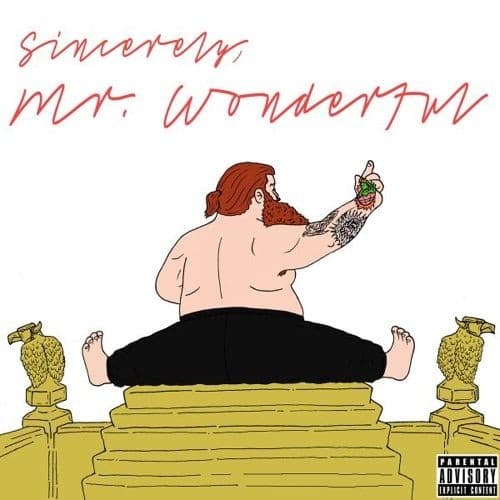
Action Bronson Mr. Wonderful — When the Gourmet Rapper Walked Into the Majors With a Suitcase Full of References
This is the sound of a brilliant underground MC trying to figure out what happens when the underground stops being enough. Bronson had already built his legend on grimy boom-bap and absurdist culinary flex — a Queens loudmouth who could go bar-for-bar with anyone while simultaneously describing the perfect sear on a ribeye. Then Atlantic came calling. The major label deal promised resources, reach, visibility.
It also demanded compromise.
Mr. Wonderful documents that negotiation in real time, and the results are gloriously uneven. Does this album belong alongside his best indie work? Not quite. But does it capture an artist refusing to sand down his weirdest edges even when the corporate machinery expected him to?
Absolutely. That tension — between Bronson's natural instinct for maximalist storytelling and the label's hunger for radio singles — defines every corner of this record. Sometimes it produces magic. Sometimes it just produces clutter. The editorial angle here is simple: Mr. Wonderful represents the moment when one of rap's most charismatic oddballs realized the major label dream might cost more than it pays.
The album works when Bronson leans into his strengths — vivid scene-setting, oddball humor, lived-in Queens grit. It stumbles when it chases trends that don't fit his voice. This is not the album that made him a household name. It's the album where he learned what he was willing to sacrifice for that shot.
When Boom-Bap Meets Big Budget
Mark Ronson executive produced this thing, which tells you everything about Atlantic's ambitions. They wanted crossover appeal without losing the grime. They wanted Bronson to sound expensive but still authentic. The result is a sonic patchwork that never fully settles on an identity.
Ronson brings live instrumentation and lush soul samples to tracks like "Baby Blue," where Mark Ronson himself handles keys and Chance the Rapper delivers one of the era's most memorable guest verses. The production there is gorgeous — rich without being slick, nostalgic without being derivative. But then you hit something like "Actin' Crazy," where the beat feels like it was assembled by committee to chase a vibe that doesn't suit Bronson's natural cadence.
The Alchemist appears here, which grounds the project in the world Bronson came from.
Noah "40" Shebib shows up too, lending that moody Drake-adjacent atmosphere to tracks that benefit from restraint. But the production never coheres into a singular vision. This sounds like five different albums competing for dominance. Part of that is intentional — Bronson has always been an eclectic curator.
Part of it is the label hedging bets, throwing every style at the wall to see what connects with a broader audience. Lyrically, Bronson is still Bronson. He name-drops obscure athletes, describes meals with forensic detail, and pivots from tenderness to violence within the same bar.
His voice — that unmistakable Queens rasp — carries every song even when the production doesn't fully support him. But there are moments where you can hear him trying to write for a bigger room, and it doesn't always land. The punchlines feel slightly more calculated. The references slightly less organic.
The flaw here is bloat. At thirteen tracks, the album needed tighter editing. Several songs could have been cut without losing the narrative thread. The pacing drags in the middle, and by the time you reach the back half, you're not sure if this is a statement album or a mood board?
When Bronson trusts his instincts, the results are stunning. When he defers to the major label playbook, the music loses its center.
The Journey From Flex to Reflection
The album opens with confidence. The first stretch establishes Bronson as the same larger-than-life character who dominated the underground, but now with budget to match ambition. The production here feels intentional, crafted for impact. By the middle section, the momentum shifts.
The energy becomes more introspective, more conflicted. Bronson starts grappling with what success actually means, and the music reflects that uncertainty. The sequencing here is the album's quiet strength — it mirrors the psychological arc of an artist realizing the dream might not look like he imagined.
The back half tries to reclaim some of that early swagger but never fully commits. "Easy Rider" feels like Bronson remembering who he was before the contracts and expectations. The closing run doesn't land with the force the album needs, but it does leave you with the sense that this was never meant to be a triumphant victory lap. This was always going to be a transitional record.
The sequencing reflects that honest ambivalence, even if it doesn't always make for the most satisfying listen.
The Cost of Going Major
In the Bronson discography, Mr. Wonderful sits somewhere in the middle. It's not as immediate or vital as Blue Chips or Rare Chandeliers, but it's more ambitious and emotionally complex than anything he'd done before. This is an album for fans who want to hear Bronson wrestle with his own mythology. It's also an album that reveals the limits of the major label system for artists who built their identity outside it.
Who should listen? Bronson die-hards who want to understand his career trajectory. Hip-hop heads who appreciate the tension between underground credibility and mainstream ambition. Anyone curious about what happens when a cult figure tries to go wide without losing what made them compelling in the first place.
Who might skip it? Listeners expecting the raw spontaneity of his indie work will find this too polished. Casual fans looking for bangers will find too much introspection.
The album has aged better than it was received. In 2015, it felt like a misstep — too unfocused, too caught between worlds. A decade later, it reads as an honest document of an artist navigating an impossible task.
The standout tracks remain essential. "Baby Blue" still sounds like one of the best rap singles of the 2010s. "Terry" still reveals Bronson at his most vivid. The deeper cuts reward patience.
This album didn't change his career the way Atlantic hoped, but it didn't kill it either. It just proved Bronson was always going to be Bronson, no matter who signed the checks. That's not nothing.
Track Listing
Brand New Car
▲Bronson opens by reminding everyone exactly who he is — a walking contradiction of high culture and street grit. The production here is thick with bass and menace, but his delivery stays loose and conversational. He's flexing without breaking a sweat. The hook is minimal, almost dismissive, which works because Bronson has never needed catchy melodies to hold attention. He just needs to paint a scene. And he does. The verses move through luxury cars, obscure sports references, and threats delivered with the casual confidence of someone who knows he earned this moment. This is Bronson at his most assured, refusing to compromise even as he steps into a bigger arena. The track establishes the album's central tension — can he stay himself while playing by new rules?
The Rising
▲This is where the major label budget starts to show. The production is lush, layered, almost cinematic. Strings swell beneath Bronson's voice as he reflects on the journey from obscurity to something resembling fame. The introspection feels earned. He's not celebrating yet — he's taking stock. The verses balance pride with paranoia, gratitude with skepticism. What makes this work is Bronson's refusal to soften his voice for the occasion. He still sounds like he's holding court in a corner bodega, even as the music around him reaches for grandeur. The pacing is deliberate, almost meditative. This is not a hype track. It's a moment of pause before the chaos resumes. The only weakness is the outro, which lingers a bit too long without adding anything new.
Terry
▲One of the best songs Bronson has ever recorded. The Alchemist's production is spare and dusty, just a looped soul sample and drums that sound like they were recorded in a basement. Bronson uses the space to tell a story about a friend named Terry who got caught up in the street life and paid the price. The storytelling here is vivid and unsentimental. Bronson doesn't moralize or romanticize. He just describes what happened with the clarity of someone who watched it unfold. His voice carries a rare tenderness, especially in the way he delivers certain lines about loyalty and loss. The hook is minimal — just Bronson repeating the name "Terry" like a eulogy. By the end, you feel like you knew this person. That's the power of great rap storytelling. No wasted words. No cheap sentiment. Just the truth, delivered with weight.
Actin' Crazy
●This is the obligatory attempt at a radio single, and it shows. The production is louder, shinier, more eager to please than anything else on the album. The beat bangs, but it feels like it was designed by focus group. Bronson does his best to match the energy, but his natural cadence doesn't quite fit the pocket. The verses are solid — plenty of quotable lines, plenty of Bronson's signature absurdism — but the song never fully commits to being either a club banger or a showcase for his lyrical skill. It just exists in the middle, trying to do too much at once. The hook is repetitive in a way that feels calculated rather than infectious. This is the sound of a label trying to manufacture a moment that should have happened organically. It's not bad. It's just not Bronson at his most inspired.
Falconry
●A strange, atmospheric interlude that doubles as a full song. The production is minimal — just eerie keys and sparse percussion. Bronson delivers short, clipped verses that feel more like thoughts mumbled to himself than fully formed ideas. The subject matter is predictably odd: falcons, old money, vague threats. The mood is unsettling, almost paranoid. This track works as a palette cleanser after the louder, more commercial energy of "Actin' Crazy." It reminds you that Bronson is still capable of left turns that make no concession to accessibility. The only issue is that the song doesn't really go anywhere. It establishes a vibe and then just sits in it. That's fine for an interlude, but at over two minutes, it starts to feel like dead air.
Thug Love Story 2017 The Musical (interlude)
●A brief, absurd comedy sketch where Bronson adopts multiple voices and delivers a mock love story. It's goofy, self-aware, and completely unnecessary. The humor works if you're already on Bronson's wavelength. If not, it's just sixty seconds of wasted runtime. Interludes like this are a signature of Bronson's mixtape era, but on a major label debut, it feels slightly out of place. Still, it's brief enough that it doesn't derail the album's momentum.
City Boy Blues
▲Bronson gets melancholic here, reflecting on the cost of ambition and the loneliness that comes with success. The production is somber — minor key piano, muted drums, no flashy embellishments. His delivery is slower, more deliberate, almost weary. The verses are deeply personal, touching on strained relationships, paranoia, and the realization that fame doesn't fix the things that were broken before. This is Bronson at his most vulnerable, and it's quietly devastating. The song never veers into self-pity, which is crucial. He's just stating facts. The hook is understated, just a repeated phrase that becomes more affecting with each repetition. This is the kind of song that reveals why Bronson is more than just a punchline rapper. He can make you feel something when he wants to.
A Light in the Addict
▲The production here is jazzy and warm, built around a looped horn sample that gives the track a vintage feel. Bronson's verses are dense with detail — food, violence, loyalty, betrayal. He's back in storytelling mode, but the narrative is less linear than "Terry." This feels more like a collage of memories than a single story. The energy is laid-back, almost conversational. Bronson sounds relaxed, which makes the darker subject matter hit even harder. The hook is simple but effective, anchoring the song without overpowering it. This is classic Bronson — weird, vivid, impossible to categorize. The only minor flaw is that the song runs a bit long. By the final verse, the momentum starts to fade.
Baby Blue
▲The album's undeniable peak. Mark Ronson's production is lush and soulful, built around a Curtis Mayfield sample that feels both timeless and fresh. Bronson delivers one of his most confident performances, balancing swagger with introspection. The verses are packed with memorable lines, but they never feel overstuffed. Everything serves the mood. And then Chance the Rapper shows up for the second verse and steals the show. His sing-song flow and earnest energy provide the perfect contrast to Bronson's gruff realism. The two voices complement each other in a way that feels effortless. The hook is gorgeous — just Bronson crooning over those strings. This is the rare song that works as both a showcase for lyrical skill and a straight-up beautiful piece of music. If Mr. Wonderful had been built entirely around this sound, it would have been a masterpiece.
Only in America
▲A darker, more cynical track that explores the contradictions of the American dream. The production is heavy and foreboding, with distorted bass and eerie synths. Bronson's verses are biting and sarcastic, cataloging the ways the system promises opportunity while delivering exploitation. The hook is repetitive but effective, hammering home the central irony. This is Bronson at his most overtly political, though he never loses his sense of humor. The song works as a counterbalance to the more celebratory tracks earlier in the album. It's a reminder that Bronson sees through the mythology even as he participates in it. The only weakness is that the production feels a bit too murky. The mix buries some of Bronson's best lines.
Galactic Love
●The production here is ethereal and spacey, built around shimmering synths and a slow, hypnotic groove. Bronson's verses are more abstract than usual, leaning into metaphor and surreal imagery. The subject matter is ostensibly about love, but it's filtered through Bronson's peculiar lens — part romantic fantasy, part drug-induced hallucination. The hook is dreamy and repetitive, which suits the vibe but doesn't quite stick. This is an interesting experiment, but it doesn't fully land. Bronson sounds slightly uncomfortable in the soundscape, like he's trying to force his voice into a space that doesn't naturally fit him. Still, it's worth hearing for the ambition alone.
The Passage (live from Prague)
●A live recording that captures Bronson performing over a sparse, jazzy instrumental. The energy is raw and immediate, with crowd noise audible in the mix. Bronson sounds loose and improvisational, riffing over the beat rather than delivering polished verses. The production is minimal — just keys and drums. This track works as a reminder of Bronson's roots as a live performer, but it feels slightly out of place on a studio album. The recording quality is deliberately rough, which adds authenticity but also makes it feel like a bonus track rather than an essential part of the album's narrative. Still, it's a fun detour for fans who want to hear Bronson in a different context.
Easy Rider
▲The album closes with Bronson sounding exhausted but defiant. The production is mellow and reflective, built around a gentle guitar loop and laid-back drums. His verses are less focused on flexing and more on taking stock. He reflects on the journey, the sacrifices, the people he left behind. The hook is subdued, almost resigned. This is not a triumphant ending. It's an honest one. Bronson sounds like someone who got what he wanted and realized it wasn't quite what he expected. The song doesn't provide closure so much as it leaves the door open for whatever comes next. It's a fitting end to an album that was always more about the struggle than the victory.