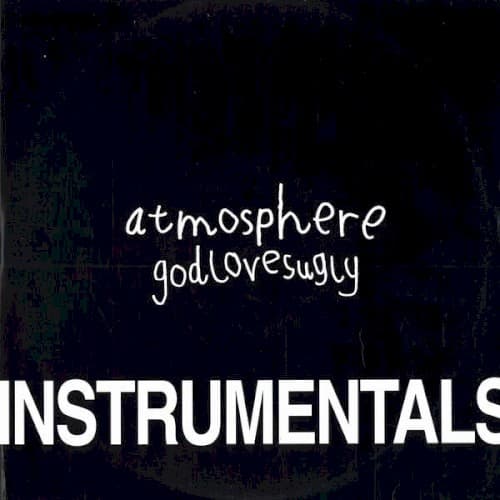
Atmosphere God Loves Ugly Instrumentals — The Blueprint Without the Blood
Remove Slug's voice from God Loves Ugly and what remains is not emptiness but architecture. The scaffolding stands exposed. Every crack in the foundation becomes visible. Ant's beats, stripped of their lyrical partner, transform from backdrop into thesis statement — and the thesis is darker than anyone expected.
This is not a remix album. This is not a DJ tool. This is the original album played backward through a mirror, revealing what was always there beneath the confessional poetry and self-loathing punchlines. The melancholy was never just in Slug's words.
What does an instrumental album prove? That the producer was carrying more weight than the credits suggested. That the emotional architecture of an emo-rap landmark was built before a single bar was written. That sometimes the most honest version of an album is the one without words.
God Loves Ugly Instrumentals arrived in 2002 through Fat Beats, the same year the original became the blueprint for every sad white rapper with a notebook and a Akai MPC. The vocal version made Atmosphere backpack-rap royalty. The instrumental version made Ant's case as one of underground hip-hop's most underrated architects.
The Emotional Machinery Ant Built in Minnesota Basements
Ant's production philosophy across these fifteen instrumentals is rooted in texture over flash. He samples like a crate-digger with clinical depression — jazz piano loops that sound like they were recorded in empty rooms, string sections that never resolve, drum breaks that hit with the weight of regret rather than aggression. This is boom-bap filtered through Midwest isolation, where winter lasts six months and studio time means disappearing into basements until spring.
The sonic palette pulls from 1970s soul, obscure film scores, and the kind of jazz records that never made it to reissue. Ant chops samples the way Slug writes bars — obsessively, finding the saddest possible phrase in a three-minute song and looping it until it becomes a mantra. The drums snap with analog warmth but never overpower the melodic elements. Kick patterns stay simple.
Snares crack without reverb. Hi-hats whisper.
What emerges is a production style that anticipated the emo-rap wave by a decade. The emotional vocabulary here — minor-key melodies, unresolved chord progressions, beats that feel like exhaling — became the template for artists who would dominate SoundCloud fifteen years later, from Earl Sweatshirt's sample-collage experiments on Some Rap Songs to the melancholic loops that define modern introspective hip-hop. Ant was building sad-boy infrastructure before the term existed.
The weakness shows in the sameness. Fifteen tracks of melancholy can blur together. The tempos rarely shift. The energy never spikes.
Without Slug's voice to create contrast and narrative momentum, some instrumentals dissolve into wallpaper — beautiful wallpaper, but wallpaper nonetheless. By track ten, the emotional palette starts to feel like a limitation rather than a statement. Does sustained melancholy without variation become its own form of monotony?
The Architecture of Sadness, Track by Track
The sequencing mirrors the vocal album's structure but removes the storytelling guardrails. The opening stretch establishes the emotional baseline — mid-tempo gloom, sample-heavy textures, drums that knock without aggression. The middle section sags under its own weight, several instrumentals bleeding into each other without the vocal hooks to differentiate them. The back half attempts to build toward catharsis but never quite arrives, ending instead on sustained melancholy.
Without lyrics to anchor the listener, the album functions less as a journey and more as an extended meditation on a single mood. The pacing feels intentional but exhausting. Where the vocal version used Slug's storytelling to create peaks and valleys, the instrumental version holds one note for forty-five minutes. Some listeners will find that hypnotic.
The sequencing choice to include both the main version and reprise of the title track highlights Ant's commitment to the original album's structure, even when that structure no longer serves the instrumental format. It creates redundancy where the vocal version had thematic reinforcement.
The Case for Ant as Underground Architect
In Atmosphere's discography, this sits as essential context rather than essential listening. It is the Rosetta Stone for understanding how much heavy lifting Ant did on God Loves Ugly. It proves that the emotional core of that album was not just Slug's diary entries but the sonic world Ant constructed for those confessions to inhabit.
This album rewards producers, beatmakers, and obsessive fans who want to understand the machinery. Casual listeners will miss Slug's voice. New fans should start with the vocal version. But for anyone who ever wondered how underground hip-hop built its melancholy infrastructure, this is the blueprint.
The aging process has been kind. What sounded like backpack-rap production in 2002 now sounds like proto-emo-rap. Ant's instinct to prioritize emotion over technical flex positioned him ahead of the curve. The influence echoes through every SoundCloud producer who samples old jazz records and calls it a beat tape.
Standout instrumentals include the title track for its layered string arrangements, "Fuck You Lucy" for its off-kilter drum pattern, and "One of a Kind" for its rare moment of sonic optimism. Similar albums worth exploring include RJD2's Deadringer, Blockhead's Music By Cavelight, and J Dilla's Donuts for parallel approaches to instrumental hip-hop with emotional depth. The long-term influence shows in how many producers cite Ant as the template for sad beats that still knock.
This is what ambition sounds like without a voice. Forty-five minutes of Minneapolis basement wisdom, one sample chop at a time.
Track Listing
Onemosphere
▲The album opens with cascading piano and a drum break that sounds like it was sampled from a record played in another room. Ant establishes the emotional palette immediately — this will not be a triumphant listen. The loop repeats with minor variations, adding texture without ever shifting the mood. No bass drop, no payoff, just sustained melancholy that sets the template for everything that follows. The mixing is deliberately sparse, leaving space where Slug's voice used to live.
The Bass and the Movement
▲The low end finally arrives here, a rolling bassline that gives the album its first moment of physical weight. The drum pattern locks into a head-nod groove while strings float above, creating the kind of layered texture that made Rhymesayers production stand out in the early 2000s underground. Ant knows how to make a loop breathe — the sample chops shift slightly on each rotation, keeping the ear engaged. This is the instrumental that translates best to a live setting, the one where the absence of vocals feels intentional rather than empty.
Give Me
▲A jazz piano loop that sounds lifted from a Sunday morning in 1973. The drums shuffle rather than knock, giving the track a loose, almost improvisational feel. Ant layers in subtle scratches and vocal samples that hint at the original album's narrative without committing to it. The mixing buries elements in the background, creating depth through restraint. Without Slug's aggressive delivery, the beat reveals itself as more vulnerable than combative — the musical equivalent of asking for help without making eye contact.
Twomosphere
●Functions as an interlude, ninety seconds of downtempo texture that bridges the album's first act into its darker middle section. Minimal drums, heavy on atmosphere, light on hooks. The kind of instrumental that disappears if you are not paying attention but adds essential pacing when consumed as part of the full album experience.
Fuck You Lucy
▲The drums hit off-kilter here, slightly behind the beat in a way that creates tension rather than groove. Ant samples what sounds like a Wurlitzer organ, the kind of texture that became a underground hip-hop signature in the early 2000s. The bassline moves in unexpected intervals, refusing to settle into a predictable pattern. This is one of the few instrumentals where the absence of vocals feels like a feature rather than a subtraction — the beat is complex enough to hold attention on its own, the production choices bold enough to reward repeat listens. I wore this one out in college, looping it while writing papers at 3 AM, the perfect soundtrack for productive melancholy.
Hair
▲A rare uptempo moment, though "uptempo" is relative in an album this committed to mid-tempo depression. The sample sounds like it came from a 1960s soul record, all warmth and analog grit. Ant chops it into a rhythm that almost swings, the closest the album comes to making you move your head with anything resembling joy. The drums crack with more presence than anywhere else on the record. Brief but necessary, a reminder that Ant's palette includes colors beyond gray.
Godlovesugly
▲The centerpiece, and it carries that weight even without Slug's most visceral lyrics. The string arrangement here is cinematic in scope, a minor-key melody that repeats and builds without ever resolving. Ant layers in subtle percussion — shakers, rim shots, barely audible clicks — that add texture without cluttering the mix. The bassline enters late, a low rumble that anchors the strings without overwhelming them. This is Ant operating at his peak, constructing emotional architecture that stands independent of vocals. The production anticipates the emo-rap wave by understanding that sadness requires space, not filler.
Godlovesugly (reprise)
●A shorter, more skeletal version of the title track that strips away the layers and exposes the core sample loop. The drums hit harder here, less reverb, more crack. Necessary on the vocal album as a thematic bookend, but redundant in instrumental format. Feels like an obligation to the original sequencing rather than a choice that serves this version.
Saves the Day
●The sample sounds like it was pulled from a forgotten film score, strings that suggest narrative without telling a story. The drums are mixed low, almost subliminal, letting the melodic elements dominate. Ant adds vocal chops — wordless phrases, more texture than meaning — that fill some of the space left by Slug's absence. The result is hypnotic but not memorable, the kind of instrumental that works as background music for late-night drives but lacks the hooks to demand active listening.
Lovelife
●Another mid-tempo meditation, this one built around a piano loop that repeats without variation. The drums shuffle politely. The bass moves predictably. By this point in the album, the sameness becomes apparent — Ant's commitment to a single emotional register starts to feel like a creative limitation. Solid craftsmanship, but the absence of dynamics makes it forgettable.
Breathing
●The tempo slows further, entering genuine downtempo territory. Ant samples what might be a flute or a synthesizer imitating a flute, layering it over kick drums that feel more like a heartbeat than a rhythm section. The mixing is deliberately murky, elements bleeding into each other in a way that suggests exhaustion rather than precision. This works better with Slug's voice providing focus. Without it, the track drifts.
One of a Kind
▲A surprise shift toward something approaching optimism. The sample is brighter, the drums more energetic, the bassline almost playful. Ant proves he can construct instrumentals with dynamic range when he chooses to, making the preceding tracks feel even more deliberately oppressive. The piano chops here have a staccato rhythm that creates momentum rather than stasis. Too late in the album to shift the overall mood, but a welcome reminder that the producer has range.
A Girl Named Hope
●Returns to the melancholy baseline after the brief detour into brighter territory. The sample sounds like it was recorded on tape and left in a basement for two decades, all warmth and degradation. Ant's drum programming stays minimal, letting the melodic elements carry the emotional weight. The track title promises uplift but the production delivers only resignation. Honest, at least.
My Songs
▲A guitar loop, rare for an album built primarily on soul and jazz samples. The drums knock harder than they have in several tracks, giving the instrumental some much-needed physical presence. Ant layers in string stabs and vocal samples that create texture without overwhelming the core loop. One of the stronger back-half instrumentals, proof that variety in source material creates variety in output. Should have appeared earlier in the sequence.
Shrapnel
●The album ends with its most skeletal production, drums and bass with minimal melodic embellishment. The mixing leaves vast empty spaces, the kind of negative space that invites vocals but receives none. As a closer, it feels incomplete rather than definitive. The vocal version ends with emotional resolution. The instrumental version ends with a shrug. An honest ending for an album that never promised catharsis, but not a satisfying one.