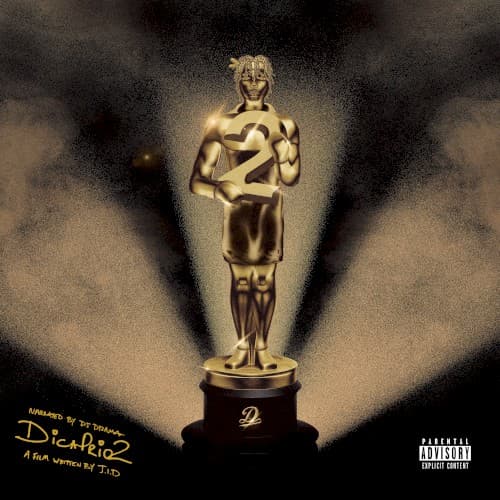
J.I.D DiCaprio 2 — The Pen That Broke the Algorithm
No rapper in 2018 sounded like they were trying this hard to prove something. The year belonged to playlists and vibes — Drake stretched songs into moods, Travis Scott turned albums into amusement parks, Cardi B owned summer with a single. Then came this East Atlanta kid with a forty-three-minute thesis on why technical skill still mattered, why syllable stacking could compete with melody, why a backpack rapper from Dreamville could hang with anyone bar for bar. He named it after an actor famous for refusing to phone it in.
J.I.D arrived at a crossroads. His debut The Never Story had made believers out of purists but barely dented streaming charts. Dreamville was expanding — Cole was building an empire, Ari Lennox was breaking through, Bas had carved his lane. The label needed proof that rappity-rap could scale beyond Reddit threads and Genius annotations.
DiCaprio 2 became the test case. Could a rapper this dense, this allergic to repetition, this committed to internal rhyme schemes build a project that rewarded both close reading and casual listening?
The answer sits somewhere between validation and warning. This is an album that demands your attention then rewards it with craft so meticulous it borders on compulsive. J.I.D raps like someone who discovered multisyllabic rhyming at fourteen and never looked back, never slowed down, never second-guessed whether listeners could keep up. Every verse contains at least three different rhyme schemes operating simultaneously.
Every feature gets matched or outpaced. Every hook serves the song rather than radio. It is exhausting in the way great art often is — too much to absorb in one sitting, too layered to dismiss after three.
What makes DiCaprio 2 vital is not just the technical brilliance but the hunger underneath it. This is not an artist coasting on natural ability. This is someone who watched Kendrick rewrite the rules, watched Cole build an independent empire, watched the South finally get its critical due, and decided the only way forward was through the bars themselves. No gimmicks, no viral moments, just forty-three minutes of someone trying to earn respect the hardest way possible.
The Geometry of East Atlanta Syllables
The production here pulls from boom bap's golden age while sidestepping nostalgia. J. Cole executive produced but resisted the urge to make this sound like a Dreamville house record. Instead the palette moves between Christo's chopped soul, ChaseTheMoney's minimal trap, and lesser-known collaborators like Louis Futon. The drums hit hard without overwhelming — kick patterns stay simple while hi-hat rolls add complexity.
Sample flips favor obscure soul and jazz rather than obvious crate-digging. The mixing leaves space for J.I.D's voice to breathe even when the syllables pile up like rush hour traffic.
What separates this from typical technical rap is the tonal variation. J.I.D does not have one flow — he has twelve, switching mid-verse based on production shifts and thematic turns. His voice can go nasal and urgent, then drop into a deeper register for emphasis, then speed up until consonants blur into percussive texture. He treats rhyme schemes like architecture, building structures where every line connects to what came before and after.
Internal rhymes nest inside multisyllabic patterns. Assonance creates momentum even when the tempo slows. This is not showing off for its own sake — this is a rapper who believes the craft itself is the content.
Lyrically the album operates in two modes. The first is technical flexing — extended metaphors about elevation, competition, separation from the pack. The second is street memoir, stories from East Atlanta rendered in specific detail. J.I.D references trap houses and church pews with equal familiarity, code-switches between AAVE and more formal diction, never smooths out the contradictions.
He is too smart to romanticize the struggle but too grounded to pretend he outgrew it. The honesty lands hardest when he admits ambition's cost — relationships strained, paranoia creeping in, success that feels conditional.
The weakness shows up in moments where complexity overtakes clarity. Some verses pack so many ideas into sixteen bars that the emotional core gets buried under technique. A few hooks prioritize syllable counts over memorability, which works for the purists but limits crossover potential. The sequencing occasionally favors variety over momentum — the album shifts moods so frequently that sustained emotional arcs get interrupted.
These are not fatal flaws but they keep DiCaprio 2 from reaching the heights of projects that balance technicality with accessibility. This album knows exactly what it is and who it serves. That confidence is both its greatest strength and the ceiling it chose for itself. But does choosing your audience mean limiting your impact or protecting your vision?
The Forty-Three Minute Argument
The opening stretch establishes authority immediately. Three tracks in and J.I.D has already cycled through more flows than most rappers attempt across entire albums. The production stays lean, letting the wordplay breathe. By the time the first guest verse arrives the thesis is clear — this will not be an easy listen but it will be a rewarding one.
The tempo never lets up but the intensity varies, creating pockets of space before the next technical onslaught.
The middle section introduces more melody without sacrificing complexity. Hooks become more prominent, production gets slightly warmer, features arrive to shift the energy. This is where the album's accessibility peaks — still dense, still demanding, but offering entry points for listeners who need more than syllable stacking. The sequencing here works best, each track flowing naturally into the next while maintaining distinct identities.
The emotional range expands too, moving from pure competition into introspection and storytelling.
The back half takes risks. The production gets weirder, the subject matter more personal, the flows more experimental. Some tracks abandon traditional structure entirely, favoring stream-of-consciousness over verse-chorus-verse. This is where casual listeners might check out but where the album reveals its depth.
The closing run feels like watching someone empty the clip — every remaining idea, every leftover flow, every ounce of hunger poured into the final moments. It is messy in the way great ambition often is, unwilling to leave anything unsaid or any technical boundary untested.
The Cost of Caring This Much
DiCaprio 2 sits second in J.I.D's discography behind The Forever Story's more mature ambition but miles ahead of everything that came before. This is the album that proved technical rap could still find an audience in the streaming era, that Dreamville could develop artists beyond J. Cole's shadow, that East Atlanta had more to offer than trap melodies and ad-libs. Four years later it still sounds urgent, still rewards close listening, still separates believers from casual fans within the first three tracks.
This album works best for listeners who treat rap as literature — people who rewind bars to catch internal rhymes, who read Genius annotations, who care about syllable placement and breath control. It will frustrate anyone looking for easy hooks or background music. The density is the point. J.I.D built this for the close listeners, the ones who still believe craft matters more than virality, the ones who remember when technical skill was the baseline rather than a niche concern.
Five years out DiCaprio 2 has aged into a time capsule of a specific moment — the last gasp of boom bap revivalism before melodic rap fully took over, the moment before TikTok changed how albums got consumed, the brief window when Dreamville looked like it might challenge TDE's critical dominance. The album's influence shows up in how many young rappers now prioritize wordplay over melody, how technical skill became cool again in certain circles, how independent labels started betting on difficult artists.
Standout tracks for first-time listeners: Off Deez for the A$AP Ferg clash, 151 Rum for pure technical display. For similar energy try Saba's CARE FOR ME for introspective boom bap, Denzel Curry's TA13OO for technical aggression, or early Kendrick for West Coast syllable stacking. J.I.D never made another album this relentlessly dense — The Forever Story smoothed the edges and found a bigger audience. Whether that was growth or compromise depends on how much you value the hunger that fueled DiCaprio 2.
Track Listing
Frequency Change
▲The album opens with J.I.D announcing his presence through pure velocity. Over minimal production — just drums and a subtle bass hum — he stacks syllables until the flow itself becomes the melody. The rhyme scheme operates on three levels simultaneously: end rhymes that land on the two and four, internal rhymes that create mid-bar pockets, and assonance that carries momentum between lines. No hook, no pause, just two minutes of someone proving they belong in every conversation about technical skill. The mixing keeps his voice front and center, every consonant crisp, every breath audible. It functions as thesis statement and warning: if you cannot keep up with this, the next forty minutes will lose you.
Slick Talk
▲This is J.I.D at his most casually lethal, coasting over Christo's chopped soul loop like he has nothing to prove despite proving everything. The flow stays in the pocket, conversational but precise, every bar connected by slant rhyme and internal callbacks. He code-switches between AAVE and more formal diction mid-verse, a technical flex disguised as natural speech. The hook is barely a hook — just a repeated phrase that serves as punctuation rather than chorus. The second verse shifts into storytelling mode, specific details about East Atlanta rendered in images rather than exposition. The production stays sparse enough to let every syllable land but warm enough to feel lived-in rather than clinical.
Westbrook
▲The Russell Westbrook comparison writes itself but J.I.D earns it through sheer relentlessness. The beat — courtesy of ChaseTheMoney and Childish Major — moves like an And1 mixtape, drums cutting and pivoting while J.I.D matches every tempo shift with flow adjustments. The first verse operates in triple-time, syllables compressing until they blur into texture. The second verse slows down just enough to let the wordplay breathe, extended metaphors about elevation and competition delivered with the confidence of someone who has already won. The hook actually functions as a hook here, repetitive enough to stick but complex enough to reward repeated listens. This is what happens when technical skill meets actual songcraft.
Off Deez
▲The A$AP Ferg feature transforms this into a friendly competition that J.I.D wins by decision rather than knockout. Ferg opens with his signature aggression, ad-libs stacked over punch-in flows, energy that feels expensive and reckless. Then J.I.D arrives and dismantles him through precision. Same beat, completely different approach — where Ferg prioritizes impact, J.I.D prioritizes architecture. The rhyme scheme here might be the most complex on the album, nested structures where every line connects to three others simultaneously. He even flips Ferg's cadence in the second verse, a subtle diss disguised as homage. The beat — handled by J. Cole and various collaborators — stays minimal, letting both rappers work without interference. This is the album's most obvious single and its sharpest proof that bars still matter.
151 Rum
▲Pure technical exhibition with just enough melody to avoid sounding like a Rap Olympics audition. The production stays skeletal — drums, bass, a looped vocal sample that never resolves — while J.I.D uses every available pocket. The flow switches eight times in three minutes, never repeating a pattern, never giving the ear time to settle. The rhyme schemes operate in such tight clusters that individual bars become secondary to the larger structure. He is not saying anything particularly deep here and that is fine — sometimes craft is content. The mixing emphasizes the syllable placement, every punch-in audible, every breath timed for maximum impact. This is what separates good technical rappers from great ones: the ability to make complexity feel effortless even when the construction is obviously meticulous.
Off da Zoinkys
▲The weirdest beat on the album — chopped vocals, off-kilter drums, a bassline that feels slightly out of time — gives J.I.D room to experiment with flow as texture rather than structure. He treats his voice like a percussive instrument here, syllables hitting on unexpected counts, phrases starting mid-bar and ending two bars later. The hook is more atmosphere than chorus, repeated vocal stabs that create space rather than fill it. The second verse abandons traditional rhyme schemes entirely, favoring assonance and rhythm over end-rhyme patterns. This is the sound of someone comfortable enough with the basics to start breaking rules. It is messy in the way jazz solos are messy — controlled chaos that only works because the fundamentals are so locked in.
Workin Out
▲The smoothest track on the album, production courtesy of J. Cole and others who understand that accessibility does not require dumbing down. The drums knock without overwhelming, the sample flips between major and minor, the hook is the first truly memorable chorus since the opening tracks. J.I.D adjusts his approach accordingly — still technical but more melodic, still dense but more digestible. The subject matter shifts too, focusing on grind and elevation rather than pure competition. The flow stays in the pocket longer, letting phrases breathe before the next cluster of syllables. This is the album's clearest bid for broader appeal and it works without feeling like compromise. The final verse brings the complexity back, a reminder that even when J.I.D makes it easy he can still make it hard.
Tiiied
▲6LACK shows up and nearly steals the track through sheer tonal contrast. His melodic approach — sad boy vibes over moody production — sits in direct opposition to J.I.D's technical aggression. The beat accommodates both, spacious enough for 6LACK's sustained notes and tight enough for J.I.D's rapid-fire clusters. When J.I.D arrives he matches the mood without abandoning his style, syllables stacking but delivery more restrained, complexity in service of emotion rather than exhibition. The hook is genuinely catchy, the most radio-ready moment on the album. This is proof that J.I.D can operate in multiple modes without losing his identity. The mixing gives each artist space, no competition for sonic real estate, just two different approaches to the same theme.
Skrawberries
▲The album's emotional centerpiece, production sparse enough to let the storytelling breathe. J.I.D slows down here — not in tempo but in density, giving each line room to land before the next arrives. The narrative follows a specific memory, details concrete enough to feel autobiographical: a girl, a moment, a decision that still haunts. The rhyme schemes stay complex but serve the story rather than overshadow it. The hook is a question repeated until it becomes mantra, vulnerability disguised as technical exercise. The second verse shifts perspective, same story from a different angle, showing rather than telling how memory distorts over time. This is the track that proves J.I.D is more than a technical rapper — he can write, really write, when he trusts the material enough to get out of its way.
Hot Box
▲Method Man and Joey Bada$$ turn this into a generational summit, three different eras of technical rap sharing the same canvas. Method Man opens and sounds exactly like Method Man — effortless cool, voice like gravel, every line landing with the weight of someone who has nothing left to prove. Joey arrives next, boom bap revivalist meeting the original, flows sharp but respectful. Then J.I.D closes and holds his own against two legends through sheer hunger. The beat — handled by multiple producers — nods to Wu-Tang's dusty aesthetic while staying contemporary. This is the album's most obvious flex, proof that J.I.D belongs in the conversation with anyone from any era. The chemistry is real, everyone elevating rather than competing.
Mounted Up
●The momentum dips here. The production feels like an interlude stretched into a full track, the hook repetitive without being memorable, the verses solid but not essential. J.I.D experiments with a slower, more deliberate flow that never quite finds its pocket. The rhyme schemes stay complex but the energy flags, momentum lost after the Hot Box summit. This is the album's clearest example of ambition exceeding execution — the idea works on paper but the final product feels like a rough draft. It is not bad, just forgettable in the context of an album that rarely wastes time. Skip this on first listen and you will miss nothing crucial.
Just da Other Day
▲The album's longest track at nearly five minutes, an extended meditation on memory and ambition that earns its runtime. The production shifts twice, each section getting its own sonic palette while maintaining thematic continuity. J.I.D uses the space to experiment with narrative structure, stories nested inside stories, timelines collapsing and expanding. The technical skill is still present but secondary to the storytelling — syllables serve the scenes rather than overshadow them. The hook is minimal, just a phrase repeated between sections, punctuation rather than chorus. The final verse brings everything together, past and present colliding, hunger and paranoia coexisting. This is J.I.D at his most novelistic, treating the track like a short story that needs room to develop.
Despacito Too
▲The title is pure troll energy and the track delivers on the joke while somehow also working as a song. The production flips Latin-influenced elements without sounding like parody, drums hitting on unexpected counts, melody walking the line between homage and satire. J.I.D matches the vibe with a flow that feels intentionally off-balance, syllables landing just behind or ahead of the beat, never quite settling. The hook is absurd in the best way, self-aware enough to acknowledge the joke while committing fully to the bit. This is the album at its loosest, J.I.D having enough fun to momentarily abandon the thesis. It should not work but it does, a palate cleanser before the final track.
Hasta luego
▲The album closes with J.I.D emptying the clip, every remaining idea and flow compressed into four minutes. The production stays minimal — just drums and bass — leaving maximum space for the verbal onslaught. The first verse might be the most technically demanding on the album, rhyme schemes so dense they border on incomprehensible on first listen. The second verse shifts into reflection mode, looking back at the journey that led here, forward at what comes next. No hook, no feature, no compromise — just J.I.D proving one last time that the pen still matters, that technical skill can carry an entire project, that hunger is its own kind of genius. The final bar arrives and the album ends abruptly, no fade-out, no resolution. Just silence and the question of whether you are ready to press play again.