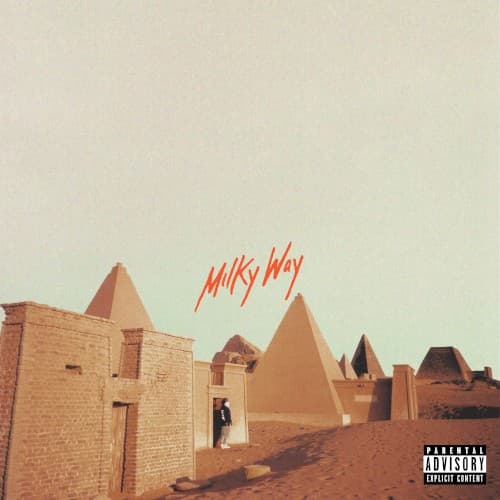
Bas Milky Way — The Kid Who Finally Stopped Apologizing
Play the first three tracks back to back and something clicks that never quite landed on Too High To Riot. The hesitation is gone. Bas spent his debut sounding like he was waiting for permission to exist in the same room as J. Cole. By the time he sat down to make this album, he stopped asking.
The difference between an artist who feels like a passenger and one who grabs the wheel is physical, and Milky Way is forty-six minutes of Bas finally driving. Dreamville had spent years positioning itself as the alternative to radio trap, the thinking fan's label, the place where bars mattered more than billboard placement. That positioning created space for Bas but also painted him into a corner. He was the international kid, the Queens-raised son of immigrants, the technical rapper who never quite found his lane.
Too High To Riot had moments but no momentum. It felt like a collection of good ideas waiting for a thesis. Milky Way arrives with a thesis fully formed. This is an album about reconciling ambition with self-doubt, luxury with loneliness, success with the fear that none of it means anything.
The production leans into twilight moods — hazy keys, muted drums, samples that float rather than knock. Producers like Childish Major and Elite craft soundscapes that feel expensive but never flashy, like late-night drives through empty neighborhoods where every streetlight looks the same.
What does it sound like when a rapper stops chasing co-signs and starts writing for himself?
Twilight Production and the Architect of Doubt
Childish Major and Elite handle most of the production, and their approach feels deliberate — spacious without being minimalist, polished without losing texture. The drums sit back in the mix, letting melody carry weight. Samples never announce themselves; they blur into the background like memory. Keys shimmer at the edges.
Bass lines roll slow and steady, never punching hard enough to dominate. This is music designed for headphones and long commutes, not clubs or cyphers. It sounds like money that does not need to scream.
Lyrically, Bas splits time between flexing and questioning whether the flex means anything. He writes about designer clothes and hotel suites, then pivots to lines about feeling hollow in the middle of success. His flow is technically clean — multisyllabic patterns, internal rhyme schemes that stack neatly without feeling forced. He never rushes.
Every bar lands with precision, but precision alone does not guarantee impact. When he writes about ambition, the imagery sharpens. When he writes about women or excess, the pen softens into familiar territory. The album struggles most when Bas reaches for profundity but lands on vague declarations about growth and self-improvement.
Lines about being present or finding peace read like journal entries that needed one more draft.
The features help. J. Cole shows up and reminds everyone why he runs the label, delivering a verse that rewrites the song's emotional center. Cozz matches Bas's technical skill but adds bite. The Dreamville roster functions like a safety net, lifting songs when Bas's perspective alone is not enough.
The album's greatest weakness is its sameness. Fourteen tracks at this tempo, with this production palette, start to bleed together by the back half. Bas never changes gears. He never gets angry, never speeds up, never breaks the spell.
That consistency works as a mood but limits replay value. By track ten, the album feels like background music to itself. When does restraint become repetition? When does cohesion become monotony?
A Journey With No Climax
The sequencing is smart but ultimately flat. The album opens with purpose, builds momentum through the first stretch, then coasts. There is no peak, no moment where the energy shifts or the stakes raise. Bas paces the record like someone afraid to disrupt the vibe, and that caution drains the album of drama.
The first section establishes the tone — reflective, confident, technically sharp. Bas sounds present, like he finally trusts his own voice. The hooks land softly but effectively. This is the album at its most cohesive.
The middle section maintains the same energy, which becomes the problem. No song disrupts the flow. No beat switches. No tempo shifts.
Every track operates at the same emotional register, the same volume, the same pace. That consistency feels like restraint, but restraint is not the same as tension.
The back half drifts. By the time the album reaches its final stretch, the songs blur into a uniform haze. Individual moments still shine — a sharp bar here, a smooth transition there — but the cumulative effect is numbing. Bas never raises his voice, never breaks the spell, never gives the listener a reason to wake up and lean in.
The album ends the way it began, which is both its strength and its limitation. It is an immersive listen that never demands attention, a mood piece that forgets mood alone cannot sustain forty-six minutes.
The Sound of Arrival Without Announcement
This is Bas's best album, but that statement carries an asterisk. Too High To Riot was solid but unfocused. Milky Way tightens the vision, sharpens the pen, and establishes a lane. But the lane is narrow.
This is the album Bas needed to make to prove he belonged on Dreamville, but it is not the album that will make fans care about Bas beyond Dreamville. It is music for people who already trust him, not music designed to convert skeptics.
Who should listen: fans of Saba, 6LACK, or the mellower side of Isaiah Rashad. Listeners who want technical rapping without aggression, who value polish over rawness, who treat albums as background soundtracks to introspection. This is date-night music for people who read their own tarot cards.
Who might not enjoy it: anyone looking for bangers, punchlines, or energy. Anyone who thinks J. Cole's introspection can feel preachy will find Bas's version even softer.
Standout tracks to try: start with Tribe for the smoothest entry point, then Front Desk for the clearest example of Bas's technical skill. Similar albums listeners might enjoy: Saba's Care For Me for deeper emotional weight, Isaiah Rashad's The Sun's Tirade for similar twilight production, 6LACK's East Atlanta Love Letter for the same mood with better hooks.
Long-term influence: Milky Way will age well as a mood piece but will not be remembered as essential. It carved out space for Bas but did not expand the sound of Dreamville or push the needle on introspective rap. It is a solid album that will live in playlists but not in conversations about the best albums of the era.
Five years from now, fans will remember this as the album where Bas finally sounded confident, even if he never sounded urgent.
Track Listing
Icarus
▲The album opens with myth as metaphor, Bas positioning himself as the ambitious kid who flew too close to something — success, expectations, his own hype. The production is skeletal, just keys and bass, giving Bas room to establish tone without distraction. His flow is measured, every syllable placed with intent. The hook is simple, almost whispered. This is not a grand opening statement; it is a confession delivered in a quiet room. The track works as a thesis: ambition paired with self-awareness, confidence shadowed by doubt. It sets the mood but does not knock.
Front Desk
▲One of the album's sharpest moments. Bas writes about hotel lobbies and fleeting encounters, using the front desk as a symbol for transactional relationships and the emptiness of success. The production is clean — soft keys, muted drums, a bassline that rolls like a slow exhale. His rhyme schemes stack neatly, internal rhymes linking bars without sounding forced. The imagery is vivid: designer luggage, late check-ins, women whose names he forgets by morning. The hook is understated but sticky. This is technical rapping that prioritizes clarity over flash, and it lands. The track showcases Bas at his most confident, writing about hollowness without sounding hollow himself. If the album had five more songs at this level, it would be essential.
Tribe
▲Bas raps about loyalty and chosen family over production that feels like twilight — hazy keys, a bassline that pulses softly, drums that never push. The flow is smooth, every transition effortless. He writes about finding his people, about the difference between industry friends and real ones, about building something that lasts beyond hype. The hook is warm, almost comforting. This is the album's most accessible moment, the song that works as both an entry point and a mission statement. It does not challenge the listener, but it does not need to. Sometimes a song just needs to feel right, and this one does.
Boca Raton
●A geographic flex that never feels like a flex. Bas writes about Florida as a state of mind, a place where success looks like rest. The production is breezy, almost tropical, with keys that shimmer and drums that stay out of the way. His flow is relaxed, matching the vibe. The imagery is sharp: palm trees, designer slides, hotel pools that all look the same. He writes about winning but sounds tired, like he crossed the finish line and realized the race never actually ends. The hook is fine, not memorable but not weak. The track works as a vignette, a snapshot of a specific mood, but it does not push the album forward.
Barack Obama Special
●The title promises a concept the song never delivers. Bas raps about ambition and legacy, but the Obama reference feels decorative rather than thematic. The production is clean, with soft keys and a bassline that rolls steady. His flow is technically solid, stacking multisyllabic rhymes without rushing. The hook is understated, almost buried in the mix. The track is fine. It has no glaring weaknesses, but it also has no standout moments. It feels like an album cut that exists to maintain momentum rather than create it. By the time it ends, it has already started to fade.
Purge
▲J. Cole arrives and rewrites the song. Bas opens with solid bars about shedding baggage and cutting ties, but Cole's verse is a clinic. He writes about loyalty, betrayal, and the cost of keeping people around who do not deserve the seat. His flow is sharper, his imagery more vivid, his presence more commanding. The production is stripped down, just keys and bass, letting the bars carry weight. Cozz closes the track with a verse that matches Bas's energy but adds bite. This is the album's best showcase of Dreamville as a collective, three rappers with different perspectives united by technical skill. Bas holds his own, but Cole reminds everyone why he runs the room.
Fragrance
●A short interlude about scent memory and nostalgia. Bas raps about smells that trigger memories — perfume, smoke, home cooking — over minimal production. The track is under two minutes, which is the right choice. It works as a breath, a moment of stillness before the album picks up again. The writing is evocative but slight, more sketch than finished painting. It does its job without demanding attention.
Infiniti
●Sixty seconds of Bas in luxury-car-commercial mode. He raps about driving with no destination, about freedom that feels like drift. The production is smooth, just keys and bass, no drums. The flow is measured, almost conversational. This is not a full song; it is a vignette, a moment captured before it dissolves. It works as a transition, setting up the longer track that follows.
Infiniti+2
▲The title suggests continuation, and the track delivers. Bas expands on the themes from the first Infiniti, writing about motion without purpose, success without satisfaction. The production adds drums this time, pushing the energy forward. His flow is sharper, more urgent, but still controlled. The hook is understated, almost whispered. This is one of the album's best examples of Bas writing about emptiness without sounding empty. The imagery is vivid: highways at night, hotel rooms that blur together, conversations that end before they begin. The track works because it commits to the mood without overstaying. It knows when to end.
Sanufa
▼A two-minute interlude that feels like filler. Bas raps about identity and heritage, but the writing lacks specificity. The production is minimal, just keys and a distant vocal sample. The flow is fine, but the bars do not land with the weight the topic demands. This is the album's weakest moment, a track that exists to pad the runtime rather than advance the narrative. By the time it ends, it has already been forgotten.
Great Ones
●Bas writes about ambition and the cost of chasing greatness over production that feels expensive — layered keys, soft drums, a bassline that rolls like a slow exhale. His flow is technically sharp, stacking internal rhymes without forcing them. The hook is simple, almost mantra-like. The writing is solid but not revelatory. He touches on familiar themes — sacrifice, loneliness, the gap between success and fulfillment — without adding new insight. The track works as a mood piece but does not challenge the listener. It is the sound of Bas operating at a high technical level without taking creative risks.
PDA
▲The album's most melodic moment. Bas writes about relationships that exist in public but fall apart in private, using PDA as a metaphor for performance versus intimacy. The production is lush, with layered keys and soft drums that let melody lead. His flow shifts between rapping and singing, never fully committing to either. The hook is sticky, the album's most radio-ready moment. The writing is sharp when it focuses on specifics — arguments in parking lots, affection that only exists for an audience — but softens into vague declarations about trust and honesty. The track works as a change of pace, a moment of warmth in an album full of cool distance.
Designer
●A short track about materialism and the emptiness that comes with it. Bas raps about designer clothes and expensive taste, then questions why none of it feels like enough. The production is minimal, just keys and bass. The flow is measured, every bar placed with intent. The writing is solid but predictable. He covers familiar territory — the hollow feeling that comes with success, the realization that possessions do not fill the void — without adding new perspective. The track is fine. It does not hurt the album, but it does not elevate it either.
Spaceships + Rockets
▲The album closes with its most ambitious track, Bas writing about escape and transcendence over production that feels cosmic — swirling keys, soft drums, a bassline that drifts. His flow is measured, almost hypnotic, matching the mood. He writes about wanting to leave everything behind, about the fantasy of starting over somewhere no one knows his name. The imagery is vivid: space travel as metaphor, rockets as symbols of ambition that doubles as running away. The hook is understated, almost whispered. The track works as a closing statement, a final exhale after forty-five minutes of introspection. It does not resolve the album's themes, but it does not need to. Sometimes the only way to end a mood piece is to let it drift into silence.