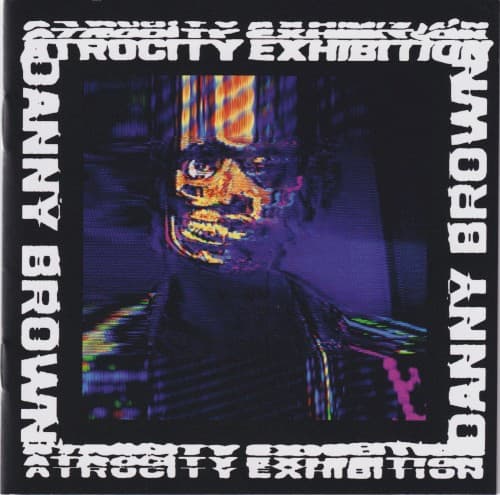
Danny Brown Atrocity Exhibition — When the Party Finally Ended
Play the first three minutes and you'll understand why half the rap internet still argues about this album. "Downward Spiral" doesn't ease you in. It throws you down concrete stairs while someone plays a theremin through blown speakers. The production sounds like Paul White recorded a panic attack inside an abandoned factory.
Danny's voice cracks over detuned bass and your first instinct is to skip. Your second instinct is to turn it up. This is not a party album. It's the album you make after a decade of partying almost kills you.
Danny Brown spent the years before this becoming the internet's favorite chaos agent, the Detroit weirdo who could rap about molly and Adderall over beats that sounded like video game glitches. Festival crowds loved him. Blog writers called him a genius. And the drugs kept working until they stopped working.
"Atrocity Exhibition" is what happened when he looked up from the tour van and realized he'd been running from himself for ten years.
The album landed in 2016 on Warp Records, which had never signed a rapper this explicitly about his own self-destruction. Electronic labels don't usually touch raw addiction narratives, but Warp understood what Danny was building. This wasn't experimental for the sake of being weird. Every off-kilter snare hit and distorted sample served the larger concept: a man documenting his own psychological collapse in real time while refusing to sanitize it for commercial consumption.
What does it sound like when someone finally stops running?
The Sound of Everything Breaking
The production across "Atrocity Exhibition" feels like it was assembled by producers who studied Madlib and Aphex Twin with equal obsession. Paul White, Evian Christ, and The Alchemist each contributed tracks that prioritize texture over groove, dissonance over melody. Where most rap albums from 2016 chased the clean punch of Metro Boomin or the lush soul of No I.D., Danny and his collaborators went the opposite direction. They made beats that sound damaged.
Broken drum machines. Samples pitched until they become unrecognizable. Basslines that walk drunk. Evian Christ's work turns a carousel organ into a horror movie soundtrack.
Paul White's contributions feel like he recorded them during a migraine.
The Alchemist's track is the only one that resembles traditional boom bap, and even that one lands like a brick through a window. Danny's voice remains one of rap's most divisive instruments. The nasal yelp that made "Grown Up" a cult hit becomes a weapon here. He switches between registers without warning, shifting from rapid-fire technical verses to sung melodies that sound like they're collapsing mid-phrase.
His delivery matches the production's refusal to comfort. Lyrically, the album catalogs addiction, paranoia, sexual dysfunction, and suicidal ideation with forensic detail. Danny doesn't romanticize drug use the way he did on "XXX." He documents the aftermath.
The hangovers. The panic attacks. The moments when the high stops working and you're just poisoning yourself to feel less. He also refuses to offer redemption or recovery narratives.
The album ends ambiguously, without resolution or catharsis. The main weakness is accessibility. Casual listeners expecting bangers will find nothing here. There are no hooks designed for playlists, no beat switches engineered for viral moments.
This is headphone music for people who want to sit with discomfort. That makes it brilliant but limits its reach. The abrasive textures and rejection of conventional melody place it closer to industrial hip-hop than anything on commercial radio. Can music this uncompromising find an audience beyond the dedicated few?
The Descent and What Comes After
The album opens with three tracks that establish the emotional framework: descent, panic, recklessness. The first stretch refuses to let you settle. By the time the posse-cut arrives, it feels like a brief moment of oxygen before the album pulls you back under.
The middle section represents the album's darkest stretch. These five tracks feel like freefall. The production gets more abstract. Danny's vocals get more desperate.
If you're going to bail on the album, you'll do it here. The back half shifts toward something resembling acceptance without ever becoming hopeful. The tempo slows without softening the emotional weight. One track lands like someone finally catching their breath after running for miles.
The closing run doesn't resolve the album's central tension. Danny doesn't get clean. He doesn't find peace. He just keeps going.
The sequencing ensures you can't skip to the easier moments. The album demands you experience the whole journey or nothing. That commitment to structure over singles is why it still feels radical eight years later.
The Album That Proved Rap Could Go Anywhere
In Danny Brown's discography, "Atrocity Exhibition" stands as his artistic peak and commercial ceiling. "XXX" had the underground hits. "uknowhatimsayin" had Kendrick Lamar and Run the Jewels. But this album represents the moment when he stopped trying to be anything other than exactly what he was: a damaged, brilliant, uncompromising artist making music for people who don't need their rap to sound like rap.
Fans of abstract hip-hop and experimental production should start here. This is the album that proved Warp's gamble on signing a Detroit rapper. Listeners who need melodic hooks or traditional song structure will struggle. This is not background music.
It demands attention and rewards patience. Eight years later, the album has aged into something resembling a modern classic within underground circles. You hear its influence in how younger artists like JPEGMAFIA and billy woods approach production, in how they refuse to sand down the rough edges for broader appeal.
For essential tracks, begin with the posse-cut for the clearest entry point, then move to the carnival-organ track if you want to understand the album's sonic ambition. The slower back-half entry offers a glimpse of the album's more meditative side.
If you connect with "Atrocity Exhibition," explore Earl Sweatshirt's "Some Rap Songs" and Armand Hammer's "Shrines" for similar approaches to abstract, emotionally raw hip-hop. Clipping's "Splendor & Misery" shares the album's commitment to challenging sonics. Shabazz Palaces' "Black Up" predates this but exists in the same experimental space.
The album's lasting impact lies in what it gave permission for. You can make a rap album that sounds like this and still be taken seriously. You can document your worst moments without offering redemption. You can prioritize art over commerce and carve out a lane.
Danny Brown spent the next decade proving you can survive making music this uncompromising.
Track Listing
Downward Spiral
▲Paul White's production sounds like he sampled a nightmare and ran it through a broken synthesizer. The beat lurches and stutters, never settling into a comfortable pocket. Danny enters with his voice pitched somewhere between panic and exhaustion, documenting the moment when recreational drug use crosses into dependency. The hook lands like someone trying to convince themselves everything's fine while their hands shake. No other opening track from 2016 announced its intentions this aggressively. Most rappers ease listeners in. Danny kicks the door down and drags you into the deep end. The song works as both warning and invitation, establishing that the next forty-five minutes will not provide comfort. Production-wise, the off-kilter percussion and detuned melodies create a sense of vertigo that mirrors the lyrical content. This is the album announcing it will not sound like anything else you heard that year.
Tell Me What I Don't Know
▲Evian Christ's production here strips away almost everything except distorted bass and minimal percussion. The beat feels claustrophobic, like the walls are closing in. Danny's flow matches the paranoia in the production, shifting between rapid-fire technical verses and moments where his voice cracks under the weight of what he's describing. The second verse catalogs the physical toll of prolonged substance abuse with clinical detail. No euphemisms, no metaphors, just documentation. The song has no traditional hook, just Danny repeating variations of the title phrase like someone trying to remember something important. What makes this track essential is how it refuses to offer any perspective outside Danny's deteriorating mental state. We're locked inside his head with no exit. The production's refusal to provide melodic relief mirrors that claustrophobia perfectly.
Rolling Stone
●Petey Paranoid builds a beat that sounds like industrial machinery breaking down mid-operation. Harsh metallic percussion and distorted synths create a soundscape that's physically uncomfortable to sit with. Danny uses the track to document reckless behavior and its consequences, his voice oscillating between manic energy and exhaustion. The hook interpolates the classic rock reference but twists it into something darker. This isn't celebration. It's documentation of someone moving too fast to stop. The production choices—the grating high-end frequencies, the bass that never sits where you expect—make this one of the album's most abrasive moments. Some listeners will skip it. Others will recognize it as necessary to the album's larger arc. The song works as a bridge between the opening panic and the deeper descent that follows.
Really Doe
▲The Alchemist delivers the album's most traditional hip-hop beat, a grimy soul loop with hard-hitting drums that would fit on a Mobb Deep album. Danny anchors the posse cut with Kendrick Lamar, Ab-Soul and Earl Sweatshirt, and each rapper rises to the challenge. Kendrick's verse alone justifies the track's placement—technical precision with quotable bars that still get referenced in rap forums. Danny holds his own, matching Kendrick's intensity while maintaining his distinct voice. Earl's verse works as a masterclass in economy, saying more with fewer words. Ab-Soul delivers the most aggressive performance of the four. What's remarkable is how the track functions within the album's larger structure. It arrives as a moment of relative accessibility after three difficult opening tracks, giving listeners something to hold onto before the album gets darker. The beat switch at the end signals that the comfort won't last. This is the album taking a breath before diving deeper.
Lost
●Paul White returns with production that feels like drowning in slow motion. The beat moves at a glacial pace, with distorted bass and minimal percussion creating massive empty space. Danny's delivery matches the production's lethargy, his voice sounding physically exhausted. The lyrics document dissociation and loss of identity, the moments when prolonged substance abuse erases the person you used to be. The song has no hook, no clear structure, just Danny wandering through verses that blur together. Some will hear this as the album's weakest moment. Others will recognize it as essential to documenting what prolonged addiction actually feels like—the stretches of time that disappear, the days that blend together, the moments when you can't remember who you were before this started. The production's refusal to provide any energy or momentum mirrors that emptiness perfectly. This is not a song you'll return to for enjoyment. It's a song that exists to serve the album's larger narrative arc.
Ain't It Funny
▲Evian Christ builds one of the most unsettling instrumentals in modern hip-hop. A carnival organ sample gets pitched and distorted until it sounds like a horror movie soundtrack, while the drums hit with trap-influenced patterns that create constant rhythmic tension. Danny's vocals match the production's manic energy, his flow shifting between technical precision and moments where his voice nearly breaks. The song ostensibly celebrates getting high, but the production and delivery drain any joy from the activity. This is not party music. It's documentation of someone using humor and drugs to mask psychological collapse. The hook—"ain't it funny how it happens"—lands like gallows humor. The music video amplified the song's impact, with Danny performing choreographed dance routines that turned the track's darkness into something visually arresting. But even without the video, the song works as the album's centerpiece, the moment when Danny's artistic vision and his collaborators' production ambitions align perfectly. This is what experimental hip-hop can sound like when it refuses to compromise.
Goldust
●Straightforward dismissal of transparent industry types. Danny spends ninety seconds cataloging fake personas and opportunistic behavior. Nothing revelatory.
White Lines
▲Paul White creates a beat that sounds like it's glitching out in real time, with distorted samples and percussion that never settles into a consistent pattern. Danny uses the track to address both cocaine use and the racial dynamics of the music industry. The song moves between documentation of drug use and sharp observations about how white audiences consume Black art. The production's instability mirrors the song's thematic tension. What elevates this beyond standard industry critique is how Danny refuses to separate his personal chaos from the larger cultural context. He's not positioning himself above the problems he's documenting. He's implicating himself in the same systems he's critiquing. The track works as one of the album's more conceptually dense moments, requiring multiple listens to catch everything Danny's addressing. The abrasive production ensures casual listeners will bounce off it, but that's by design.
Pneumonia
▲The album's darkest moment. Producer Evian Christ strips everything down to distorted bass and minimal percussion while Danny documents rock bottom with forensic detail. His voice sounds physically ill, matching the song's title. The lyrics catalog suicidal ideation, physical deterioration, and complete loss of control with no attempt to soften the impact. There is no hook. There is no relief. Just Danny documenting the lowest point of his addiction with brutal honesty. I first heard this song alone at 2 AM during a particularly bad stretch of my own life, and I had to turn it off halfway through. Came back to it weeks later and understood why it needed to sound exactly this uncomfortable. The song works because it refuses to provide catharsis or perspective. We're trapped in Danny's headspace with no exit strategy. Some will call this the album's most important track. Others will never make it through a full listen. Both responses are valid.
Dance in the Water
▲Paul White shifts the sonic palette toward something resembling ambient electronic music. The tempo slows dramatically, and the production opens up space for the first time in several tracks. Danny's delivery becomes more melodic, almost sung in places, as he processes the wreckage of the album's first two-thirds. The song doesn't offer redemption or recovery, but it provides breathing room. The lyrics remain heavy—Danny's still documenting psychological damage—but the production's relative gentleness creates contrast with what came before. This track functions as the album's turning point, the moment when the freefall slows enough to assess the damage. The underwater acoustic quality of the production matches the title perfectly. Everything sounds muffled and distant, like you're hearing it from beneath the surface. What makes it work is how it resists the urge to pivot toward hope or resolution. Danny's just catching his breath, not healing.
From the Ground
●Petey Paranoid continues the slower, more meditative pace established by the previous track. The production maintains the abstract electronic approach while incorporating more melodic elements. Danny's vocals remain subdued, processing rather than performing. The song works as a continuation of "Dance in the Water," extending the album's brief moment of reduced intensity. Lyrically, Danny addresses the possibility of moving forward without pretending he's fixed anything. The song lacks the immediate impact of the album's more aggressive moments, but it serves the larger sequencing purpose. Coming after "Pneumonia" and before the closing stretch, these calmer tracks prevent the album from becoming relentlessly punishing. The production's emphasis on texture over rhythm gives the track an almost ambient quality. Not essential on its own, but necessary for the album's emotional arc.
When It Rain
●Another brief respite. Clean instrumental work. Danny's at his most introspective without tipping into sentimentality. Solid but not essential.
Today
▲SKYWLKR produces a beat that reintroduces energy without returning to the manic intensity of the album's first half. The production has more rhythmic momentum than the previous three tracks, with percussion that actually hits on the expected beats. Danny's flow regains some technical precision, and his voice sounds stronger than it did during the album's darkest stretch. The song addresses the present moment without offering false optimism. Danny's still processing damage, still dealing with consequences, but he's functional again. The lyrics catalog daily struggles with the same unflinching honesty that defined earlier tracks, but the production's relative accessibility makes this one of the back half's most listenable moments. What keeps the track from feeling out of place is how it avoids the trap of sudden recovery or redemption. Danny hasn't fixed anything. He's just making it through another day. That realistic portrayal of ongoing struggle gives the song weight without requiring the sonic extremity of earlier tracks.
Get Hi
▲The album returns to its abrasive roots for the penultimate track. Darq E Freaker builds a beat that sounds like it's falling apart in real time, with distorted synths and erratic percussion creating a sense of renewed chaos. Danny's vocals match the production's instability, his voice shifting between different registers as he returns to documenting drug use. After several tracks of relative calm, the song announces that Danny hasn't resolved anything. He's still trapped in the same cycles, still using substances to cope, still dealing with the same psychological damage. The production's aggressive attack ensures listeners can't mistake this for a recovery narrative. The song works as a deliberate rejection of easy resolutions. Most addiction narratives end with recovery or death. Danny refuses both, instead documenting the messier reality of ongoing struggle. The sonic assault makes this one of the album's most difficult listens, but that difficulty serves the larger conceptual purpose.
Hell for It
▲Paul White closes the album with production that brings back some of the sonic extremity of the opening tracks while maintaining the exhausted tone of the back half. The beat stumbles and lurches, never settling into comfortable patterns. Danny's vocals sound drained but determined, processing everything that came before without offering neat conclusions. The song addresses mortality, consequences, and the impossibility of returning to the person he was before addiction. The lyrics maintain the forensic honesty that defined the entire album, refusing to soften the reality for a satisfying ending. I remember finishing this album for the first time, sitting in my car outside my apartment in 2017, and realizing Danny wasn't going to give us catharsis. The song just ends. No resolution. No recovery montage. Just Danny documenting where he is and the knowledge that tomorrow he'll wake up and do it again. That refusal to provide narrative closure makes the album's ending either frustrating or brilliant depending on what you wanted from it. What's undeniable is how the song functions as a conclusion. It doesn't resolve the tension, but it acknowledges that resolution might not be possible. Sometimes you just keep going because the alternative is worse.