The scorecard
6.5/10 · Good
- Writing25%
- 6.0
- Production25%
- 7.5
- Delivery15%
- 7.0
- Cohesion15%
- 5.5
- Originality10%
- 5.5
- Replay value10%
- 6.5
Fat Joe is at his sharpest when he stays on street-boss bluster and loyalty themes on Definition of a Don, but the album leans on stock threats and the singles trade specifics for hook-friendly generalities.
The sample-based cuts from Buckwild and Alchemist carry real weight, and Ron G and Irv Gotti built radio records that still work, though the beats range widely in quality across fourteen-plus producers.
His gravel-throated, front-of-the-beat bark gives King of N.Y. and Fight Club their menace, and he is a better hook partner than most of his peers, even if Remy Ma often sounds hungrier than the host.
Eighteen entries, four skits and intros, and a remix tacked on the end make the album sag in its back half, where the guest-heavy run from Get the Hell on With That onward loses focus.
The street-to-pop crossover template of We Thuggin' and What's Luv? followed what Ja Rule and Murder Inc. were already doing, and Fat Joe adapts to it more than he shapes it.
The two singles and a handful of Bronx-grit records stay in rotation, but the filler and interludes make the full album a harder sit than its sales suggest.
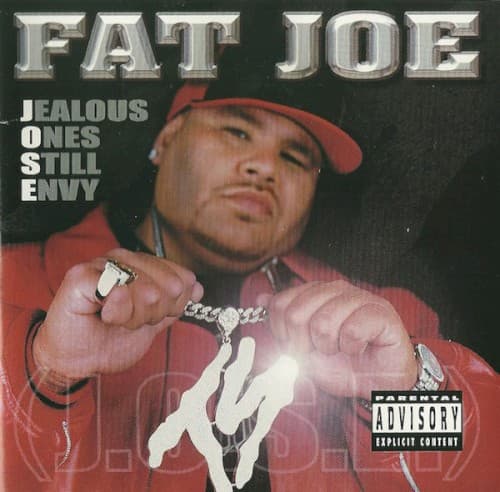
Fat Joe Jealous Ones Still Envy (J.O.S.E.): The Bronx Boss Takes the Pop Offer
Jealous Ones Still Envy is two albums fighting over one tracklist, and the winner was decided by the cash register, not by the rapping. On one side sits a hard-nosed New York record built from soul samples and street bluster, the kind of thing Fat Joe had been making since the mid-1990s. On the other sits a pair of radio singles, "We Thuggin'" and "What's Luv?", that wrap his gravel voice in smooth R&B hooks and carried him into territory he had never reached. Those two songs are why this is his best-selling album. They are not why it is his best album.
That is the thesis, and it needs defending in both directions. The singles are not sellouts. "What's Luv?" peaked at number two on the Billboard Hot 100, and it earned that position with a hook that is genuinely hard to shake and a chemistry between Fat Joe and Ashanti that most pop-rap pairings never find.
The trouble is what surrounds them. A record that goes platinum on the strength of two crossover moments has to justify the other sixteen entries, and this one only partly does. The best of them are sturdy, committed New York rap. The rest are guest-list filler, interludes that go nowhere, and a remix appended like an afterthought.
The title promises a sequel to Fat Joe's 1995 album Jealous One's Envy, and the packaging leans on that lineage. But the 2001 version is a different animal. The mid-1990s record belonged to a regional rapper from the Bronx working inside the Diggin' in the Crates orbit. This one belongs to a man with a Terror Squad imprint, an Atlantic deal and a Rolodex of every hitmaker then active in the city. It sounds like a rapper at the exact moment he decided he would rather win than be respected, and discovered he could do both for about forty minutes.
The stakes are simple. If you want to know whether this album deserves its reputation as Fat Joe's commercial peak, the answer is yes, with caveats. If you want to know whether it deserves a spot next to the best New York records of its era, the answer is closer to no. It is a good album with a great single, a strong one, and too many tracks that exist because a guest said yes.
Buckwild Weight, Murder Inc. Sheen, and a Rolodex Problem
The production sheet reads like a conference attendee list: Buckwild, Irv Gotti, Ron G, Alchemist, Bink!, Cool & Dre, Rockwilder, Sean C, Younglord and more. That breadth is the album's strength and its biggest structural weakness. When the beats lean on warm soul samples, as on "King of N.Y." and "Still Real", Fat Joe sounds like himself: a heavy, deliberate rapper who sits just behind the drum and lets his voice do the intimidating. When the beat is built for the radio, he adapts, and he adapts well, but the through-line disappears.
His delivery is the most consistent thing here. He is not a technical stylist, and he has never pretended to be. His appeal is mass and conviction, a voice that sounds like it has been up all night and does not need to raise itself to be believed. On "Definition of a Don", with Alchemist's beat giving him room, he stays level and lets the arrogance accumulate. On "Fight Club", he cedes the bruising energy to M.O.P. and Petey Pablo and wisely stays out of their way, which is an underrated skill for a host.
His hooks, from the singles to "My Lifestyle", are usually the best thing about the song they sit on.
The writing is where the album shows its limits. Fat Joe's lyrics work in broad strokes: loyalty, street authority, loud confidence, a few warnings to people who underestimate him. There is little imagery that sticks and almost no narrative. "Murder Rap" and "The Wild Life" both repeat tough-guy gestures that the genre had already worn smooth by 2001, and neither adds a detail you would remember a week later.
The best that can be said is that he understands what the beat is asking for. The worst is that the beat is asking for very little.
Guests are a mixed asset. Remy Ma pops up across several tracks and is consistently the sharpest voice on the ones she touches, which is both a compliment to her and a small indictment of the host. R. Kelly turns "We Thuggin'" into a crossover event with a hook that almost redeems the lyrics. Ja Rule and Ashanti carry the other half of the album's signature moment.
Busta Rhymes, Ludacris, Xzibit and Prospect each get a slot, but the cumulative effect is of a rapper constantly handing the microphone away. On the strongest tracks, the guest elevates the song. On the weakest, the guest is the reason the song exists.
The mix across such a spread of producers is surprisingly consistent in weight, which keeps the album from sounding like a compilation. What it cannot hide is the difference in intent. Some of these records were made to be played in a car with the windows down in New York. Others were made to be programmed between Ashanti and Ja Rule on a pop station. Both groups are executed professionally. They simply do not share a spine.
Four Skits and a Remix: How the Sequencing Costs the Album
The first half of the album is its best stretch. The record opens with a brief spoken opener and then moves quickly through a run of hard New York records, each cut establishing a different shade of his persona before the mood tightens on "Definition of a Don". The sequencing here is smart: it buys credibility early, so the singles that follow feel like a reward rather than a pivot.
The problems begin in the middle. The two singles are separated by tracks that function more as bridges than as destinations, and the album loses momentum while it waits for them to arrive. Then comes a stretch built around short spoken bits, including a lead-in and an interlude that adds little beyond a few seconds of attitude. Individually, none of these is a crime. Collectively, they chop the record into fragments right when it should be building toward a second peak.
The back half is where the length stops being earned. Eighteen entries is a lot for a record whose best ideas cluster in the first six. By the time the album reaches the stretch of guest-driven tracks near its end, the rapping and the beats are competent but interchangeable, and the energy that opened the record has drained out. Ending with a remix of the lead single, an extended version of a song you have already heard, is the clearest sign that the sequencing ran out of ideas.
The album does recover some ground with "Still Real", a late and welcome return to the sample-driven sound that made the first half work. It is a better closer, in spirit, than the remix that actually follows it. If you rebuilt this album as a tighter fourteen-song record, with the singles in the middle and the interludes trimmed, it would hold together much better. As released, it has the shape of a platinum record of its time: front-loaded, hit-dependent, and a few songs too long.
A Platinum Peak That Isn't a Career Peak
Within Fat Joe's catalog, this is the commercial high point and a very good argument for what he does best. It was certified platinum in the United States in 2002 and remains his best-selling album, which is a rare outcome for a rapper whose appeal was never about technical dazzle. But commercial and artistic peaks do not always coincide. The catalog context here is thin, with no other Fat Joe albums rated on the site yet, so this score stands on its own against the genre, and on that measure it lands as good rather than great. It has real highlights and real filler in roughly equal measure.
The album is for listeners who want to understand how a veteran New York rapper navigated the early-2000s pop-rap moment, and who value strong hooks and heavy delivery over complicated lyricism. If you came for "What's Luv?", you will not be disappointed, and you will probably enjoy the harder material surrounding it more than you expected. It is not for anyone who needs a cohesive album statement, or who finds guest-heavy records tiring. People who prize tight lyricism above everything will get more from other East Coast rappers of the era.
As for aging, the singles have held up better than the album around them. "What's Luv?" is still a recognizable early-2000s record, and "We Thuggin'" sounds like a precise snapshot of the moment R&B hooks became rap's default engine. The deeper cuts hold up less well, because the genre has absorbed their tough-guy gestures many times over.
Start with "What's Luv?", then "Definition of a Don" and "King of N.Y.", which together cover the pop side and the street side of the record. For further listening, go back to the 1995 album Jealous One's Envy, the record this one is named after, to hear the same voice in a starker, less polished setting. After that, try a Terror Squad-era Remy Ma project to hear what the sharpest guest on this album does with the whole stage. This is a good album that became a big one, and the gap between those two facts is the whole story.
Track by track
Track Listing
Intro
SolidA short spoken opener that sets the tone and gets out of the way. Filler, but brief enough not to matter.
J.O.S.E.
StandoutThe title track works as a brisk statement of purpose, with Fat Joe's gravel delivery doing most of the work over a sparse, hard beat. It is more about tone than writing, but it establishes the persona quickly and sets up the harder material that follows.
King of N.Y.
StandoutBuju Banton's guest turn gives this a different texture from the rest of the opening run, and the soul-sample base lets Fat Joe stretch out and sound unhurried. The beat is warm but heavy, and his rhyming is simple and effective: declarative lines delivered with the confidence of someone who does not need to prove the claim. It is one of the album's best examples of a street record that still has a groove, and the guest feature adds contrast rather than clutter. Its main weakness is that the writing never gets more specific than the title, but the performance covers for that.
Opposites Attract (What They Like)
SolidA glossy, Irv Gotti-co-produced record with Remy Ma on the hook side, built for the club and the radio at once. Fat Joe sounds comfortable but a little less sharp than his guest, and the writing is all attitude. A solid listen, if not a memorable one.
Definition of a Don
StandoutAlchemist gives Fat Joe a stripped-down, shadowy backdrop, and the result is the album's most convincing pure rap performance. He keeps his delivery level and lets the swagger build from line to line instead of announcing it, and Remy Ma provides a sharp counterweight. The song lacks narrative and leans on familiar boss-talk, but the control in the performance is the point. This is what the album sounds like when it commits to being a New York rap record instead of a hit delivery system. If the entire record had stayed at this level of focus, it would sit much higher.
My Lifestyle
StandoutBuckwild's production gives this a rolling, confident feel, and Fat Joe's hook is among the stickiest outside the singles. The lyrics are self-mythologizing and generic, but the delivery sells it. A strong mid-tier track.
We Thuggin'
StandoutThe lead single reached number 15 on the Hot 100, and its logic is obvious from the first bar: an R. Kelly hook gives a tough-guy record a pop spine, and Ron G's beat keeps just enough menace underneath it. Fat Joe's verses are typical, built from stock toughness and brotherhood talk, and they are not why the song works. What works is the way his gruff voice contrasts with Kelly's smoothness, a blueprint that later rap singles copied relentlessly. It is a better record than it sounds on paper, and it did a lot to set up the bigger single that followed, but the writing is thin and it plays as a vehicle for its hook. Good, not great.
Fight Club
StandoutA guest-heavy posse cut that is built on M.O.P. and Petey Pablo supplying the aggression while Fat Joe holds the middle. Reef's production keeps the pace aggressive, and the sample work gives the track a pugnacious bounce. At more than five minutes it is the album's longest song, and it is a little baggy as a result, but the energy does not drop. It is a rare moment where the host's willingness to step back improves the record, and it sits among the best things on the second half.
What's Luv?
StandoutThe album's centerpiece and biggest hit, which peaked at number two on the Billboard Hot 100. Irv Gotti and Chink Santana built a beat with a bright, winding melody, and Ashanti's hook gives it the emotional pull that everything else on the album lacks. Ja Rule is the weakest link in the triangle, but his presence tied the record to the Murder Inc. sound dominating radio at the time. Fat Joe's verses are surprisingly vulnerable, and he rides the beat with a looseness he rarely shows elsewhere. Its power is mostly in the hook and the arrangement, not the writing, and it works best as a pop single that happens to feature a rapper. It earns its status, and it also exposes how much of the rest of the album is built on less appealing materials.
He's Not Real (intro)
SolidA brief spoken lead-in that adds a few seconds of attitude and little else. Skippable.
He's Not Real
SolidYounglord's beat gives Prospect and Remy Ma a platform alongside Fat Joe, and the cut is a decent showing for the Terror Squad extended family. The hook is forgettable and the writing is predictable, but the energy is solid and nobody embarrasses themselves.
The Fuck Up (interlude)
WeakUnder a minute of skit material that interrupts the momentum without adding anything to the record. Filler.
Get the Hell on With That
SolidBink!'s beat has a nice bounce, and Ludacris turns in an animated guest verse that tends to outshine the host. Armageddon adds a gritty contrast. It is a fun, loose record that does not go deep, and it marks the point where the guest list starts to take over the album.
It's O.K.
SolidThe Cypress Hill excerpts give this a West Coast tinge that is unusual for the album, and the beat has a stoned, rolling groove. It is a good change of pace, but Fat Joe's writing is routine and the hook is repeated more than it is developed.
Murder Rap
WeakRockwilder's production is sturdy and Armageddon adds some grit, but the song leans on tough-guy gestures that the genre had exhausted by 2001. Competent filler that would not be missed.
The Wild Life
SolidXzibit and Prospect join Fat Joe over DJ Nasty and LVM's beat, which interpolates an Isaac Hayes piece. The production is the draw here, but the rapping is straightforward and does not leave much behind. A middling late-album cut.
Still Real
StandoutBuckwild returns with a sample-driven beat built on Millie Jackson, and the result is the album's best late-run moment. Fat Joe is reflective without being soft, and the track feels like a true closing statement, which makes the remix that follows feel even less necessary.
We Thuggin' (remix)
SolidBusta Rhymes, N.O.R.E. and Remy Ma join R. Kelly on an expanded take of the lead single, and the extra verses give it a posse-cut energy. It is a fun bonus but an anticlimactic way to end the record, and the new guests do not improve on the original's hook.
Frequently Asked Questions
Is Fat Joe's Jealous Ones Still Envy a good album?
What are the singles from Jealous Ones Still Envy?
Is Jealous Ones Still Envy Fat Joe's best-selling album?
How does J.O.S.E. relate to Jealous One's Envy?
Styles