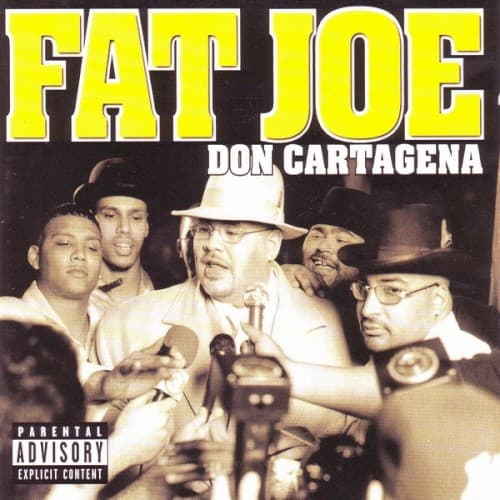
The scorecard
7.0/10 · Good
- Writing25%
- 7.0
- Production25%
- 7.5
- Delivery15%
- 7.0
- Cohesion15%
- 6.5
- Originality10%
- 6.5
- Replay value10%
- 7.0
The gangster scenarios are vivid and consistent in tone, but Joe's verses mostly restate menace and loyalty instead of adding new angles, and the weaker Terror Squad cuts lean on stock boasts.
A deep bench of East Coast producers keeps the bass heavy and the mood dark, with the DJ Premier and Buckwild tracks standing well above the more routine radio-minded ones.
Joe's gravelly, flat-footed bark suits the material, and Big Punisher, Nas and Jadakiss repeatedly out-perform him on his own songs.
At fifteen tracks and over an hour, the second half drifts into posse cuts and a solo Armageddon track that stall the momentum built early.
It sharpens the mafioso template that peers were already working in rather than inventing a new one, though the Terror Squad branding gave Joe a distinct identity.
The best five or six songs hold up well, but the long posse stretches make the full album a harder sit on repeat.
Fat Joe Don Cartagena: A Crew Record Dressed as a Solo Album
Don Cartagena works best when Fat Joe stops trying to be the loudest person in the room and lets the room talk. That is both the album's central strength and its main limit. Across fifteen tracks, Joe plays the boss of a Bronx organization, and the record is built like a film about that organization: a courtroom opening, a villain's theme song, a long list of lieutenants and hired guns, and beats that sound like they were chosen to make a basement meeting feel dangerous. The argument of this review is simple. Don Cartagena is the first Fat Joe album with a clear identity, and the identity belongs to the Terror Squad as much as to him.
That matters because the two albums before it had treated Joe as a rapper looking for a lane. Here the lane is mafioso rap, the crime-boss fantasy that Nas, Jay-Z and others were pushing through New York radio in the late 1990s, and Joe commits to it with a hoarse, unhurried voice that sounds more like an enforcer than a showman.
The casting does the heavy lifting. Big Punisher turns up on several of the strongest songs and regularly walks away with them. Nas, Jadakiss and Raekwon share a single posse cut. DJ Premier and Buckwild each get a beat. For a rapper who had not yet had a major hit, this was a very large amount of credibility to borrow in one release.
The borrowing is also the problem. Joe is rarely the most interesting rapper on a Joe record, and the album asks you to accept the Terror Squad as a franchise before it has fully earned that. The best songs make the case anyway. When the beats are dark and the guests are sharp, Don Cartagena feels like a proper East Coast crime epic, and when the filler arrives, the cast list starts to look like padding. It is a good record with a great first half, and it deserves to be heard as the moment Joe found the sound he would build a career around.
Menace as a House Style: Bass, Bark and Borrowed Credibility
The sound of Don Cartagena is a controlled argument for darkness. Almost every producer on the fact sheet, from Marley Marl and DJ Premier to Buckwild, Ski, Rashad Smith and the Ghetto Pros and Beatnuts side represented by V.I.C., was working in a New York idiom of heavy low end, spare drums and minor-key loops. The result is that a record built by more than a dozen hands still sounds like one room. That consistency is the production team's real achievement, and it is why the album hangs together tonally even when individual songs do not.
The beats also leave Joe a lot of space, and he uses it the way a bruiser uses a doorway. His voice is thick, grainy and slightly behind the beat, which gives even routine threats a physical weight. He rarely accelerates, rarely switches cadence and never tries to out-clever a guest.
That restraint is a choice, and on the better songs it works as intimidation. Where it fails is on the songs that need range. On the radio-minded tracks, such as the Charli Baltimore and Rell collaboration, his flat delivery makes the hook feel like it belongs to another record. A reader hoping for a technical rapper should look elsewhere. This is voice-first rap, and the voice is the instrument.
The writing leans heavily on gangster storylines and braggadocio. The strongest verses use sharp, concrete scenarios: a deal gone wrong, a loyalty tested, a warning to a rival. The weakest ones repeat the same status claims in slightly different words. Joe is a competent narrator but not a surprising one, and across an hour of music the lack of variation becomes the album's clearest weakness. Humor is nearly absent, vulnerability even more so, and the one stretch that tries a softer register does not suit him.
Guests are used as strategy rather than decoration. Big Punisher supplies the rhythmic agility and wit that Joe's own style lacks, and the album knows it. Nas and Raekwon add the weight of New York's established gangster-rap voices to a posse cut, while Bone Thugs-N-Harmony members bring a completely different cadence to a late-album detour. These choices make Don Cartagena feel wide, but they also expose a tension. Because the best verses so often belong to someone else, the album works more convincingly as a crew record than as a solo statement, and Joe's biggest achievement is probably curatorial. He chose the right producers, assembled the right voices and set a tone that everyone else could play inside.
Front-Loaded Menace, a Posse-Heavy Back Half
The sequencing is the clearest sign of ambition. The album opens with a short courtroom scene that sets the premise, and the first stretch moves quickly from there: tight songs, strong beats and guests who sharpen rather than interrupt the mood. Within the first third, the tempo, the tone and the stakes are all established. The pacing feels deliberate, and the run from the second track through the title song is the most consistent stretch of music on the record.
The middle is where Don Cartagena peaks. The central songs pair Joe's gravel with his strongest collaborators and strongest beats, and the album gains real momentum. It is here that the long posse cut arrives, and its length is earned, because the voices contrast so cleanly with each other. This is the stretch that justifies the record's reputation, and it is the section to play if you only have fifteen minutes.
The back half is a different story. Fifteen tracks and well over an hour is a lot for an album whose mood barely changes, and the later songs lean on long group cuts and a solo song for one of Joe's lieutenants. Individually they are not bad, but they arrive when the listener's attention has already been fully spent, and they slow a record that had been moving with real purpose. A shorter version, perhaps twelve songs, would have kept the menace intact and cut the sag. The closing posse track tries to send the crew off with a flourish, but it runs past five minutes without adding much to a point the album had already made.
Still, the record's structure deserves credit for its confidence. It plays like a short film with a clear opening, a strong second act and an ending that trades tension for pageantry. The length is only partially earned, and the album's real value lives in the first two-thirds.
The Record That Made the Terror Squad Real
Don Cartagena is the first Fat Joe album that gives a listener a reason to return, and it remains the cleanest introduction to what he and his crew were trying to build. It is not a flawless album and not an essential one in the strict sense, but it is a confident, well-cast and consistently dark record from an era when New York was fighting to define its sound against the pop-leaning rap of the moment. As Joe's catalog is not yet otherwise rated on this site, its place can only be judged against the genre itself: a strong, flawed East Coast record that lands in the good-to-great range and wins mostly on atmosphere.
It is for listeners who like their rap hard, dark and built around beats, and for anyone curious about how the late-1990s mafioso template worked in the Bronx. It is also worth hearing for Big Punisher fans, since he is one of the album's most dependable assets. People who need lyrical complexity, emotional range or concise sequencing should skip the second half or skip the album, because those are exactly the things it lacks.
It has aged unevenly. The production still sounds sturdy, and the best songs retain their menace. The radio attempts feel dated, and the sheer number of guests makes the album feel more like a roster than a statement. Even so, it stands as a clear marker for the Terror Squad and for the kind of East Coast crew record that was already becoming rare.
Start with Dat Gangsta Shit for the DJ Premier beat, John Blaze for the all-star posse cut and Bet Ya Man Can't (Triz) for the single that gave Joe his first UK chart entry. If you want more of the same era and mood, hear Nas by way of his classic work, and Big Punisher's own music for the rapper who most often steals Joe's verses. The strongest argument for the album is that its best three songs still make a case that Joe could lead a crew, even if he rarely led a verse.
Track by track
Track Listing
Courtroom Intro
SolidA one-minute scene-setter produced by Mack 10 that frames the album as a crime story. It is theater rather than music, and it does its job quickly.
The Crack Attack
StandoutJoe at his most direct, rapping over a hard, stripped-down beat from L.E.S. with no guest to share the load. The writing is a street-level rundown rather than a story, and it establishes the album's heavy, unhurried posture.
Triplets
StandoutBig Punisher and Prospect join Joe over a Dame Grease beat, and the three voices give the song a lively, rotating energy. Pun's looser, more playful flow is the highlight, and it shows why the album leans on him so often.
Find Out
SolidA Marley Marl production with Armageddon on the guest spot, it is a competent hard-edged track that never quite breaks out of the album's default mood.
Don Cartagena
StandoutThe title track and lead single, with Puff Daddy as the guest and a beat from Younglord. This is the song that fixes the album's persona: Joe as a kingpin figure, backed by the biggest name in New York pop-rap at the time. It is slick and radio-ready without softening the pose, and its chart performance on the R&B/Hip-Hop side gave the Terror Squad its first real public footing. It is more polished than the grittier material around it, which is both its appeal and its small limitation, since it sounds a notch more commercial than the album's best work. Still, it is a statement of intent, and it makes the case for Joe as a headliner.
My World
StandoutBaby Paul builds the beat around a Luther Vandross sample, with Big Punisher alongside Joe. The smoother backdrop gives the album a moment of reflection, and the track works because both rappers sound at ease rather than defensive.
John Blaze
StandoutThe album's marquee posse cut, with Nas, Big Punisher, Jadakiss and Raekwon alongside Joe, over a Ski beat that samples the Method Man and Redman song How High. It is the clearest example of Joe's curatorial skill. Each guest brings a different cadence, and the contrast sharpens the whole song, while Joe's grainy voice anchors it. It runs nearly five minutes and the length is earned, because the verses feel like contributions rather than turns taken. The video the song received, despite not being a single, is a sign of how it was received. If the album has a centerpiece, this is it, even if Joe's own verse is probably not the best one.
Walk On By
WeakBuckwild produces a duet-style track with Charli Baltimore and Rell on the hook. It is the album's attempt at crossover, and Joe's flat delivery sits awkwardly against the melodic setup. Not a disaster, but one of the weaker fits.
Dat Gangsta Shit
StandoutDJ Premier's contribution is easily one of the album's best beats, with a bass-heavy, chopped-and-scratched drive that gives Joe a firm, forward-leaning pocket. Solo, short and concentrated, it is the purest hit of the album's sound, and it shows what Joe can do when the production gives him something to push against.
Bet Ya Man Can’t (Triz)
StandoutThe second single, produced by JAO with Big Punisher, Cuban Link and Triple Seis, and built on a Cheryl Lynn sample plus an interpolation of the song No Time. It is a long, crowded posse cut that works because the beat is bright and propulsive and the voices differ enough to keep it moving. It gave Joe his first UK singles chart entry, and it is the album's most accessible track. Its main weakness is length, as the verses accumulate without much escalation past the midpoint. Still, it is among the most replayable songs on the record.
Misery Needs Company
SolidNoreaga joins Joe on a V.I.C. beat that sits comfortably in the album's dark register. A solid, mid-tempo track with a good chemistry between two rough voices, though not a standout.
My Prerogative
WeakA solo track by Armageddon, not Joe. It is a fair spotlight for a crew member but it breaks the album's momentum and reads as filler within a Fat Joe record.
Good Times
SolidLayzie Bone and Krayzie Bone bring a fast, melodic delivery to a Rashad Smith beat, a clear change of pace from the New York-heavy rest of the album. The mix of styles is interesting, but Joe's gruff voice and the guests' rapid-fire flow never fully lock together.
Terror Squadians
WeakThe closing crew anthem, over five minutes long. It is a victory lap that feels more like a roll call than a song, and it runs longer than its ideas justify.
Frequently Asked Questions
Is Fat Joe's Don Cartagena worth listening to?
What are the best songs on Don Cartagena?
Did Don Cartagena sell well?
Styles