The scorecard
5.9/10 · Mixed
- Writing25%
- 5.5
- Production25%
- 7.0
- Delivery15%
- 5.5
- Cohesion15%
- 5.5
- Originality10%
- 5.5
- Replay value10%
- 6.0
Street boasts and tough-guy posturing dominate the tracklist, and a contemporary critic noted the lack of the lyrical complexity or narrative skill of the West Coast gangsta rappers he was compared with.
A producer roster of Diamond D, Lord Finesse, the Beatnuts and Showbiz, plus scratches from DJ Roc Raida and DJ Rob Swift, gives the record a dense, authentic early-90s New York sound, though the beats are stronger than what the rapper does on them.
Fat Joe's gruff, forceful voice is convincing and suits the hard beats, but it stays in one register, carries few memorable hooks, and offers little to rescue a weaker track, so the strengths and limits roughly cancel out.
The sound stays consistent across fourteen songs and several producers, but the similar street material, the sagging middle and the lack of a clear peak leave the sequence feeling more like a collection than an album.
It follows the hardcore New York template of its moment closely and borrows a West Coast gangsta image, yet the awkward fit of that image with Bronx beats gives it a little character as a debut in search of an angle.
The beats and a couple of singles reward return visits, while the deeper cuts are easy to skip.
Fat Joe Represent: Great Beats, a Rapper Still Finding His Own
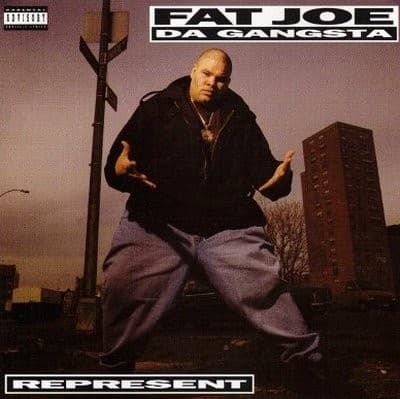
Represent is an album whose producers sound more sure of themselves than its rapper. Fat Joe arrives on his debut with a gruff, forceful voice and a street image, and he is surrounded by some of the best beat-makers New York had to offer in 1993. The beats are built to hit and the voice is built to match, but the writing on top of them is rarely as sharp as the music underneath.
The thesis is that this is a good-sounding record by a rapper who had not yet developed a reason for people to remember him. The production gives the album its character and its staying power, and the delivery gives it conviction, but the content is generic hardcore posturing, and nothing here sets Joe apart from the crowd. A review from the time said as much, describing his tough delivery as convincing while observing that he lacked the lyrical complexity or storytelling of the West Coast gangsta rappers he was being measured against.
The stakes are small but real. This is the starting point for a career that would later produce much bigger hits, and it is useful to hear what the beginning sounded like. It is also a document of a moment when New York rap was adjusting to the rise of West Coast gangsta rap, and when a Bronx rapper took on a gangsta tag without much change to his sound. That awkward fit explains both the record's appeal and its limits.
It also matters as a producer reveal. The list of credited beat-makers reads like a roll call of the era's best, and hearing them work for a new rapper makes the album more interesting than the rapper alone would have. The rest of this review argues that the beats carry the record and that the voice only partly keeps up.
Heavy Drums, Crowded Credits and a Voice That Stays Level
The sound of Represent is the sound of early-90s New York rap, built from hard drums, sampled loops, deep bass and scratches. Five producers share the credit, Diamond D, Lord Finesse, the Beatnuts, Showbiz and Chilly Dee, and DJ Roc Raida and DJ Rob Swift add scratches. With that many hands the album could have sounded scattered, but the shared taste for tough, dusty beats keeps it consistent. The mix, handled at Powerplay, leaves the drums loud and the vocals upfront, which suits the material.
Fat Joe's delivery is the other pillar of the record. His voice is deep, gruff and forceful, and he rides the beats with the kind of authority that makes the posturing at least believable. He does not vary much, and the tone he sets on the opening song is the tone he keeps for the whole record. That consistency is a strength when the beat is strong and a limit when it is not, because there is little in his performance to rescue a weaker track.
The writing is where the album is thinnest. The song titles tell most of the story: street boasts, club talk, hard-man posturing and the occasional attempt to say something more serious. The central problem is that the lines do not carry much imagery or narrative, and the album leans on tone to cover the gap. The comparison to the Ices from Los Angeles in the Philadelphia Inquirer was unflattering but fair, because a gangsta stance without storytelling reads as a pose.
There is also a question of identity. The gangsta tag in his stage name was borrowed from a style that was dominant on the other coast at the time, and the album does not do much to adapt it to New York. The beats are Bronx and Harlem; the stance is more general. That mismatch is part of what makes the record feel like a debut in search of an angle.
The most useful way to hear the album is as a collection of strong beats with a competent rapper on top. When the two align, the songs have weight and drive. When they do not, the record settles into a generic hardcore groove that is easy to enjoy and hard to remember.
Fourteen Tracks, One Mood and a Lot of Repetition
As a sequence, Represent is more a collection than a journey. The album moves through fourteen songs in the same hard-edged mood, and the changes of producer are the main source of variety. The result is a record that is easy to start anywhere, and one that offers few moments where the sequencing seems to mean something.
The early part of the album is the strongest. The lead single, Flow Joe, arrived first and reached the Hot 100, and the opening run makes the case for the record with confident, loud songs that establish the sound quickly. By the time the first few songs have played, the listener knows exactly what the album is.
The middle is where it sags. The tempos and moods start to repeat, the hooks get less memorable, and the lyrical subjects stay narrow. A listener who skips ahead would not lose much, and the sequence has no real peak to reward patience. The record does not collapse so much as flatten.
The back half has a few recoveries. The later singles, including a song that would later get a remix by DJ Premier for another album, show the record at its most focused, and the closing stretch ends with energy instead of a fade. The length is slightly too long for the amount of material, since a tighter ten or eleven songs would have kept the best parts and cut the repetition. As a whole, the record plays like a good mixtape that was released as an album, and the sequencing does not argue against that reading.
A Solid Debut for the Beats, Not the Bars
No other Fat Joe albums are rated on this site yet, so this is a judgment, not a table: Represent is a decent, well-produced debut that sits just below the good mark, because the rapping does not match the beats. It is a record worth hearing for its sound and for what it shows about where a long career began. The scores reflect that gap, with production well ahead of writing and originality.
It is for listeners who love early-90s New York production and want to hear a roster of top beat-makers on one record, for fans of Fat Joe who want to hear where he started, and for anyone studying how East Coast rappers responded to the gangsta wave. It is less for listeners who care most about lyricism or storytelling, since those are the album's weakest areas. Critics at the time were mixed in the same way, crediting the toughness and noting the lack of depth.
On aging, the beats have held up better than the rhymes. The production sounds right for its era and still has weight, while the writing sounds more dated and generic. The album has more historical interest than replay value for a casual listener, though a few songs are worth keeping on a playlist.
Start with Flow Joe, the lead single and the cleanest statement of what the record does well, then Watch the Sound for the second single, and The Shit Is Real for the song that would later get a remix by DJ Premier on his second album. After that, hear one of the other debut albums from the period by a rapper with a stronger lyrical identity, to hear the gap that this record still had to close.
The most useful thing about Represent is that the beats are good enough to make you want to hear a better rapper on them.
Track by track
Track Listing
A Word to da Wise
StandoutThe opening track sets the tone for the whole album: a hard beat, a gruff voice and a confident stance. It establishes the sound quickly and gives the listener a clear idea of what to expect. A solid, if familiar, start.
Livin’ Fat
SolidAn early boast song that leans on swagger more than detail. Joe's delivery is forceful and the beat gives it weight, but the material is the standard hardcore posturing that fills much of the record. Decent and loud rather than distinctive.
My Man Ski
SolidA short, street-flavored cut that gives the early part of the album a bit of personality. It is not a major song, but it breaks up the run of similar material.
Bad Bad Man
SolidA tough-guy track in the hardcore tradition that fits the album's persona. The beat is heavy and the delivery is steady, and it works as a solid middle of the early stretch. It is competent but does not stand out from the songs around it.
Watch the Sound
StandoutThe second single, released in 1994, and one of the album's more focused songs. The production gives the track a clear, hard-hitting identity, and Joe's delivery fits the beat closely. It is a good example of what the record does best, with the rapper and the beat aligned instead of just coexisting. The hook is simple and effective, the energy is steady, and the track makes a good case for the record in a compact form. It does not break new ground, but it is one of the few songs here that sounds like a complete idea.
Flow Joe
StandoutThe lead single, which reached the Billboard Hot 100 at number 82 in late 1993, and the track that most clearly shows the sound of the album. It is a hard, direct song built around a confident hook and a beat that leaves plenty of room for the voice. Joe's delivery is forceful and clear, and the track is the best argument that he could carry a record on presence alone. The writing is plain and the idea is simple, but the execution is tight and the song does exactly what a lead single should. It is the best place to start for a new listener, and it holds up as one of the more replayable cuts on the album.
Da Fat Gangsta
SolidA self-defining track that sets out the persona in the artist's own terms, and it works as a statement of identity even if the material is generic. The beat is solid and the delivery is confident. It shows the album's central tension between a borrowed gangsta image and a New York sound.
Shorty Gotta Fat Ass
WeakA lighter, club-oriented cut that gives the middle of the record a change of subject. It is built for attitude and bounce more than depth, and it is easy to enjoy and quick to forget. Filler by the album's standards.
The Shit Is Real
StandoutThe third single, later remixed by DJ Premier on a version that appeared on his second album. The original is a harder, more serious track that reaches for something beyond the standard boast, and the tone is heavier than most of the record. Joe's delivery is at its most direct here, and the track shows the best case for his writing. It is one of the album's stronger moments, with a clearer sense of purpose than the songs around it, and a good sign of where his later work was heading.
You Must Be Out of Your Fuckin’ Mind
SolidA confrontational track in the hardcore mold, built on attitude and volume. The beat is heavy and the delivery is aggressive, though the idea is thin and the title is the most memorable part. Loud without much to say.
I Got This in a Smash
SolidA mid-late cut that continues the album's street boasting. The production gives it momentum, but the writing adds little new. A competent, forgettable track.
Another Wild Nigger From the Bronx
SolidA track that plants the rapper's hometown at the center of his identity and ties the gangsta stance to the Bronx. The title announces the persona clearly, and the song serves as a statement of origin. The beat and delivery are in line with the rest of the album, and the track is more about positioning than about new ideas. It is one of the more pointed songs on the record, even if it does not break the pattern.
Get on Up
StandoutA more energetic late-album cut that lifts the sequence after the long middle. The beat has some bounce and the delivery is livelier. A welcome change of pace, though not a major song.
I’m a Hit That
SolidThe closer returns to the album's standard attitude and ends the record without a strong finish. It is competent and loud, but it adds little to what the earlier songs have already said. A serviceable ending to a record that does not build toward one.
Frequently Asked Questions
Is Fat Joe's Represent a good album?
What are the best songs on Represent?
Who produced Fat Joe's Represent?
Styles