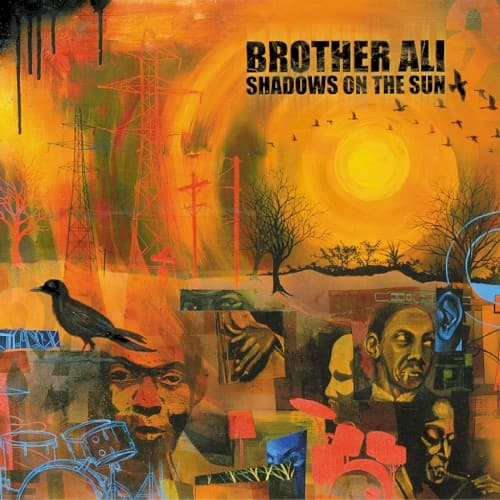
Brother Ali Shadows on the Sun — The Albino Muslim Who Refused to Whisper
No other rapper in 2003 was this comfortable admitting weakness while still sounding dangerous. Brother Ali built an entire career on that tension — the softness of confession wrapped around the hardness of conviction. His debut for Rhymesayers came at a strange moment for underground hip-hop. The blog era had not arrived yet.
Indie rap still meant hand-to-hand sales, touring in vans, building scenes city by city. Minneapolis was not a rap town the way New York or LA claimed ownership. But Rhymesayers was carving out something different — a Midwestern alternative to both coasts, anchored in craft over commercialism.
Ali was already an anomaly before anyone pressed play. An albino Muslim convert from Madison, Wisconsin, rapping about fatherhood and self-doubt over Ant's dusty soul loops. The industry had no template for him. He was not trying to fit one.
Where mainstream rap in 2003 chased club records and ringtone hooks, Ali recorded an album about raising a son, mourning friendships, and navigating a body the world reads as both spectacle and target. The courage was not in the subject matter alone. It was in the refusal to perform toughness as compensation.
What makes this album work seventeen years later? It never pretended to be anything other than what it was — a working-class rapper from the Midwest processing grief, pride, and survival through boom-bap and prayer. The structures Ant built gave Ali space to breathe, to stretch sentences across two bars, to let silence sit between thoughts. The sequencing pushed the heaviest material to the middle, trusting listeners to stay through the discomfort.
And Ali's voice — that hoarse, lived-in rasp — carried the weight without ever sounding like it was begging for sympathy. This is not the best album he ever made. But it is the one that announced he belonged in the conversation.
Prayer Rugs and Breakbeats — How Ant Built the Sound of Doubt
Ant produced the entire album and the decision to keep it in-house was not just practical. It was philosophical. The sound is deliberately spare — drums that crack without overwhelming, samples that float rather than dominate, basslines that anchor without demanding attention. Ant works in the tradition of DJ Premier and Pete Rock, but his palette leans softer.
There is more Donny Hathaway than James Brown here, more Bill Withers than Sly Stone. The loops breathe. The kicks thump but never punch. It is boom-bap designed for introspection rather than aggression.
Ali's voice locks into those pockets with precision. He rarely rushes. His flow is conversational but controlled, the cadence of someone who has thought through every word before recording it. The lyrical themes orbit around fatherhood, physical difference, and spiritual seeking.
He raps about raising a Black son as a white-looking father. He raps about being stared at in grocery stores. He raps about the gap between who he is and who strangers assume he must be. There is no posturing here, no attempt to manufacture struggle for credibility.
The vulnerability is structural — built into the writing, not performed on top of it.
But the album is not flawless. The back half sags. Too many tracks stretch past four minutes without earning the runtime. Some of the hooks feel like placeholders rather than payoffs.
While Ali's sincerity is the album's greatest strength, it occasionally tips into heavy-handedness. A few songs would have landed harder with one less verse, one less explanation. The sequencing also works against momentum — placing some of the strongest material in the middle means the final stretch lacks the punch needed to seal the legacy.
Still, what remains when the flaws are catalogued? Ant's production philosophy remains the album's greatest asset. He understood that Ali did not need complexity. He needed space.
The restraint allowed the writing to carry the weight. And when the writing faltered, the beats held firm.
The Weight Distribution — How the Album Carries Itself Through Eighteen Tracks
Eighteen tracks is a gamble. Most albums cannot sustain that length without filler creeping in. This one almost pulls it off. The first stretch establishes the tone — grounded, introspective, unafraid of slowness.
The early run does not chase singles. It builds atmosphere, letting Ali's voice settle into the production before asking listeners to invest emotionally. By the time the middle section arrives, the foundation is solid enough to support the heaviest material.
The middle stretch is where the album makes its case for permanence. This is not where Ali flexes technique or chases clever punchlines. This is where he unpacks the contradictions of his life — the gap between faith and doubt, the tension between pride and insecurity, the confusion of being both visible and invisible depending on who is looking.
The sequencing here is intentional. The album does not rush to resolution. It sits in discomfort, trusting that the writing will keep listeners engaged even when the subject matter turns inward.
The back half loses momentum. Too many tracks repeat ideas without adding new layers. The pacing slows without deepening. A few songs feel like extended thoughts rather than finished compositions.
The album would have been stronger at fourteen tracks. But even in the weaker stretch, nothing feels cynical or lazy. The drop in quality is not a collapse — it is fatigue. Ali kept pushing when he should have stopped recording.
The ambition is admirable even when the execution falters. What saves the listening experience is the refusal to pad runtime with skits or interludes pretending to be songs. When Ali records a track, it is a track. When Ant builds a beat, it serves the writing.
The Blueprint for a Career Built on Refusal
This is the second-best album in Ali's discography. The Undisputed Truth would refine everything introduced here — sharper writing, tighter sequencing, more confident vocal delivery. But Shadows on the Sun remains the foundation. It is the album where he established the terms.
No commercialism. No posturing. No apology for who he was or what he believed. Rhymesayers built an entire label ethos around that refusal, and Ali was the clearest embodiment of it.
Who should listen to this album? Fans of Atmosphere, Sage Francis, and early Slug will recognize the aesthetic. Listeners who value writing over production spectacle will find plenty to return to. But this is not an entry point for casual fans.
The pacing is too slow, the subject matter too inward-facing. Start with The Undisputed Truth if you want the accessible version. Come here if you want to hear the blueprint.
How has it aged? Better than most underground rap from the same era. The production has not dated badly because Ant never chased trends. The writing holds up because Ali was never trying to capture a moment — he was documenting a life.
The album does not sound like 2003. It sounds like Minneapolis in the early 2000s, which is a different kind of time capsule. Regional scenes matter more now than they did then, and this album is a document of a city building its own language.
Standout tracks to start with: Room With a View, Forest Whitiker, Dorian. Similar albums: Atmosphere's God Loves Ugly, Slug's introspective runs, early Eyedea projects. Long-term influence: this album proved that Midwestern rap could build a national audience without compromising regional identity. It laid groundwork for what Rhymesayers would become — a home for artists who refused to play the industry game.
Ali never became a star. He became something more durable.
Track Listing
Room With a View
▲Ali opens the album sitting still. The production is minimal — a looped piano, a slow kick, no rush. He raps about watching the world from a distance, physically present but emotionally removed. The hook is simple repetition rather than melody, which sets the tone for an album that values clarity over catchiness. This is not a banger. It is not trying to be. It is an invitation to sit down and listen without distraction. The first verse establishes Ali's perspective as an outsider even within communities that claim to welcome him. The second verse shifts to fatherhood, describing the fear of raising a child in a body that draws stares. The writing is direct without being preachy. Ant's production gives every line space to breathe, refusing to crowd the vocal with unnecessary layers. By the end of three minutes, the album's emotional stakes are clear. This is a project about navigating a world that refuses to see you accurately. The song does not resolve that tension. It just names it and moves forward.
Champion
▲The tempo picks up slightly but the mood stays grounded. Ali raps about the grind of being an underground artist — van tours, small crowds, the gap between respect and income. The hook flips the word champion into a question rather than a declaration. Are you a champion if nobody outside your city knows your name? The production leans heavier on the drums here, giving the track more propulsion than the opener. Ali's flow tightens, packing more syllables into each bar without losing the conversational tone. This is the closest the album gets to a traditional rap banger in the first half. But even here, Ali refuses to flex without context. The second verse admits doubt, questioning whether the sacrifice is worth it. The song ends without answering. It just keeps moving.
Star Quality
▲Ant flips a soulful vocal sample into a hypnotic loop and Ali uses it to deconstruct the myth of the rap star. The writing here is sharp — no wasted lines, no filler bars. He describes the gap between the image rappers project and the reality of their lives. The hook is sarcastic, mocking the idea that charisma alone justifies fame. This is one of the album's best sequenced moments. After two introspective tracks, Ali steps outside himself and critiques the industry's obsession with surface-level appeal. The second verse gets personal again, admitting that he wants recognition even while rejecting the performance required to get it. The contradiction is the point. Ali is not above wanting success. He is just unwilling to compromise to achieve it. The track ends abruptly, no fade-out, no resolution. It cuts and moves on.
Prince Charming
▲Ant builds a slower, moodier beat and Ali uses it to talk about relationships without falling into cliches. The writing is specific — he describes arguments, misunderstandings, the weight of trying to be a good partner while struggling with self-doubt. The hook is sung rather than rapped, a rare melodic moment that actually works. This is not a love song. It is a song about the difficulty of love when you do not fully trust yourself. The second verse shifts to regret, looking back at past relationships that ended because he was not ready. The production stays restrained, never overwhelming the vocal. By the end, the song feels like a conversation you were not supposed to hear. It is intimate without being performative. One of the album's quieter standouts.
Win Some Lose Some
●This is filler disguised as reflection. The beat is solid but the writing treads water. Ali raps about setbacks and resilience, but the specifics are missing. The hook is generic — a platitude stretched into a chorus. The song is not bad. It is just unnecessary. Nothing here adds new layers to what the album has already established. The second verse tries to pivot to broader social commentary but the observations are surface-level. This is the first track that feels like it was included to hit a runtime rather than because it had something urgent to say. It is not offensive. It is just forgettable.
Pay Them Back
▲The energy picks up. Ali shifts from introspection to confrontation, calling out fake allies and industry vultures. The production is harder — sharper drums, a more aggressive bassline. This is the closest the album gets to a battle rap energy. The writing is meaner here, less concerned with empathy and more focused on drawing lines. The hook is a chant rather than a melody, designed to be shouted rather than sung. This song works as a palate cleanser after the slower middle stretch. But it also feels slightly out of place. The aggression is earned, but the shift in tone is jarring. By the final verse, Ali has made his point. The song could have ended a minute earlier without losing impact.
Blah Blah Blah
●Dismissible. The title tells you everything you need to know. Ali is tired of empty conversation, tired of people who talk without saying anything. The beat is stripped-down, almost skeletal. The hook is repetitive to the point of annoyance, which might be intentional but does not make it enjoyable to sit through. The verses are fine but unremarkable. This is another track that feels like an extended idea rather than a finished song. It does not add much to the album's arc and could have been cut without consequence.
Shadows on the Sun
▲The title track arrives late and earns its placement. Ant builds one of the album's richest productions — layered strings, a melancholy piano loop, drums that hit without dominating. Ali raps about identity, faith, and the weight of being visibly different in a world that demands conformity. The first verse describes the experience of being albino in predominantly Black spaces, navigating the tension between cultural belonging and physical appearance. The second verse shifts to Islam, exploring the gap between spiritual conviction and public perception. The writing here is the album's most vulnerable. Ali is not performing struggle. He is documenting it. The hook is wordless, just a hummed melody that lets the production carry the emotional weight. This is the album's centerpiece. Everything before it builds toward this moment. Everything after it is aftermath.
Prelude
●A short instrumental that functions as a breath before the next emotional stretch. Ant layers a vocal sample over quiet drums and lets it sit. No lyrics. No urgency. Just space. It works as transition rather than standalone track.
Forest Whitiker
▲One of the album's best songs and one of the most emotionally direct. Ali raps about physical difference and the daily experience of being stared at, mocked, and misunderstood. The writing is specific without being self-pitying. He describes childhood teasing, adult cruelty, and the exhaustion of constantly explaining yourself. The second verse shifts to empathy, connecting his experience to anyone who has felt othered. The hook is simple and devastating — a repeated line about loving yourself when the world refuses to. Ant's production is restrained, giving Ali room to carry the full weight of the subject matter. This is the song that made Ali's career. It is the track that proved he could write about pain without drowning in it. The final verse lands like a gut punch. Nothing about the song feels manipulative. It is just honest in a way that most rap refuses to be.
Bitchslap!
●The exclamation point in the title is doing too much work. This is an aggression track that arrives too late in the album to feel necessary. The beat is fine. The writing is competent. But the energy feels forced. Ali is better when he is introspective than when he is trying to prove toughness. The hook is forgettable. The verses are solid but unremarkable. This song exists because every rap album in 2003 needed at least one hard track. It does not ruin the album. It just does not add anything.
Back Stage Pacin'
●Ali raps about pre-show anxiety and the gap between the performer audiences see and the person offstage. The writing is specific — he describes nerves, self-doubt, the pressure to deliver every night. The production is mid-tempo, neither slow nor aggressive. This song works as a behind-the-scenes moment, pulling back the curtain on the grind of touring. But it is not essential. The subject matter is interesting but the execution is workmanlike. The hook does not stick. The verses are competent but lack the emotional punch of the album's best moments. It is a solid deep cut that will not make anyone's playlist.
When the Beat Comes In
▲Ant builds a head-nodding loop and Ali raps about the power of music as escape and survival. The writing is celebratory without being corny. He describes the feeling of losing yourself in a beat, the way rhythm can temporarily erase everything else. The hook is catchy, one of the album's most repeatable moments. This song functions as a brief reprieve from the heavier material. It is not trying to be profound. It is just trying to capture the joy of creation. The second verse shifts to the communal aspect of hip-hop, describing crowds, cyphers, and shared energy. It is one of the album's lighter moments and it works because it does not overstay its welcome. Short, focused, effective.
Missing Teeth
▲Ant flips a melancholy sample into a slow-burning meditation and Ali uses it to reflect on poverty and childhood trauma. The writing is specific — he describes growing up broke, the shame of not having what other kids had, the way poverty marks you even after you escape it. The second verse shifts to adulthood, admitting that financial stability has not erased the scars. The hook is understated, almost whispered rather than sung. This is one of the album's most quietly devastating tracks. Ali is not asking for pity. He is just naming the cost of survival. The production stays minimal, refusing to over-dramatize the subject matter. By the final verse, the song has made its point without once raising its voice.
Dorian
▲A storytelling track about a friend who chose a different path. Ali raps about watching someone he grew up with spiral into addiction and violence. The writing is compassionate without romanticizing the choices. He describes the friendship, the slow drift apart, the final falling out. The second verse shifts to aftermath, processing the loss without pretending to have answers. Ant's production is somber, built around a looped piano and minimal drums. This is one of the album's most novelistic moments. Ali is not preaching. He is just documenting a life that could have been his. The hook is a repeated question — where did you go? — that never gets answered. The song ends in silence, no fade-out, no resolution. Just absence.
Soul Whisper
●Filler. The beat is pleasant but forgettable. The writing is vague. Ali raps about perseverance and inner strength but the specifics are missing. The hook is generic. This song does not add anything the album has not already said better elsewhere. It is not offensively bad. It is just unnecessary. By this point in the tracklist, fatigue is setting in. The album needed fewer songs, not more reflections on the same themes.
Picket Fence
▲Ali deconstructs the myth of the American Dream, rapping about the gap between the life he was sold and the reality he inherited. The writing is sharp again after a few weaker tracks. He describes the pressure to pursue stability, the shame of rejecting traditional success, the confusion of wanting something different without knowing what that looks like. The production is stripped-down, giving the writing room to breathe. The hook is a repeated line about chasing something that does not exist. This song works as a return to form after a sagging back half. Ali is best when he is interrogating expectations rather than meeting them. The final verse admits that he still does not have answers, which is more honest than most albums allow themselves to be.
Victory! (Come Forward)
▲The closer is celebratory without being triumphant. Ali raps about survival rather than conquest. The writing is reflective, looking back at the journey without pretending it is over. Ant builds a brighter production than most of the album, letting sunlight in after seventeen tracks of shadow. The hook is a call to action, inviting listeners to keep moving forward. This is not a victory lap. It is a deep breath before the next fight. The second verse shifts to gratitude, naming the people who helped him survive. The song ends with a fade-out rather than a hard stop, suggesting continuation rather than conclusion. It is a fitting end to an album that never promised resolution, only honesty.