The scorecard
6.7/10 · Good
- Writing25%
- 6.0
- Production25%
- 7.0
- Delivery15%
- 7.0
- Cohesion15%
- 6.5
- Originality10%
- 7.0
- Replay value10%
- 7.0
The plain statements of loss on Oomps Revenge and How You Feel land, but Bird Shit, Gore and Uka Uka lean on routine haters-and-doubters material.
OZ's hard, clean beats on Missing My Idols and Bang! give the voice room to push, while the guitar-driven slow songs often sit under the vocal without interacting with it.
Redd moves from fragile melody to rock shriek within a hook on Bang! and raps with real control on Missing My Idols, and he matches Young Thug's melodic moves on Forever Ever.
The middle run is well paced, but the opening is slow, the late stretch blurs, and the nearly six-minute closer ends the record on an anticlimax.
The blend of rock gestures, trap drums and confessional melody helped define emo rap and gave a debut real range.
The best songs hold up well and several have grown over time, but the slower drumless material is easy to skip on repeat.
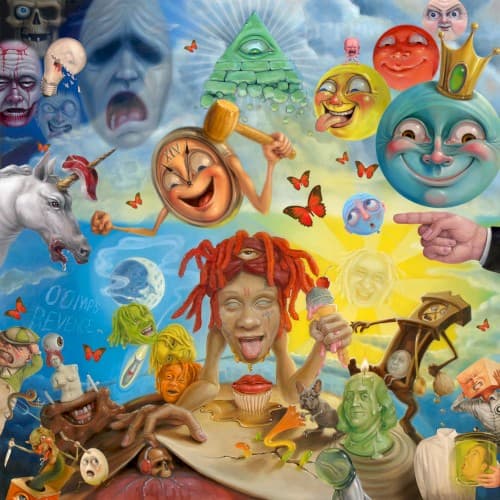
Trippie Redd Life's a Trip: A Rollout That Became an Album
Life's a Trip is best understood as a rollout that became an album. By the time it arrived in August 2018, its lead single had been out for more than eight months, and a second, third and fourth single had followed across the spring and summer. A fifth, released days before the album, completed the set. That is a very streaming-era way to build a debut: release the songs that work, let them circulate, and gather them into a statement afterward. The problem is that the statement is only as strong as the songs that were already public, and the new material does not always keep up.
My thesis is that Life's a Trip is a good album held together by its best four or five songs, and that its reputation as a pioneering emo rap record is earned by those songs rather than by the project as a whole. When Trippie Redd pairs his voice with hard, clean beats and lets the melody lead, the record is thrilling: the pitch climbs, the delivery turns sharp, and the tracks move with a speed that makes the more sombre moments hit harder. When he turns to guitar-driven ballads and drumless slow songs, the album gets slower, flatter and more repetitive.
The context matters here. The debut studio album arrived after a breakout mixtape, and expectations were high. The record debuted at number four on the Billboard 200 and eventually went platinum, which is a strong return for a project that mixes rock gestures, trap rhythms and R&B melodies with no obvious commercial template. It also served as a highlight for a young artist who wanted to be more than a hook machine: he wanted to be a singer, a rapper, a rock frontman and an emotional confessor at once.
That ambition is both the album's draw and its flaw. The best songs show a rapper who can stretch his voice into every register, and the weaker ones show an album trying to prove range at the expense of focus. There is a great forty-minute record hiding inside this fifty-minute one, and the argument of this review is that the good version is easy to find if you know where to look. It starts with the songs that put Redd's voice on beats built for it, and it ends before the guitars take over.
Hard Beats, Elastic Vocals, and a Weakness for Slow Guitars
The strongest sections of the album are built on a simple pairing: a bright, hard-hitting beat and a voice willing to push every limit. OZ produces five of the tracks, including Missing My Idols, Bang!, Uka Uka, Shake It Up and Gore, and the best of them give Redd room to scream, croon and rap in the same minute. The drums hit crisply, the synth lines are kept clean, and the vocals sit high in the mix, so every crack and squeal registers. When it works, the music has an urgency that borders on cartoon energy, and the delivery feels more like a performance than a recording.
The vocal range is the real attraction. Redd shifts from a sweet, almost fragile melody to a harsh rock shriek in the span of a single hook, and the shifts are not decoration: they carry the emotional charge of the writing. Songs about doubt, loss and paranoia are given a sense of physical strain that a smoother voice could not supply. Alongside the melody, he raps with surprising technical control on tracks like Missing My Idols, where punchlines and quick turns replace the sing-song flow, and the contrast shows a young artist who can do more than one thing well.
The album's grief runs through it quietly. A tribute to his late brother and a song that critics read as addressed to him give the record emotional gravity that its more playful tracks cannot. The writing is strongest when it is plain: short statements of loss and longing delivered without dressing. It is weakest when it leans on shock-value imagery or the same references to haters and doubters that have become routine in the genre. The writing never reaches the level of the singing, and it is the album's persistent limitation.
The biggest weakness is the slower material. The record opens with a run of dark, guitar-driven songs, and a few of the drumless tracks, including the closer at nearly six minutes, are too long for their ideas. The guitar is not the problem in itself, but the production choices often feel imposed rather than organic: the instruments sit under the vocals without really interacting with them, and the songs lose the momentum that the hard beats supply. Some critics at the time argued that the production lacked identity and that the guitar detours pulled the voice away from what made it special, and the point has force on a handful of tracks.
The guests are used well on the one song where it matters. Young Thug's chorus on Forever Ever and Travis Scott's presence on Dark Knight Dummo give those tracks a second axis, a counterweight to Redd's voice. Elsewhere, the album relies on his own range and the producers' variety to carry the weight, and it largely succeeds. The sound is varied without being incoherent: rock, trap and R&B ideas rotate, but the vocal personality ties them together, which is the clearest sign that this is a real debut album and not a mixtape in disguise.
A Strong Middle Between a Slow Open and a Drifting Close
The sequence opens with a statement of intent and then spends the next quarter hour trying to live up to it. The first three songs set a dark, intimate tone built around guitar, minimal drums and confessional lyrics, and they establish the record's emotional stakes quickly. It is a strong opening gesture, but it also front-loads the slowest material, and the album does not hit its first real peak until the fourth and fifth songs, where the tempo rises, the beats sharpen and the vocal performances become more dynamic.
From there the record is at its best. A run of songs mixes hard drums with sharp melodies, and the pacing has the push and pull of a well-judged playlist: a fast song, a slower song, a collaboration, a burst of rock energy. The middle of the album is the strongest stretch, and the guitar ballads and trap bangers sit beside each other without feeling forced. This is where the wide range of the album works in its favor, and the mix of moods feels deliberate.
The late stretch is the weakest part of the sequence. A few of the songs after the midpoint blur together, the tempos settle into the same mid-range, and the energy that the central run built begins to dissipate. A short tribute near the end gives the record a moment of focus, and a darker, harder cut follows it, but the closing track runs nearly six minutes and sits at the end of the album without adding anything the opening did not already say. After the energy of the middle, it is an anticlimax.
The length is only partly earned. Fourteen songs and almost fifty minutes is a normal album length, but this particular record contains a set of excellent short songs surrounded by a few that overstay. The best parts are brief and punchy, and the weakest parts are long and slow, which is the opposite of what a streaming-era project should do. A tighter version would drop the weaker slow material and let the sharper songs carry the experience, and it would be remembered as a classic of its style. As it stands, it is a very good album with a visible seam where the best songs end and the filler begins.
A Defining Emo Rap Debut With a Visible Seam
This site has no other Trippie Redd albums rated yet, so the placement is provisional, but the record's position is clear: Life's a Trip is the artist's definitive studio debut and the album that made his sound legible to a wider audience. It is more polished than the earlier mixtape work and more varied than much of what followed, and its blend of rock gestures, melodic hooks and trap rhythms made it a reference point for a generation of emo-leaning rappers. The scores reflect that: strong marks for delivery and production, solid marks for originality and replay, and lower marks for writing and cohesion.
Who is it for? Anyone interested in how melodic, confessional rap developed after the SoundCloud boom, anyone who likes singing and rapping in the same song, and anyone who wants a debut with real range. It is an especially good fit for listeners who care more about vocal performance than lyrical density. Who should skip it? People who want consistently tight writing, a coherent narrative or an album with no slow stretches will be frustrated, and anyone who dislikes strained, shrieking vocals will not find much to enjoy.
How has it aged? Well, on the evidence of the numbers. It reached platinum certification in 2022, several of its songs have also been certified separately, and one of the album's tracks returned to the Billboard Hot 100 years after release when it went viral. The critical conversation has also shifted: a mixed Pitchfork review at the time argued that the production lacked identity, while other critics treated the album as a defining emo rap record. Both views have merit. The weaker material has aged less well than the best songs, but the best songs still sound current.
To start, play Missing My Idols, Forever Ever and Bang!. The first is the record's best rap performance, the second shows how well Redd matches a melodic guest, and the third is the most complete expression of the guitar-and-trap mix. For further listening, the earlier mixtape A Love Letter to You is rawer and more direct, and the later Trip at Knight is a spin-off that trades emotional range for rage-driven energy.
The strongest evidence for this record is how often its best songs prove the rest of the album right, and how often the rest of the album gets in their way.
Track by track
Track Listing
Together
SolidA drumless, guitar-led opener produced by We Are the Stars, with a dark and paranoid set of lyrics about holding himself together. It sets the album's tone effectively, but the pacing is slow and the idea is thin. A moody opener rather than a memorable song.
Taking a Walk
StandoutA minimal trap beat by Scott Storch and Avedon, and the fifth single. The sparse production leaves Redd's voice exposed, and the song works because the emptiness feels like the point: a lonely, unsettled question asked over almost nothing. It is two minutes long and does not waste any of them. A strong early highlight that earned its place among the album's best-known songs.
Wish (Trippie mix)
StandoutThe original version of a song first released on a Diplo EP, restored here after Redd said he disliked the changes. The vocal is quieter and the arrangement more urgent, with a mixture of chill and pulse that suits the subject matter of love and despair. A solid track and a good piece of context for how the album was assembled.
Missing My Idols
StandoutThe album's best rap performance, produced by OZ and Nik D, and originally conceived as a sequel to a song from the earlier mixtape. Redd drops the singing for punchlines and tight, quick delivery, and the song pays homage to Lil Wayne without sounding imitative. The beat is hard and clean, and the song runs just under two and a half minutes. A key track and the clearest proof that the artist can rap as well as sing.
Forever Ever
StandoutMurda Beatz produces, and Young Thug supplies the chorus with Reese Laflare also featured. Redd matches the guest's wildest melodic moves with his own, and the first four bars of his verse are almost as strong as the hook. The song is nearly four minutes but moves quickly, and it is the strongest collaboration on the record. A key track, and the album's peak alongside the song before it.
Bird Shit
SolidProduced by Wheezy and We Are the Stars, this is a looser, more relaxed track about dismissing doubters. The vocal patterns are inventive and the bird-like ad-libs are playful, but the writing is thin and the hook does not stick. Fun and light, if not essential.
BANG!
StandoutProduced by OZ, this begins as a gentle guitar ballad and turns into a trap banger with a rock-style wail on the hook. The extended outro samples gunfire from an anime series. It is the best distillation of the album's central idea, the blending of rock, trap and melody, and the contrast between the soft opening and the hard drop is exciting. A key track and one of the best songs on the record.
How You Feel
StandoutA drumless, guitar-based song with an interpolation of an Eddie Money hit, and the fourth single. The vocal is raw and heartfelt, and several critics heard it as addressed to his late brother. It is the album's most sincere moment, though the writing is plain and the song moves slowly. Strong, and a fine example of the record's emotional side.
Dark Knight Dummo
StandoutThe lead single, with Travis Scott, produced by Honorable C.N.O.T.E. The beat is dark and aggressive, and the contrast between Scott's heavily processed voice and Redd's cleaner one gives the song an edge. It has the energy of a mosh-pit track and became his first song as a lead artist on the Hot 100. A key track, though it was released months before the album and feels like an earlier chapter.
UKA UKA
StandoutAn OZ production with a Marvin Gaye sample, addressing his haters over hard drums. The pacing is tight and the vocal explosions are well placed, but the lyrics repeat the same defiance as elsewhere. A solid, energetic cut that does what it needs to and little more.
Shake It Up
SolidThe shortest song on the album at under two minutes, and an explicit, playful track about women dancing for him. It provides a needed lift after the slower material, and the arrangement is amusing. The content is light, but the energy is welcome.
Oomps Revenge
StandoutA two-minute tribute to his late brother, produced by BeatPusher with a sample from the Gene Dunlap Band. The writing is tighter and more serious than most of the record, and the brevity gives it weight. It reads as a mission statement hidden in an interlude, and it is one of the best songs on the album. A key track.
Gore
SolidProduced by OZ and Reske, a growling, aggressive track about what happens to those who disrespect him. The vocal has a Lil Peep-like rasp, and the beat is heavy, but the writing is generic. Competent filler.
Underwater FlyZone
WeakA guitar-driven closer by We Are the Stars, and at nearly six minutes the longest song on the record. It has no real drums, and the length is hard to justify given how little changes. The mood is pleasant, but it ends the album on a slow, drifting note rather than a peak. The weakest ending the sequence could have chosen.