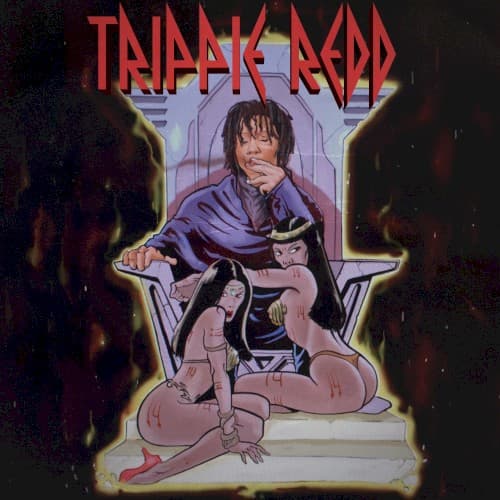
The scorecard
6.3/10 · Mixed
- Writing25%
- 5.5
- Production25%
- 6.5
- Delivery15%
- 7.0
- Cohesion15%
- 6.0
- Originality10%
- 6.5
- Replay value10%
- 6.5
The hooks on Love Scars and Romeo & Juliet carry real feeling, but most verses lean on the same heartbreak and defiance images and read like sketches.
Spare synths, small bright melodies and reverb give the tape a consistent mood, and the Metroid Prime sample on Love Scars and Pi'erre Bourne's beat on Poles 1469 show how much a simple figure can do.
Trippie Redd's cracked, climbing hooks give the best songs emotional risk, and the contrast with 6ix9ine's harder voice on Poles 1469 gives the tape its most dynamic moment.
A strong opening run gives way to interchangeable mid-tape songs and a closing stretch that never recovers the early momentum.
The tape helped make a melodic, emo-leaning rap style into a commercial format, though it is more an early template than a finished statement.
The short, hook-driven best songs hold up well as playlist material, but the weaker back half is easy to skip on repeat.
Trippie Redd A Love Letter to You: Three Great Songs and a Playlist's Worth of Filler
A Love Letter to You has a reputation as a timeless mixtape, and the reputation is half right. The half that is right is enormous: the first two songs plus the Pi'erre Bourne collaboration with 6ix9ine contain more melody, hurt and replay value than most full-length rap albums released that year. The half that is wrong is the assumption that a platinum plaque and a critic's retrospective list prove the whole tape holds together. It does not. This is a record with three or four songs that define a style and a back half that mostly proves how much those songs were carrying.
That is a streaming-era problem, and it is worth stating plainly. The tape's songs are short, many of them barely clearing two and a half minutes, and they were built to be saved, replayed and slotted into playlists rather than heard as a sequence. Judged as a playlist, A Love Letter to You is excellent. Judged as an album, it has the uneven pacing of a collection assembled from a pile of songs, with a handful of producers, a rotating cast of guests and an arc that loses focus well before the end.
What makes the best songs work is not complicated. Trippie Redd sings like someone who has not yet learned to hide how much he means it, and the hooks are hurt, melodic and slightly cracked. The beats leave him room: sparse, atmospheric, a little gloomy, and light on distraction. When the tape lets a hook sit in front of that kind of beat, it is as good as anything in the emo-leaning corner of SoundCloud rap, and it explains why the project broke out the way it did.
The stakes are about influence as well as taste. This is the tape that made the melodic, tortured style of rap into a commercial format, and its success shaped the labels' ideas about what a young rapper from that scene could be. That legacy is real. So is the argument of this review: A Love Letter to You is a very good introduction to a style, carried by a few exceptional songs, and not the cohesive classic its fans sometimes claim.
Cracked Hooks, Spare Beats, and Thin Verses
The tape's main asset is the melody, and it is worth being specific about how it works. Trippie Redd writes hooks that rise and then break: the pitch climbs, the voice strains, and the note cracks just as the line ends. It is a deliberate effect, and it gives the best songs a sense of emotional risk that polished R&B rarely attempts. The verses are less memorable than the choruses, which is exactly what you would expect from a young artist whose gift is his instrument rather than his pen, but the melodic ideas are strong enough that the weaker writing rarely gets in the way.
The production is varied in credit and consistent in mood. Elliot Trent, 12Hunna, DJ Flippp, Goose the Guru, Pi'erre Bourne and others share the work, and yet the overall sound stays cohesive: soft synth pads, sparse drums, small bright melodies and plenty of reverb. The best beats are the simplest. A single repeated figure over a spare kick pattern gives the vocals room to carry the song, and the Metroid Prime sample on the lead single is a good example of how a small, strange detail can anchor an entire track. That economy is the reason the tape sounds more modern than many of its peers.
The guests are a more mixed matter. Famous Dex, UnoTheActivist, Pachino, Black Jezuss and others appear across the middle of the tape, and their verses mostly provide a change of voice rather than a change of idea. The most important guest spot, 6ix9ine on the Pi'erre Bourne-produced single, works because it is a contrast: Redd's melodic delivery against a harsher, more confrontational voice gives the song a dynamic the rest of the record rarely achieves. Elsewhere, the guests function as filler between the star's own hooks, and the collaboration list is longer than the material needs.
The weaknesses are easy to hear. Songwriting is thin once the tempo and emotional pitch are removed: a lot of the verses lean on the same images of heartbreak, danger and defiance without much variation, and the lyrics often feel like sketches rather than finished writing. The back half contains songs that are plainly weaker than the front half, with less memorable hooks and more generic beats, and a few tracks sound like they were chosen for the sake of volume. The tape also leans on a narrow emotional range: it is melancholy, it is angry, and it is a little defiant, but it rarely allows itself to be anything else.
That narrowness is both a limitation and a strength. The consistent mood gives the tape an identity, and the best songs make that identity feel earned rather than imposed. But the same consistency makes the weaker songs blur together, and anyone listening for variety will find the record repetitive. This is a project that rewards listeners who want a mood and punishes those who want a range, and its success in the streaming era reflects how well it served the first kind of listener.
A Front-Loaded Tape Built for Playlists
The sequence is the tape's weakest structural feature. The opening is as strong as any in rap that year: a hit single, a sequel to it with a punchy guest-driven second half, and then a melodic song built on melodrama. By the time the tape reaches the middle, the listener has heard the project's most distinctive material, and the momentum is as high as it will get.
The middle of the tape is where the pacing begins to slip. A run of songs from the fourth track onward moves at similar tempos and in similar emotional registers, and the guests rotate in without changing the shape of the music. The tracks are short, which helps, but the hooks are less distinctive, and the beats start to feel interchangeable. This is the stretch where the tape plays most like a playlist and least like an album, because each song could be reordered without changing the experience.
The closing stretch is more varied. A longer song with two guests, a brief rap demonstrate and a short closer give the end of the tape a little more shape than the middle, but the energy never returns to the level of the opening. The tape ends with a whimper rather than a peak, which is a pity because the first few songs would have supported a much stronger finish.
Is the length earned? Twelve songs at an average of about three minutes is short, and in that sense the tape is efficient. But efficiency is not the same as cohesion. The tape would be more convincing as an eight-song project that kept the best material and dropped the filler, and the fact that many listeners treat the first few songs as the whole record is a sign that the sequence does not justify the full run. In the streaming era that is a feature rather than a bug: the best songs live on playlists and the rest of the tape is an afterthought. As an album, though, the sequence is the clearest sign that A Love Letter to You is a collection of songs rather than a finished piece of work.
An Influential Template, Not a Cohesive Classic
This site has no other Trippie Redd albums rated yet, so the placement is provisional. As a debut commercial mixtape, A Love Letter to You is the project that established the style, and it remains among the most influential records in the melodic, emo-leaning corner of SoundCloud-era rap. Its ranking among the artist's projects will depend on how the later, more polished releases are judged, but it is easy to see why fans return to it: the best songs are the artist's most direct and least calculated.
The score reflects that. Writing and cohesion sit in the middle because the verses are thin and the sequence is uneven. Delivery and production score higher because the melody and the beats are the real attractions. Originality is strong for the moment, and replay value is high because the best songs are short, immediate and built to be played again.
Who is it for? Anyone curious about how melodic rap became a commercial format, anyone who likes sad, hook-driven rap with sparse production, and anyone who wants to understand where a generation of younger rappers found its template. Who should skip it? Listeners who want intricate writing, a strong narrative arc or a cohesive album experience will find it frustrating, and anyone who dislikes cracked, strained vocals will probably not warm to it.
How has it aged? Better than most of its peers, mostly because its best songs depend on feeling rather than on trends. The production has a slightly dated sheen in places, and the guest verses have not aged as well as the hooks, but the central emotional pitch still lands. The record has also been rewarded with commercial longevity: it was certified gold in 2019 and upgraded to platinum in 2022.
To start, play Love Scars, Poles 1469 and It Takes Time. The first is the lead single and the clearest statement of the style, the second is the collaboration that made the tape's reputation, and the third is a longer, more reflective cut that shows the artist's range. For further listening, the sequel A Love Letter to You 2 extends the idea, and the later Life's a Trip, which is the debut studio album, offers a more polished version of the same instincts.
The most accurate way to describe the tape is as a handful of very good songs surrounded by a competent mixtape, and the handful is worth the visit.
Track by track
Track Listing
Love Scars
StandoutThe lead single and the tape's defining song, built on a sample from a video game and a hook that climbs and cracks. The beat is spare and the melody does the work, and the emotional pitch feels sincere rather than staged. At barely two and a half minutes it never overstays. A key track, and the clearest argument for why the tape broke out.
Love Scars, Pt. 2 / Rack City
StandoutA sequel to the lead single with Chris King and Forever Anti Pop, split between a sparse first half and a harder second. The guests change the dynamic and keep the song moving, and the shift gives it more shape than most of the tape. It is more aggressive than the original and slightly less distinctive, but the contrast is a good use of the guests. Strong, and the best proof that the tape could do more than one mood.
Romeo & Juliet
StandoutA melodramatic ballad produced by ParisTheProducer and Goose the Guru, and the song most committed to teenage romantic excess. The hook is strong and the vocals are raw, though the writing leans on familiar images. It works because the emotion is believable, even if the ideas are not new. A solid centerpiece for the tape's lovelorn side.
Deeply Scared
SolidFeaturing UnoTheActivist, with 12Hunna on the beat. The track is moodier and slower, and the hook is more subdued than on the tape's best songs. The guest provides a change of texture without really changing the idea. Competent and atmospheric, but it blends with its neighbors.
Blade of Woe
SolidFamous Dex joins on a beat by 12Hunna and DJ Flippp. The bounce is more playful and the guest's loose delivery contrasts with the lead's melody, but the song is slight and the hook does not stick. A little energy and not much else.
It Takes Time
StandoutProduced by Goose the Guru and the longest of the early tracks at nearly five minutes, with a voice memo in the intro. The pacing is slower and the tone more reflective, which gives the tape a needed change of mood. It is the tape's most patient song and one of its most affecting, though the length stretches the idea a little. Strong, and a good introduction to the artist's softer side.
Poles 1469
StandoutThe Pi'erre Bourne production with 6ix9ine, and the tape's most dynamic song. Redd's melodic delivery against the guest's harsher voice gives the track a real push and pull, and the beat is atmospheric without being crowded. It runs under two and a half minutes and gets the most from them. A key track, and the one that proves the tape's reputation is deserved.
No Smoke No Smoke 1400 B.C. / Sauce
WeakA two-part cut with Pachino on a beat by Elf Beatz. The structure gives it a little variety, but the writing is generic and the hook is forgettable. Filler that sounds like a mixtape track.
Stoves on 14th
WeakFeaturing Black Jezuss, with Cesar P on the beat. A harder, more street-oriented cut at barely over two minutes. The guest adds a different color, but the idea is thin and the song fades quickly from memory. Filler.
Limitless
SolidThe longest song in the back half, at four minutes, featuring Lil Tracy and Rocket Da Goon (both later removed from the track). The length is hard to justify, and the beat from DP Beats does not have enough going on to sustain it. Not a highlight, though it has a few good melodic moments.
Can You Rap Like Me?
SolidA short rap showcase produced by P. Soul. It lets the artist stretch out as a rapper rather than a singer, and it is a useful reminder that the tape has more than melody to offer. The writing is more conventional than the best songs, but the energy is welcome. A fair showing.
Never Ever Land
SolidA short closer produced by Peyote Beats. The mood is dreamy and slightly sad, and it ends the tape on a gentle note rather than a peak. It is a quiet ending and not an especially memorable one.
Frequently Asked Questions
Is Trippie Redd A Love Letter to You good?
What are the best songs on A Love Letter to You?
How successful was A Love Letter to You?
Styles