From Zone 6 to Chart Dominance: 21 Savage's Unexpected Journey
When 21 Savage appeared on the Atlanta scene in 2015, his deadpan delivery and sparse production felt like a counterargument to rap's prevailing energy. No melodic flourishes, no rapid-fire flows—just cold, measured bars delivered with the emotional temperature of someone recounting facts rather than performing them. Born Shéyaa Bin Abraham-Joseph in London but raised in Atlanta's Zone 6 neighborhood from age seven, his biography itself became a cultural flashpoint when ICE detained him in 2019, revealing his British citizenship to a surprised public.
The revelation complicated but didn't diminish his standing. If anything, it added layers to an artist who'd built his reputation on authenticity and street credibility. His music had always dealt in specifics—Zone 6 references, Atlanta trap architecture, the particular violence and survival calculus of that environment. The immigration controversy forced a broader conversation about identity, belonging, and what authenticity means in hip-hop when an artist's assumed origin story gets rewritten publicly.
By that point, 21 Savage had already established himself as a commercial force and critical presence. His collaborations with producer Metro Boomin became defining templates for late-2010s trap, while his willingness to address financial literacy, political engagement, and community investment marked him as more than a one-dimensional street rapper. The contrast between his monotone delivery and his multidimensional public presence became part of his signature.
The Architecture of Minimalism: 21 Savage's Sonic Identity
21 Savage's vocal approach strips trap rap down to its foundation. Where contemporaries add melody, he subtracts. Where others accelerate, he slows down. His delivery operates in a narrow emotional bandwidth—detached, almost conversational, as if he's explaining rather than expressing. This isn't monotony; it's discipline. The limited tonal range forces listeners to focus on word choice, narrative detail, and the weight of what's being said rather than how it's performed.
His partnership with Metro Boomin created a production aesthetic to match: skeletal 808 patterns, minimal melodic elements, space between sounds. These aren't busy tracks. The arrangements create atmosphere through absence, letting bass frequencies and hi-hat patterns carry the mood while 21's voice occupies the middle space without competing for attention. Tracks like "No Heart" demonstrate how much impact can be generated with how little—a simple piano loop, rumbling bass, and that flat delivery creating tension through understatement.
As his career progressed, the sonic palette expanded without abandoning core principles. Working with producers beyond Metro, collaborating with artists like J. Cole and Drake, and incorporating different production textures showed range. But the fundamental approach remained: restraint as a stylistic choice, emotional distance as a delivery method, space as a compositional element. Even on more melodic material, he never fully commits to singing—the voice stays in that speak-sing zone that's become his signature, a middle ground between rapping and talking that keeps everything grounded in conversational realism.
Savage Mode to Mainstream Recognition: Charting 21's Ascent
The Slaughter Tape and Slaughter King established local presence, but Savage Mode in 2016 announced a fully formed artist. The Metro Boomin collaboration became an instant classic of the trap subgenre, packaging 21's nihilistic worldview in production that felt simultaneously menacing and hypnotic. "X" featuring Future became a breakout, but deeper cuts showed an artist comfortable exploring darkness without offering easy resolutions. The project's success wasn't just commercial—it established a template others would follow.
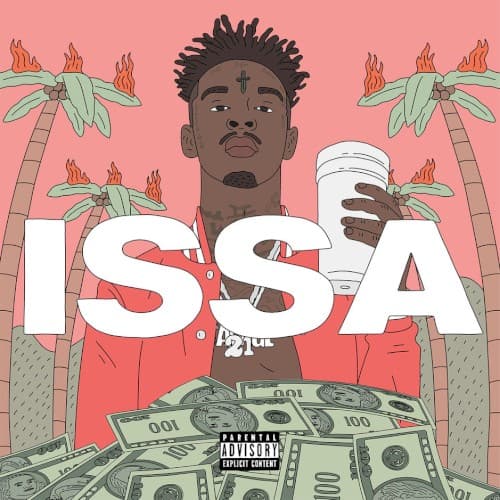
Issa Album arrived in 2017 as his major label debut, debuting at number two and confirming he could translate mixtape momentum into album-length commercial viability. The project showed growth in production diversity while maintaining the core aesthetic. Tracks ranged from the confrontational "Famous" to more introspective moments, demonstrating comfort with both aggression and reflection. Our review noted his "ability to maintain his signature monotone while exploring different emotional territories," capturing how he was expanding without abandoning what made him distinctive. The album established him as more than a regional success—this was a national presence with staying power.
Without Warning, a collaborative album with Offset and Metro Boomin released as a surprise in 2017, reinforced his ability to thrive in different contexts. Savage Mode II in 2020 returned to the original formula with even darker results, Morgan Freeman's narration adding cinematic weight to the proceedings. The sequel debuted at number one, proving the partnership with Metro remained vital years after their initial collaboration. Between these anchors, he released I Am > I Was in 2018, which also topped the charts and featured the Post Malone collaboration "rockstar"—a crossover hit that introduced him to audiences beyond hip-hop's core.
His features became almost as significant as his solo work. Appearing on tracks with Drake, Travis Scott, and Cardi B, he brought his deadpan presence to pop-adjacent spaces without compromising his approach. The contrast often worked in his favor—placed against more animated performers, his flatness became a feature rather than a limitation. Post-immigration controversy, his music took on additional weight. Bars about survival and belonging resonated differently when listeners knew his full story. Rather than derailing his career, the revelation seemed to deepen engagement with his work.
Recent projects like Her Loss with Drake in 2022 and American Dream in 2024 show an artist comfortable operating at rap's commercial center while maintaining artistic identity. The Her Loss collaboration demonstrated chemistry born from mutual respect—Drake's melodicism balanced against 21's stoicism, creating dynamic interplay. American Dream explicitly addressed his immigration experience, turning personal history into conceptual framework. The album's reception confirmed what his career trajectory already suggested: audiences were invested not just in the music but in the person behind it.
Cultural Footprint: 21 Savage Beyond the Booth
21 Savage's influence operates on multiple frequencies. Sonically, he provided a template for emotional restraint in an era often defined by excess. His deadpan delivery inspired a generation of rappers who understood that understatement could create as much impact as theatrical performance. The stripped-down production aesthetic he favored with Metro Boomin became a blueprint—space and minimalism as viable approaches in trap's increasingly maximalist landscape.
Beyond the music, his public evolution matters. The immigration controversy forced important conversations about nationality, identity, and authenticity in hip-hop. His response—maintaining dignity, fighting his case, and continuing to work—modeled resilience. His financial literacy initiatives, including Bank Account's message about economic empowerment, positioned him as an artist interested in practical community impact rather than just symbolic gestures. His 21 Savage Bank Account campaign with Get Schooled literally brought financial education to underserved communities.
Culturally, he represents a specific Atlanta lineage while transcending regional boundaries. He emerged from the same Zone 6 environment that shaped Gucci Mane and Future, but his approach differs from both. Where Gucci brought prolific energy and Future added melodic desperation, 21 brought cold-eyed assessment. That perspective—street-informed but not street-bound, rooted in specific geography but addressing universal themes—allowed him to connect with diverse audiences. The memes and social media presence added another dimension, his deadpan persona translating perfectly to internet culture without feeling like pandering. He exists simultaneously as serious artist and cultural touchstone, heavy subject matter and viral moment. That duality defines modern hip-hop stardom, and he navigates it more successfully than most.