Missy Elliott: Redefining Hip-Hop's Visual and Sonic Language
Missy Elliott didn't just enter hip-hop — she rewired it. Emerging from Virginia in the mid-1990s, she arrived with a creative vision that treated music videos as art installations, production as sculpture, and rapping as a vehicle for both playfulness and profound innovation. While her peers were establishing regional identities, Missy was building something beyond geography: a futuristic aesthetic that borrowed from Afrofuturism, funk, and electronic music while remaining unmistakably rooted in hip-hop's rhythmic core.
Her partnership with producer Timbaland created one of music's most influential creative tandems. Together, they crafted a sound defined by skeletal drum programming, elastic basslines, and negative space — beats that felt simultaneously minimal and maximal, leaving room for Missy's shape-shifting vocal performances. She moved between rapid-fire flows, melodic sung passages, and rhythmic spoken word with an ease that blurred genre boundaries before crossover became industry mandate.
What separated Missy from every female rapper before her was creative control. She wasn't packaged or positioned — she was the architect. As a songwriter and producer for Aaliyah, 702, Total, and others, she had already shaped late-90s R&B before her solo career began. That foundation gave her an authority few artists possess: she understood hit-making from multiple angles and used that knowledge to build a catalog that prioritized artistic vision over commercial formulas.
The Sound of Controlled Chaos: Missy Elliott's Production Philosophy
Missy Elliott's sonic signature is organized disorder. Her best tracks feel like they're perpetually on the verge of collapse — sounds enter and exit without warning, rhythms stutter and reset, melodies appear for four bars then vanish. This isn't sloppiness; it's precision disguised as spontaneity. Timbaland's production gave her the perfect canvas: beats that breathed, leaving gaps where most producers would add layers. That space became her playground.
Her vocal approach matched the production's unpredictability. She'd start a verse with a conventional flow, then suddenly flip into a whispered aside, a sung hook, or a vocoded robotic chant. On tracks like "Get Ur Freak On," she stacked her voice into a call-and-response choir, creating the illusion of multiple personalities occupying the same sonic space. She wasn't interested in technical rappity-rap displays — her rhythm was conversational, syncopated to match the beat's negative space rather than fill every available pocket.
The futuristic sheen of her music never came at the expense of funk. Beneath the electronic gloss, her records grooved hard. She understood that innovation without groove is just novelty. Her production vocabulary pulled from Miami bass, bounce music, dancehall, and bhangra — global rhythms filtered through a Southern sensibility that kept everything grounded in body movement. You could analyze the compositional complexity or you could just dance. Both responses were correct.
From Portsmouth Prodigy to Cultural Architect: Missy Elliott's Three-Decade Evolution
Missy's journey began in Portsmouth, Virginia, where she formed the R&B group Sista in the early 1990s. That group went nowhere commercially, but it connected her with DeVante Swing of Jodeci, who brought her into his Swing Mob collective. There she met Timbaland, a partnership that would redefine modern pop production. By the mid-90s, while still unsigned as a solo artist, she was already writing and producing for established acts — a reversal of the typical trajectory where artists gain creative control after commercial success.
Her 1997 debut "Supa Dupa Fly" arrived as a complete artistic statement. The Hype Williams-directed video for "The Rain (Supa Dupa Fly)" — with its inflatable trash bag suit and fisheye lens distortions — instantly established her visual language as equally important as her music. The album went platinum, but more importantly, it proved that left-field production could coexist with mainstream success. She wasn't making underground experimental hip-hop; she was making futuristic pop that happened to be too strange for easy categorization.
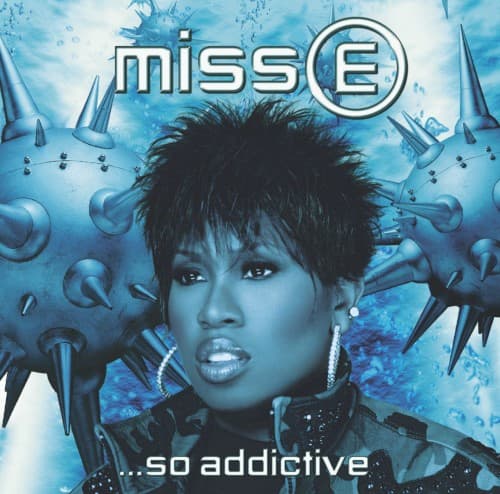
The late 90s and early 2000s marked her commercial peak. "Da Real World" (1999) and "Miss E... So Addictive" (2001) cemented her status as a hitmaker. The latter album, featuring "Get Ur Freak On" and "One Minute Man," showcased her at her most adventurous — bhangra-influenced production meeting club-ready energy, creating a hybrid that influenced everyone from M.I.A. to the grime generation emerging in the UK. She wasn't chasing trends; she was creating templates that others would follow for the next decade.
"Under Construction" (2002) marked a deliberate pivot. After pushing futurism to its limits, she turned backward, crafting an album steeped in hip-hop nostalgia — sampling old school classics and adopting a deliberately retro aesthetic. It was a creative risk that paid off, proving she could dominate multiple lanes. "This Is Not a Test!" (2003) followed, but by then, the music industry was shifting. The rise of ringtone rap and snap music represented a different kind of minimalism than what she and Timbaland had pioneered.
The mid-2000s saw her step back from releasing solo material while continuing to produce and write for others. Health issues, including Graves' disease, forced periods of reduced activity. But her influence only grew in absence. A new generation of artists — from Janelle Monáe to Tierra Whack to Rico Nasty — cited her as foundational, not just for what she accomplished as a woman in hip-hop, but for how she expanded the genre's sonic and visual possibilities. When she returned with scattered singles in the 2010s, including "WTF (Where They From)" and "I'm Better," the production still sounded ahead of the curve.
Her 2019 VMAs Video Vanguard Award wasn't just a career achievement recognition — it was a cultural coronation. The performance featured a medley that reminded everyone how many hits she'd crafted, how many visual concepts she'd originated, and how completely her aesthetic had been absorbed into mainstream pop culture. Unlike many legacy artists, her catalog hadn't aged into nostalgia; it still sounded like transmissions from the future.
The Missy Elliott Blueprint: How One Artist Expanded Hip-Hop's Creative Boundaries
Missy Elliott's influence operates on multiple frequencies. On the most obvious level, she opened creative doors for women in hip-hop, proving that female artists could control their image, production, and narrative without conforming to existing templates. She didn't reject femininity or sexuality — she reconfigured them on her own terms, creating visual and musical personas that were playful, powerful, and completely self-determined.
But her legacy extends beyond gender politics into pure sonic innovation. The Timbaland-Missy production aesthetic — stuttering drums, elastic basslines, strategic use of silence — became the foundation for 2000s pop. You hear it in Aaliyah's later work, in Justin Timberlake's solo career, in the way mainstream production started treating space as an instrument rather than something to be filled. She proved that experimental approaches could sell millions, that weirdness and accessibility weren't mutually exclusive.
Her visual language proved equally influential. The surrealist imagery, the playful use of oversized clothing and unconventional silhouettes, the fisheye lenses and CGI effects — all became part of hip-hop's visual vocabulary. She understood that in the video era, artists needed to be multimedia conceptualists. Every release was a complete aesthetic package, and that holistic approach to artistry influenced everyone from Kanye West to Tyler, The Creator to contemporary artists building worlds around their music rather than just releasing songs.