The Voice That Launched Brooklyn Drill Into the Mainstream
Pop Smoke's career lasted barely eighteen months, yet his impact on hip-hop's landscape rivals artists who spent decades building their sound. Born Bashar Barakah Jackson in Brooklyn's Canarsie neighborhood, he emerged in 2019 with a voice that seemed impossible — a thunderous baritone that rattled speakers and announced itself with undeniable presence. His fusion of UK drill's skeletal production aesthetics with New York's street authenticity created something the city hadn't heard before, a sound that felt both imported and deeply local.
What made Pop Smoke's ascent remarkable was the speed at which he became unavoidable. "Welcome to the Party" didn't just introduce a new artist; it reset expectations for what New York rap could sound like in the streaming era. While the city's drill scene had existed in pockets, Pop Smoke brought it stadium-level energy and crossover appeal without diluting its edge. His collaboration with UK producer 808Melo proved career-defining, the sliding 808s and sparse percussion creating space for his vocals to dominate.
His murder in February 2020, during a home invasion in Los Angeles, cut short a trajectory that showed no signs of slowing. He was twenty years old. The posthumous releases that followed — including the commercially dominant "Shoot for the Stars, Aim for the Moon" — revealed an artist who was already expanding beyond drill's confines, experimenting with melody and pop structures while maintaining the intensity that made him distinctive.
Subterranean Bass and the Architecture of Menace
Pop Smoke's sonic identity rested on contrast — the deep, almost impossibly low register of his voice set against production stripped to its essential elements. Where many rappers modulate their delivery across tracks, Pop carved out a narrow lane and dominated it completely. His voice carried natural aggression without needing to shout, a growling presence that felt physical. The ad-libs became signature elements: the "grr" that punctuated bars, the way he'd stretch syllables for emphasis, the call-and-response structure he employed even when rapping solo.
The UK drill influence wasn't cosmetic. Producers like 808Melo, Axl Beats, and Rico Beats built instrumentals that borrowed directly from London's drill blueprint — tempo shifts, skeletal hi-hat patterns, bass frequencies designed to hit below the chest. These weren't typical New York beats. They lacked the soul samples and jazz loops that had defined the city's sound for decades. Instead, they offered negative space, allowing Pop's voice to fill the void. Tracks like "Dior" demonstrated how much power could come from restraint, the production offering just enough framework for the vocal performance to do the heavy lifting.
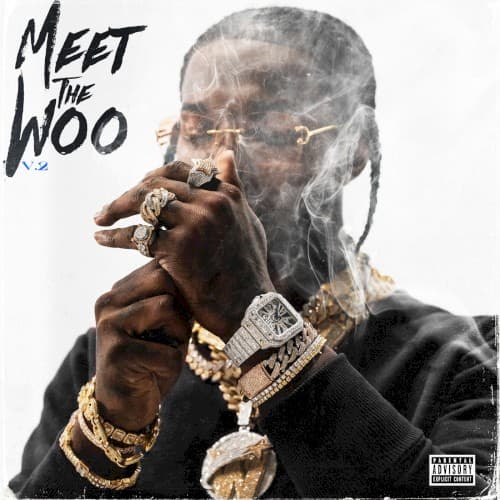
Melodically, Pop operated in a limited range but used repetition as hypnosis. Hooks didn't need complexity when delivered with his conviction. By the time of his second mixtape, Meet the Woo V.2, he was already beginning to stretch beyond pure drill, incorporating more melodic elements and experimenting with different production textures while keeping the foundational aesthetic intact.
From Canarsie Studios to Industry Phenomenon
Pop Smoke's recorded output began in earnest in 2019, though he'd been around Brooklyn's music scene absorbing influence. His earliest released tracks showed an artist still finding his voice, but "Welcome to the Party" — released in April 2019 — arrived fully formed. The track's success was organic, spreading through New York before industry machinery caught up. Nicki Minaj and Skepta jumped on remixes, validating both the song's quality and its cross-continental appeal. This wasn't a viral moment; it was a cultural shift, with Brooklyn drill suddenly positioned as New York's next defining sound.
Meet the Woo, released in July 2019, captured the rawness of that initial wave. The project was brief, eleven tracks of concentrated energy that introduced Pop's world without overthinking it. Features were minimal — the focus stayed on his presence and the production's unrelenting pressure. Songs like "PTSD" and "Jewels" showcased different facets of his approach, but the through-line remained consistent: heavy bass, menacing energy, and a voice that demanded attention.
Meet the Woo V.2 arrived in February 2020, just days before his death. The project showed growth — more confident melodic choices, features from Quavo, A Boogie wit da Hoodie, and Fivio Foreign that suggested growing industry relationships, and production that maintained the drill foundation while allowing for more variation. Tracks like "Christopher Walking" and "Shake the Room" felt designed for bigger rooms than basement parties. The success was immediate, debuting in the top ten of the Billboard 200.
His murder on February 19, 2020, turned everything that followed into memorial and speculation about what might have been. "Shoot for the Stars, Aim for the Moon," released that July, became a commercial juggernaut — debuting at number one and staying there for weeks. The album revealed an artist being steered toward crossover success, with features from DaBaby, Roddy Ricch, Future, and even posthumous arrangements with legends like Biggie. Some tracks felt like natural progressions; others raised questions about how much Pop would have shaped these collaborations himself. A second posthumous album, "Faith," followed in 2021, but by then the question of artistic intent versus estate management hung over every release.
What remains undeniable is the foundation he built in such a compressed timeframe. Brooklyn drill became exportable because Pop Smoke made it undeniable. Artists like Fivio Foreign and Sheff G benefited from the lane he carved, and the UK producers who shaped his sound gained entry into American hip-hop's mainstream.
The Blueprint That Outlived Its Architect
Pop Smoke's influence operates on two levels: the immediate sonic impact on New York's rap ecosystem and the broader proof that regional sounds could still break through in hip-hop's streaming-flattened landscape. Brooklyn drill existed before him, but he gave it a face, a voice, and a commercial template. After his death, the sound didn't recede — it expanded. Artists across the country began incorporating drill's production aesthetics, and New York's younger generation found renewed confidence in street-oriented rap that didn't chase Atlanta's or the West Coast's blueprints.
The voice remains his most lasting signature. That baritone became instantly identifiable, a tonal quality that couldn't be replicated even when others tried. It separated him from melodic trap artists dominating the charts and from traditional New York boom-bap revivalists. He occupied a space that felt new, and that newness attracted listeners who'd grown tired of hip-hop's increasing homogeneity. His ability to make menace sound effortless, to turn drill's minimal production into stadium anthems, showed that aggression and commercial appeal weren't mutually exclusive.
Culturally, Pop Smoke represented Brooklyn's continued relevance in a genre that had increasingly looked elsewhere for innovation. The borough that gave hip-hop Biggie and Jay-Z had struggled to produce defining voices in the 2010s. Pop reminded the industry and fans that New York still had something to say, and it didn't need to sound like the past to matter. His death at twenty, before he could fully realize his artistic vision, adds a tragic dimension to his legacy — not just another young talent lost to violence, but a generational voice silenced mid-sentence. What he left behind, though brief, fundamentally altered the city's sonic landscape and proved that drill's hard edges could coexist with crossover success.