
The Uncompromising Voice of Twin Cities Hip-Hop
Brother Ali emerged from Minneapolis as an albino Muslim rapper who refused to let his visual difference define his artistry, instead channeling lived experience into some of underground hip-hop's most emotionally raw music. Born Ali Douglas Newman in 1977, he found his voice within the Rhymesayers Entertainment collective during the late 1990s, forging a creative partnership with producer Ant that would anchor his sound for over two decades. His arrival in an era dominated by commercial excess offered something starkly different: unvarnished autobiography delivered with technical precision and spiritual weight.
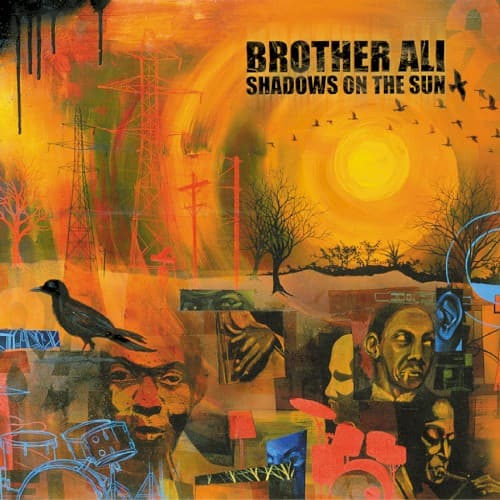
What set Ali apart from his underground peers wasn't just his willingness to address personal struggle, but his capacity to transform intimate confession into universal commentary. His 2003 breakthrough Shadows on the Sun established him as more than a regional curiosity, presenting fully realized storytelling that balanced social consciousness with street-level observation. Unlike politically minded rappers who spoke in abstractions, Ali grounded his message in specific moments—childhood poverty, family dysfunction, the daily navigation of being visibly different in America.
He built his reputation outside industry machinery, touring relentlessly through venues where fans came for substance over spectacle. His catalog documents the evolution of an artist who maintained artistic integrity while commercial hip-hop shifted around him, never compromising his message to chase trends. For listeners seeking depth and authenticity, Brother Ali became a touchstone, proof that technical skill and emotional honesty could coexist without dilution.
Boom-Bap Foundation and Confessional Lyricism
Brother Ali's sound rests on traditional boom-bap architecture, built through his long collaboration with Ant, whose production aesthetic favors dusty soul samples, crisp drums, and warm basslines that recall hip-hop's golden era without sounding retro. The musical backdrop intentionally avoids flash, creating space for Ali's voice to dominate—a deliberate choice that prioritizes message over sonic experimentation. Ant's beats provide foundation rather than decoration, layering texture without overwhelming the lyrical content that drives each track.
As an MC, Ali combines technical proficiency with conversational delivery. His flow shifts between methodical storytelling and bursts of rapid-fire intensity, always serving the narrative rather than showcasing technique for its own sake. He doesn't rely on complicated rhyme schemes or acrobatic wordplay; instead, his strength lies in clarity and emotional directness. When he addresses systemic racism, personal failure, or spiritual struggle, the language remains accessible without becoming simplistic. His voice carries weight—a gravelly instrument that conveys hard-won wisdom rather than youthful bravado.
The influence of conscious rap traditions runs through his work, echoing artists who used hip-hop as a vehicle for social commentary, yet Ali distinguishes himself through unflinching self-examination. He holds himself accountable in the same breath as critiquing society, a practice that prevents his political tracks from feeling preachy. The production rarely ventures into experimentation; this isn't music designed to push sonic boundaries. It's designed to make you listen, to create the conditions where difficult truths can land without distraction.
Building a Legacy One Album at a Time
Brother Ali's recording career began in earnest with regional releases in the early 2000s, but Shadows on the Sun in 2003 marked his proper arrival. The album distilled everything that would define his approach: personal narrative as political statement, production that honored hip-hop fundamentals, and an unwillingness to soften difficult subject matter. Tracks addressing his experience as an albino in Black culture, his conversion to Islam, and his navigation of poverty resonated beyond the underground circuit. Critics and fans responded to its honesty, establishing Ali as an artist whose credibility came from lived experience rather than manufactured persona.
The follow-up, The Undisputed Truth in 2007, expanded his reach while maintaining artistic control. Singles like "Uncle Sam Goddamn" became anthems within progressive circles, their political critique delivered with the force of personal grievance rather than academic distance. The album's success demonstrated commercial potential existed for uncompromising music, even as mainstream hip-hop moved toward ringtone rap and club-focused production. Ali toured exhaustively during this period, building an international following through word-of-mouth and relentless stage presence that translated recorded intensity into live communion.
Us in 2009 and Mourning in America and Dreaming in Color in 2012 deepened his catalog without dramatic stylistic shifts. He refined rather than reinvented, each project offering variations on established themes—systemic injustice, family responsibility, spiritual seeking, artistic integrity. Some critics noted the consistency bordered on predictability, yet fans appreciated reliability in an industry that often demanded reinvention. Ali positioned himself as a craftsman rather than an innovator, someone committed to perfecting a specific approach rather than chasing evolving trends.
His later work, including All the Beauty in This Whole Life in 2017, showed an artist comfortable in his lane. The album addressed fatherhood, aging, and legacy with the same emotional directness that characterized his earlier output, though perhaps with less urgency. He remained a fixture on the independent touring circuit, drawing audiences who valued message and authenticity over production novelty or celebrity association. Collaborations with fellow Rhymesayers artists like Atmosphere reinforced his position within a specific ecosystem—the Twin Cities scene that valued craft, independence, and regional identity.
Throughout his career, Ali navigated the tension between accessibility and uncompromising content. He never achieved mainstream crossover, but whether by choice or circumstance, his influence within conscious hip-hop circles remained substantial. Artists seeking to balance political content with personal revelation frequently cited him as a model, proof that underground status didn't require artistic compromise.
Conscious Rap's Uncompromising Standard-Bearer
Brother Ali's impact lives primarily within the underground and conscious rap communities that value message over commercial metrics. He demonstrated that an artist could build a sustainable career without industry validation, relying instead on direct fan connection and relentless touring. His catalog serves as reference point for rappers attempting to balance activism with artistry, offering a model where political content emerges from personal experience rather than ideological positioning.
His visibility as an albino Muslim in hip-hop challenged assumptions about identity and authenticity, complicating simplistic narratives about who could speak from within Black musical traditions. He addressed this tension directly in his music rather than avoiding it, turning potential controversy into conversation. This transparency influenced how subsequent artists approached questions of identity, belonging, and cultural participation—recognizing complexity rather than demanding categorical answers.
While he never achieved the commercial success of his politically minded predecessors or the critical canonization of alternative hip-hop peers, Brother Ali maintained artistic integrity across two decades. His work with Rhymesayers helped establish the label as a home for artists prioritizing independence, and his partnership with Ant provided a template for producer-rapper collaboration built on mutual understanding rather than one-off transactions. For listeners discovering conscious hip-hop, his catalog remains essential—a body of work that proves emotional vulnerability and technical skill can coexist, that political music can emerge from confession, and that underground status can reflect choice rather than failure.