Scorecard: 6.8/10 · Good
How we score- Writing(25%)
- 6.5
The serial killer concept yields some sharp punchlines and black humor, but the accents and shock-value overreach make half the verses tiresome to revisit.
- Production(25%)
- 9.0
Dr. Dre constructs a cold, meticulous soundscape of horror-movie strings, lurching drums and synth stabs that remain the album's strongest argument.
- Delivery(15%)
- 6.0
The flow mechanics are often intricate, but the cartoonish accents and manic character voices wear out their welcome across twenty tracks.
- Cohesion(15%)
- 5.0
At 77 minutes with five skits and too many filler murder fantasies, the album sags badly in the middle and tests patience long before it earns 'Underground' as a closer.
- Originality(10%)
- 6.5
Returning to Slim Shady territory after five years sounds fresh for one album cycle in 2009, but adds little to what the first two records already established.
- Replay value(10%)
- 6.0
The production holds up and a handful of tracks remain compelling, but the concept and performances have aged into a curiosity rather than a classic.
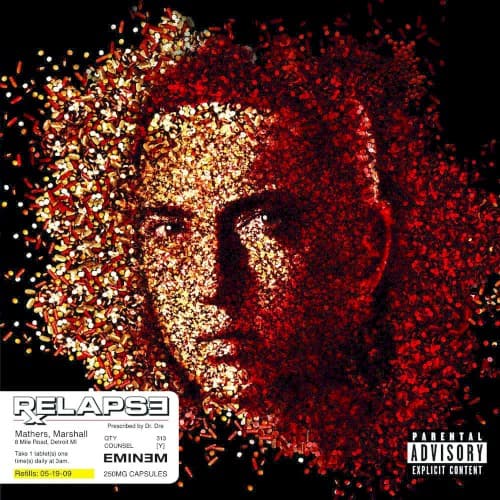
Eminem Relapse — The Detox That Went Too Far Into the Basement
Relapse is a test of whether technical skill and world-class production can carry an album when the concept wears thin by the halfway mark. Eminem's first studio album after a five-year hiatus spent battling prescription drug addiction arrives with Dr. Dre behind every board except one, and the result is a sonic achievement wrapped around a writing experiment that only half works. The pitch is simple: Eminem raps as if he is still on drugs, channeling his Slim Shady alter ego through serial killer fantasies delivered in a rotating cast of accents. For ten tracks, the idea generates some of the darkest and most technically ambitious rap he has recorded. For the other ten, it becomes a chore.
The stakes in 2009 were survival. Eminem had not released solo material since Encore stumbled in 2004, and his absence was defined by public struggles, Proof's death, and an overdose that nearly killed him in 2007. Relapse needed to prove he could still rap at the highest level and that sobriety had not dulled the edge. It does prove the first and raises questions about the second. The album works when it leans into the horror-movie production and treats the murder sprees as gallows humor about his own mental state. It falters when the accents and shock tactics become the point rather than the vehicle, turning what could have been a focused concept into a bloated exercise in provocation for its own sake.
When the Beat Is Smarter Than the Bars
Dr. Dre's production on Relapse is surgical and unrelenting, a masterclass in building atmosphere without sacrificing rhythmic complexity. The beats are cold and mechanical, built from minor-key synth lines, orchestral stabs, horror-movie strings and drums that lurch and snap rather than knock. Tracks like '3 a.m.' and 'Stay Wide Awake' sound like the inside of a locked room where something terrible is about to happen, and Dre uses space and silence as effectively as he uses sound. The mix is immaculate: every hi-hat, every vocal layer, every bass note sits exactly where it needs to be, and the album never sounds cluttered even when the arrangements are dense. Mark Batson and Dawaun Parker contribute additional touches on several tracks, but the sonic vision is pure Dre, and it remains the album's most durable achievement. This is the best Eminem has ever sounded from a purely sonic perspective, and the production alone keeps Relapse in rotation for listeners who can tolerate the writing. The production shares DNA with Dre's work on 2001, though here the atmosphere is darker and more claustrophobic.
The writing, however, is uneven in ways that production cannot fix. Eminem's technical skill is never in question: the internal rhyme schemes are intricate, the multisyllabic runs are precise, and the flow constantly shifts cadence to match the beat's pockets. The problem is that the concept asks him to play the same character in the same mode for most of the album, and the serial killer shtick runs out of new things to say by the time 'Medicine Ball' arrives. The accents, intended to add dimension to the Slim Shady persona, mostly flatten it.
The British villain voice, the nasally Midwest exaggeration, the Christopher Reeve impression: these are devices that work in small doses but become grating when deployed across fourteen full-length tracks. The shock value is deliberate and occasionally funny in a pitch-black way, but Eminem mistakes volume for impact too often here. When he drops the character work and raps plainly about his overdose on 'Deja Vu' or his depression on 'Beautiful', the writing sharpens immediately, which makes the commitment to the concept elsewhere feel like a missed opportunity.
The guest appearances are minimal and functional. Dr. Dre trades verses on 'Old Time's Sake', a weed-rap throwback that feels like a contractual obligation, and 50 Cent shows up for the hook on 'Crack a Bottle', a radio single that does its job without adding much to the album. The skits, voiced by Dominic West, Paul Rosenberg and Angela Yee, are the usual Eminem skit fare: some land, some do not, and all of them could have been cut to tighten the runtime. The real weakness is not what the guests do but what Eminem does not do: there are no perspective shifts, no storytelling tracks that break the serial killer frame, and no moments where he steps outside the concept to reflect on why he chose it. The album is so committed to the bit that it forgets to justify the bit, and that becomes a problem when the listener is seventy minutes in and still waiting for the payoff.
Seventy-Seven Minutes That Should Have Been Fifty
Relapse is too long, and the pacing suffers for it. The album opens strong with the first stretch establishing the tone and tracing addiction back to family dysfunction with enough specificity to feel personal rather than cartoonish. The momentum continues through the opening third, but the middle section sags under the weight of repetition. By the time the album reaches its midpoint, it is treading water, cycling through the same shock-rap tricks without developing them further.
The skits break up the flow without adding value, and the forced attempts at radio singles do not fit the album's darker ambitions. The final stretch redeems some of the runtime. 'Deja Vu' is the track where Eminem drops the accents and the character work and raps directly about the overdose and the depression that defined his hiatus. The closing run returns to the raw battle-rap energy of his early Detroit days, and it works as a thesis statement for what the album could have been if it had committed to sharp writing over shock value.
The problem is that these peaks are separated by long stretches of filler, and the album never builds the kind of sustained arc that would justify the length. A tighter tracklist cutting five or six songs would have made Relapse a significantly stronger record.
A Technical Showcase That Forgot to Edit Itself
Relapse sits in the middle of Eminem's catalog: better than Encore, not close to the first two Marshall Mathers records. It proves that sobriety did not cost him his technical ability, and Dr. Dre's production is some of the best work either artist has done together. But the album is undone by its own ambition, or more precisely, by its refusal to rein in that ambition. The serial killer concept is a strong idea for half an album, not a full one, and the accents and shock tactics that might have been effective in smaller doses become exhausting across seventy-seven minutes.
The writing is sharp when Eminem drops the character work, but those moments are too rare, and the album never justifies why it chose to stay in character for so long. This is an album for listeners who value production and technical craft over cohesion and restraint. If you can tolerate the concept's diminishing returns, the beats and the flow mechanics are worth the effort. If you cannot, skip to 'Deja Vu', 'Beautiful' and 'Underground' and move on.
Relapse has gained a cult following since its release, and the reevaluation is not unearned: the production has aged well, and the album's willingness to commit fully to a dark, uncommercial concept deserves credit in an era where most major-label rap plays it safe. But the reevaluation also tends to overlook the album's real problems, and those problems are structural, not subjective. Start with 'Stay Wide Awake' and '3 a.m.' if you want to hear the concept at its peak. If those tracks work for you, the rest of the album will make sense. If they do not, Recovery is the better entry point for post-hiatus Eminem, and the first two albums remain the essential listens.
Track Listing
Dr. West (skit)
●Dominic West voices a sinister therapist who reveals himself as Slim Shady, setting the album's horror-movie tone. Functional setup, nothing more.
3 a.m.
▲The album's thesis statement and one of its best tracks. Dre's beat is a slow, menacing crawl of synth stabs and deep bass, and Eminem's flow locks into the pocket with precision. The serial killer fantasy is over-the-top but specific enough to work as dark comedy, and the hook is one of the few on the album that sticks. The accent is distracting but not yet exhausting. This is the template the rest of the album tries and fails to sustain.
My Mom
▲A sharper concept track that traces addiction back to a toxic mother-son relationship, with enough concrete detail to avoid feeling like pure shock value. The beat is rubbery and hypnotic, and Eminem's cadence shifts cleverly to match the rhythm. One of the few tracks where the writing and production are equally strong.
Insane
▼Eminem's attempt to make the listener uncomfortable succeeds, but the track has no purpose beyond that. The child abuse fantasy is grotesque without being insightful, and the accent makes it harder to sit through. Filler disguised as provocation.
Bagpipes From Baghdad
▼A celebrity diss aimed at Mariah Carey and Nick Cannon that feels petty and dated even by 2009 standards. The pungi loop is interesting for about thirty seconds, then becomes irritating. Skippable.
Hello
●A reintroduction track with a cleaner pop structure and a more restrained performance. The hook is serviceable, and Eminem sounds focused rather than manic. Not essential, but solid enough to keep the album moving.
Tonya (skit)
●A brief skit setting up the next track. Disposable.
Same Song & Dance
●Another serial killer fantasy, this time targeting Lindsay Lohan and Britney Spears. The beat has a sinister dancehall bounce, and Eminem's flow is technically impressive, but the concept is wearing thin by track eight. The writing is clever in places but repetitive in execution.
We Made You
▼A forced radio single that mocks celebrities with 2009-era references that have not aged well. The production is too bright for the album's dark tone, and the humor feels try-hard. One of the album's weakest tracks.
Medicine Ball
▼More celebrity mockery, this time aimed at Christopher Reeve. The impersonation is tasteless without being funny, and the track adds nothing to the album's concept. Pure filler.
Paul (skit)
●Paul Rosenberg leaves a voicemail. Nineteen seconds that could have been cut.
Stay Wide Awake
▲The album's darkest and most technically accomplished track. The beat is claustrophobic and menacing, built from minor-key piano and a shuffling drum pattern, and Eminem's flow is relentless, packed with internal rhymes and cadence shifts that never feel forced. The subject matter is brutal and unpleasant, but the writing is specific enough to justify the concept, and the performance is committed. This is Relapse at its peak: uncomfortable, precise and impossible to ignore.
Old Time’s Sake
●A weed-rap duet with Dr. Dre that feels like a contractual obligation. The beat is solid but generic, and neither artist sounds particularly invested. Forgettable.
Must Be the Ganja
▼Eminem compares his studio obsession to drug addiction, a potentially interesting idea buried under lazy execution. The beat is fine, the writing is not. Filler.
Mr. Mathers (skit)
●Paramedics find Eminem unconscious from an overdose. A brief transition into the next track.
Deja Vu
▲The first track where Eminem drops the accents and the character work and raps plainly about his 2007 overdose. The details are specific and harrowing: the hospital visit, the fear in his daughter's eyes, the cycle of relapse. Dre's production is spare and tense, and Eminem's delivery is sober in both senses. This is the writing the album needed more of, and it stands as one of the few tracks that improves with every listen.
Beautiful
▲The album's emotional center and its best track. Eminem produced this himself, sampling Queen and Paul Rodgers over a piano-driven beat that builds slowly into a gospel-tinged climax. The writing is direct and vulnerable, addressing depression and self-doubt without hiding behind shock value or character work. The hook is the album's most memorable, and the track works as both a standalone single and a counterpoint to the horrorcore excess that dominates the rest of the record. This is what Eminem sounds like when he trusts the material enough to get out of its way.
Crack A Bottle
●A competent radio single with Dr. Dre and 50 Cent that does its job without adding much to the album. The beat is celebratory and the hook is catchy, but the track feels like a leftover from an earlier era. It topped the charts and proved Eminem could still make hits, but it is not a reason to revisit the album.
Steve Berman (skit)
●Steve Berman yells at Eminem about the album's content. The joke is that the label hates the record, which is true. One minute twenty-nine seconds that could have been cut.
Underground/Ken Kaniff
▲A closing track that returns to Eminem's Detroit battle-rap roots, stripping away the concept and the accents for six minutes of dense, multisyllabic rhyming. The beat is sparse and the writing is sharp, and the track works as a reminder of what Eminem can do when he focuses on craft over concept. A strong closer that suggests the album could have been better if it had followed this template throughout.