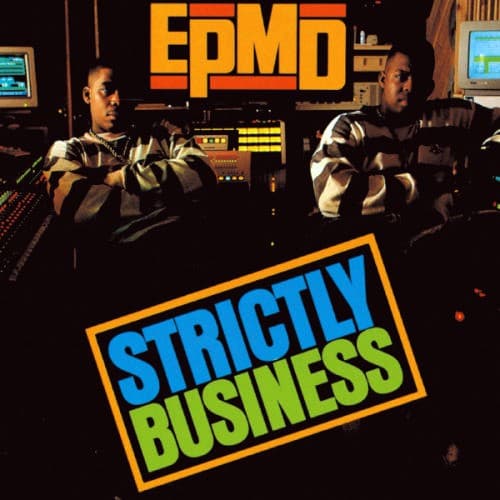
EPMD Strictly Business — The Blueprint for Getting Paid Off Loops
Two guys from Long Island split production costs fifty-fifty, cleared no samples, and recorded an album in their bedroom that became the business model for every independent rap crew that followed. Erick Sermon and Parrish Smith were working sales jobs when they pressed up Strictly Business on a label nobody had heard of. No major distribution, no radio campaign. Just a crate full of funk records and the understanding that hip-hop could be a profitable enterprise if you kept overhead low and quality high.
The duo called themselves EPMD — Erick and Parrish Making Dollars — and the name was not a flex. It was a mission statement. Where Run-DMC made rap rock-hard and Public Enemy made it militant, EPMD made it transactional. Every bar about business, every hook about moving product, every beat structured like a balance sheet: minimal investment, maximum return.
This was hip-hop as entrepreneurship, and the timing could not have been better.
East Coast rap in 1988 was at a crossroads. The old-school party rap formula was exhausted, and the golden age was about to explode. Here came EPMD with a sound that felt both classic and futuristic — stripped-down funk loops, no-frills delivery, and a work ethic that treated rap like a nine-to-five with overtime potential. Did they know they were creating a template that would define the next decade of hip-hop?
The Economics of Funk
The production on Strictly Business sounds like somebody raided their uncle's record collection and decided to flip the three dustiest funk 45s they could find. Erick Sermon — who handled most of the board work — did not overthink it. He grabbed loops from Kool and the Gang, Zapp, and Eric Clapton, let them ride for three minutes, and trusted the groove to do the work. No layering, no embellishment, just bass, drums, and the occasional stab.
The aesthetic was ruthlessly efficient, and it made every other producer in New York realize you did not need a studio budget to sound professional.
Sermon and Smith trade verses like they are passing a clipboard back and forth. Their flows are deliberate, unhurried, almost conversational. Parrish Smith — the deeper voice — anchors the tracks with a monotone that never wavers. Erick Sermon — slightly higher, slightly more animated — provides the counterpoint.
Neither man is trying to wow you with wordplay.
The content is relentlessly transactional: moves made, money earned, competition dismissed. It is the first album in hip-hop history that reads like a sales report. But the simplicity hides flaws. The album has no emotional range, and every song is about the same thing.
By the back half, the lack of thematic variety starts to weigh on the listening experience. There is no vulnerability here, no introspection, no storytelling that extends beyond the hustle. EPMD built a sound that dozens of crews would jack for the next five years. But they also built a sound with a ceiling — you can only write so many songs about being better at rap than the next guy before the message flattens.
Still, the influence is hard to argue with. EPMD proved that you could build a career on funk loops and monotone flows if you had the work ethic to back it up. Das EFX, Redman, and half the Def Squad owe their existence to this album. So do a hundred indie rap crews who realized they did not need a major label to move units — EPMD made rap feel like a small business, and for a generation of rappers who grew up watching their parents punch clocks, that was a revelation.
The Product Line
Strictly Business opens with the cleanest loop of 1988 and never apologizes for it. The first stretch is all thesis statement — three tracks that establish the sound, the attitude, and the business model without a single wasted bar. By the time the album hits the middle section, EPMD has already made their case. The question is whether they can sustain the momentum without expanding the formula.
They cannot, but they come close. The back half drags slightly — not because the quality drops, but because the conceptual repetition becomes harder to ignore. Every track is a variation on the same theme: we are better than you, and we are getting paid for it. The sequencing does not build toward anything.
There is no climax, no emotional peak, just ten songs that exist at the same temperature. It works because the temperature is perfect. But it also means the album never surprises you after the first three tracks.
What saves the listening experience is the consistency. EPMD never chase a radio single and never compromise the sound to appeal to a wider audience. The album feels like a ten-track mission briefing, and by the end, you understand exactly what EPMD is about. That clarity is rare in debut albums, and it is the reason Strictly Business still functions as a complete work even when individual tracks start to blend together.
The First Franchise
Strictly Business is the second-best album in EPMD's catalog, right behind Business as Usual. It is the blueprint, but the sequel refined the formula. Still, this is the one that mattered most. Without this album, there is no Def Squad, no Redman solo career, no indie rap boom in the early nineties.
Who should listen to this? Anyone interested in the mechanics of golden age production. Anyone who wants to understand how hip-hop became a business model before it became a culture war. Anyone who appreciates minimalism in rap — the idea that you can say more with less if you trust the loop and stay on beat.
Who might not enjoy it? Listeners who need emotional range or thematic variety. This is not an album that explores feelings. It is an album that catalogs wins.
Strictly Business has aged better than most 1988 releases because it never tried to be anything other than functional. The beats still knock, the flows still work, the attitude still feels current. EPMD did not invent boom bap, but they perfected the idea that boom bap could be a profit center.
Essential tracks to start with: the title track, the second cut, and the fifth track. If those three hit, the rest of the album will make sense. For similar vibes, check out Eric B. and Rakim's Paid in Full or Audio Two's What More Can I Say?. EPMD's influence runs through every crew that treated rap like a business venture instead of an art project.
Track Listing
Strictly Business
▲Erick Sermon flips an Eric Clapton guitar riff into the coldest loop of 1988, and the entire East Coast wakes up. The production is minimal to the point of arrogance — just the loop, a kick, and a snare — but the groove is so hypnotic that nothing else matters. Parrish Smith opens with the deepest voice in New York, and Erick Sermon follows with a flow that sounds like he is reading terms and conditions over the phone. The hook is a sample from an old comedy skit, and it should not work, but it does. This is the song that made every bedroom producer realize they did not need a studio. It is also the song that made EPMD a problem. The beat still gets played at every golden age tribute event, and it still sounds better than half the records that came out last year. No debate.
I'm Housin'
▲The Zapp interpolation hits like a eviction notice. EPMD strips the funk down to its frame and builds a track about dominance that never raises its voice. Parrish Smith delivers the "I'm housin'" refrain like he is explaining a lease violation, and the matter-of-fact tone makes the threat land harder. Erick Sermon's verse is all business — no punchlines, no flexing, just a catalog of competitive advantages. The production is even more stripped than the opener, which should not be possible, but Sermon finds a way. The bassline does all the work, and the duo stays out of the way. This is the second statement of intent in ten minutes, and it confirms that EPMD is not interested in variety. They found a formula, and they are going to ride it until the wheels fall off. The wheels do not fall off.
Let the Funk Flow
▲The tempo slows slightly, and EPMD lets the bass do the talking. This is the first track where the formula starts to feel like a formula, but the groove is strong enough to carry it. Sermon and Smith trade verses about letting the music play, which is not the most original concept, but the delivery sells it. The hook is simple — just the title repeated — and it works because EPMD never oversells anything. The production is clean, functional, and devoid of surprises. It is a solid album track that would have been a standout on most other 1988 releases, but here it feels like EPMD coasting. Still, coasting for EPMD means most crews' A-game.
You Gots to Chill
●A James Brown sample anchors the track, and EPMD delivers a lecture about staying in your lane. The message is directed at biting MCs and industry hangers-on, and the tone is more annoyed than aggressive. Parrish Smith sounds like a teacher explaining why your homework is late, and Erick Sermon backs him up with the same energy. The production is funkier than the previous three tracks, with more movement in the loop, but the track suffers from conceptual repetition. How many times can you tell competitors to step off before the message loses impact? EPMD tests the limit here. The beat saves it from being filler, but this is the first track where the lack of thematic range starts to show.
It's My Thang
▲Marvin Gaye's "Ain't That Peculiar" becomes the backbone for EPMD's independence anthem, and suddenly the album has a new gear. This is the first track where the concept expands beyond competition. Sermon and Smith are not talking about other rappers here — they are talking about control, ownership, and the right to move without permission. The hook is direct: "It's my thang, I'll swing it the way that I feel." It is the most punk rock moment on the album, and it hits harder because EPMD delivers it with the same flat affect they use for everything else. The production is warmer than the previous tracks, and the loop has more soul. This is the album's commercial peak, and it works because EPMD never chases the pop moment. They let the funk come to them. Essential.
You're a Customer
▲EPMD flips the script and addresses the audience directly. The customer in question is anyone buying into wack rap, and Sermon and Smith position themselves as the quality alternative. The metaphor is retail, and it works better than it should. Parrish Smith's verse about moving product without compromising standards feels like a mission statement for the entire indie rap movement that followed. Erick Sermon's verse doubles down on the economics, and the track becomes a blueprint for how to build a brand without major label support. The production is clean and minimal, with a bassline that could have been lifted from a corporate training video. It should not work, but EPMD makes it work by committing fully to the concept. This is the track that separates EPMD from every other crew in 1988.
The Steve Martin
▼The title is a reference to the wild and crazy guy routine, but the track itself is anything but wild. EPMD delivers another round of competitive verses over a funk loop that sounds like it was recorded in a carpeted room. The energy is lower here, and the track feels like an interlude stretched to full length. Sermon and Smith are going through the motions, and the production does not compensate. This is the first true filler moment on the album, and it exposes the limitations of the EPMD formula. When the duo does not bring intensity, the minimal production leaves nowhere to hide. Skippable.
Get Off the Bandwagon
●Another track about biting MCs, and by now the message is redundant. EPMD has made this point three times already, and the repetition drains the impact. The production is solid — a mid-tempo funk loop with a clean break — but the content adds nothing new. Sermon and Smith sound like they are checking a box rather than making a statement. The hook is functional, the verses are competent, and the track is entirely forgettable. This is what happens when a duo commits to a formula without building in room for growth. Decent filler, but nothing more.
D.J. K la Boss
▲A DJ showcase that lets the beats breathe. No verses, just scratching and loops. It is a throwback to the old-school format, and it works as a palate cleanser after two mid tracks. The scratching is clean, the breaks are tight, and the track functions as a reminder that EPMD's strength is in the production. Brief and effective.
Jane
●The album closes with a narrative track about a woman named Jane, and it is the first time EPMD attempts storytelling. The concept is simple — Jane is trouble, and the duo breaks down why — but the execution is uneven. Parrish Smith handles the first verse with his usual monotone, and it works. Erick Sermon's verse tries to inject more personality, and it feels forced. The production is slower and more atmospheric than anything else on the album, which gives the track a different texture, but the narrative never fully lands. EPMD is better at thesis statements than stories, and this track proves it. Still, the attempt at variety is appreciated, and the track functions as a decent closer even if it does not rank among the album's best moments.