The scorecard
8.1/10 · Great
- Writing25%
- 7.0
- Production25%
- 8.5
- Delivery15%
- 8.5
- Cohesion15%
- 8.0
- Originality10%
- 9.0
- Replay value10%
- 8.5
The lyrics deal in menace, appetite and paranoia through blunt, compressed imagery, and they hit hardest on the singles, but across thirteen tracks the point of view narrows to one pitch.
Zach Hill's drumming and Andy Morin's keyboards and programming turn clashing, dirty material into hard, forward-leaning beats, and the sheer force of the low end is the album's chief weapon.
The lead voice keeps a barking, physical pressure for the entire running time, and the single guest vocal on Lord of the Game gives that pressure a counterpoint.
Thirteen tracks play as one extended attack, and only the instrumental interlude and the very short 5D interrupt it.
It joined rap vocals to punk and industrial noise with a conviction that few acts of its moment, even the loud ones, were willing to match.
The singles are durable and the record rewards repeat plays, though its extremity limits how often most listeners will want it.
Death Grips Exmilitary — The Free Mixtape That Rewrote What Rap Could Sound Like
Exmilitary is the rare debut that sounds like a finished argument. It was released for free on the group's website in April 2011, a mixtape by a trio that had no obvious precedent in rap and no interest in explaining itself, and its first track already makes the case: a long, heavy, hostile opener that lets you know exactly how the next hour will treat you. The question for a reader today is whether that hostility is still a viable listen or just a historical artifact. It is still a viable listen, and a better one than most of what followed in its shadow.
My argument is that Exmilitary matters less as a stylistic first than as a lineage record. It takes the density of hardcore punk, the grind of industrial music and the confrontational pressure of rap's loudest tradition and fuses them into something that sounds like none of its parents. Rap has always had a noisy wing, with groups that treated distortion and sirens as a statement. What this mixtape did was remove the safety nets. There is no soul sample to sweeten the blow, no melodic hook to excuse the volume, and no narrative to make the violence readable as a story.
That purity is both the strength and the limit of the record. The writing is bludgeoning rather than elaborate, and it works because the delivery commits completely. Pitchfork's critic called it a bludgeoning slab of hostility that avoids being an overbearing mess, and I think that phrase gets at the real achievement: the album is brutal and it is controlled. Every track has a spine, and the spine is nearly always rhythm.
The critical consensus, an 82 on Metacritic from seven critics, is fair. Where I would part from the usual story is that the record is often described as chaotic. It is not. It is precise, and the precision is the reason it still works. This is a debut that knew exactly what it wanted to be, and it remains the best place to understand where Death Grips came from and why the group kept its audience.
Precision Disguised as Chaos
The first thing to understand about Exmilitary is that it is built on rhythm. Zach Hill, a drummer by trade, and Andy Morin, handling keyboards and programming, listed as the group's producers, make beats that behave like live drumming pushed through a wall of distortion. The kick drums land with a weight that most rap production only simulates, and the snares crack with a dry, flat edge that gives every track a physical punch. This is why the record can be so loud without becoming shapeless. The noise is arranged around a pulse, and the pulse never lets go.
The lead vocal is the second pillar. The voice is a bark, close to a chant in places, and it carries the hard, rhythmic attack of a punk frontman more than a traditional MC's conversational flow. This matters for lineage. Rap has a long history of voices used as percussion, from the early stadium shout records to the dense, aggressive delivery of the late 1980s, and this mixtape is part of that line. The difference is the context: the beats around the voice are not funk or soul, but something closer to a factory floor. The result is rap stripped of its usual warmth, which is both the point and the problem.
The writing is where the record is most open to criticism. The lyrics rely on short bursts of vivid, aggressive imagery and repeated phrases that work like slogans. At their best, they turn into the kind of refrains you carry around for days. At their weakest, they are repetitions of a posture rather than developments of an idea. A listener looking for detail, narrative or emotional range will find a narrow band of expression here, and the mixtape's moods rarely stray from threat and compulsion. That is a limitation, and it is the reason the record sits below the very best albums in the genre on pure writing.
The mixtape format is part of the story too. Because it was released free on the group's own site, the project never had to conform to a label's idea of an album, and it shows. The tracks vary in length, the sequencing is eccentric, and a short instrumental and a very brief track sit among full songs without apology. The later release of the instruments and stems, as the group's follow-up Black Google, confirms how seriously the group treated the work as raw material for others.
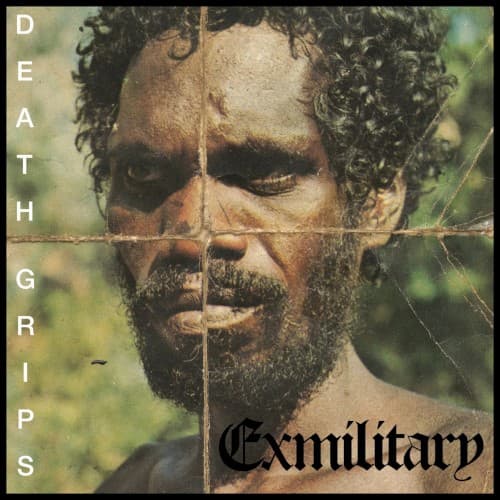
The cover, a photograph the group described as a power object, fits the album's attitude: nothing here is decoration. Taken together, the production, voice and presentation give the mixtape a rare unity of purpose. It is a record that knows what it is and refuses to dilute it, which is the best explanation for why it is still discussed a decade and a half on.
An Hour That Never Lets Up
The sequence is the album's quiet strength. Exmilitary opens with its longest song, which sets the terms: this is not a record that eases you in, and the length of the opener works as a filter. Anyone who stays through it is ready for what follows. The decision to lead with duration and weight instead of a single is the kind of confident choice that separates an album from a mixtape pile, and it gives the record an opening statement that most debuts lack.
From there the pacing works in waves. The singles arrive early and in clusters, and the rest of the record varies the attack by shifting tempo and density instead of mood. The middle sags slightly, because the consistency that gives the record its power also makes some tracks hard to tell apart on a first listen. That is a real pacing cost, and it is the reason a listener dropping into the record from a playlist will find the early singles more accessible than the deep cuts.
The interruptions are smartly placed. A short instrumental and a track under a minute break the assault at just the points where fatigue sets in, and these interludes work as pressure valves rather than filler. They are a sign that the group thought about listening as an experience over time, not only as a stack of tracks.
The closing stretch goes long again, with two of the longest tracks on the record near the end, and the album finishes on an extended, grinding note that mirrors the opener. This bookend structure gives the project a shape, and it is why the hour feels earned. The length is justified by the intensity: the album never pads, and it is long because it needs room to build momentum, not because it needs to reach a run time. A shorter version would be easier to digest, but it would lose the accumulating pressure that makes the record what it is.
The Rawest Door Into a Radical Catalog
Within the group's catalog, my judgment is that Exmilitary is the best place to meet the group at its most unfiltered. Later records refine the formula, add guitars and sharpen the songwriting, and some of them are easier to love. But none of them has the combination of surprise and total commitment that this debut has, and that is the quality that made the mixtape a reference point.
It is for listeners who want rap at its most confrontational, for punk and industrial fans curious about the hip-hop side of that family tree, and for anyone interested in how the mixtape format let a group bypass the usual gatekeepers. It is also a useful record for anyone studying how the genre's boundaries moved in the early 2010s. Skip it if you need melody, humor or lyrical detail, because the album offers little of any of them, and if you are sensitive to relentless volume.
The record has aged well. Its sound was never tied to a fashion, so there is no dated trend to wear off, and the hostility that critics noted at release still reads as intentional. If anything, the influence is more audible now, in the harsher and noisier corners of rap that came after it.
Start with Guillotine, the group's best-known song, then move to Lord of the Game for the album's most direct hook and a guest vocal that adds contrast, and Known for It for the clearest sense of how the group builds a long track from a simple rhythm. For what to hear next, the follow-up release Black Google is the obvious companion, since it strips the same songs down to their parts, and the group's later album Bottomless Pit shows how the same energy sounds when it is organized around guitars and shorter songs. The sharpest way to put it is that Exmilitary is where the group first proved that rap could be this hard and still be this exact.
Track by track
Track Listing
Beware
StandoutThe opener runs almost six minutes and sets the album's terms by refusing to ease anyone in. The beat is heavy and slow-burning, the voice is clipped and menacing, and the length functions as a filter for the listener. It is a bold choice to begin with the longest piece on the record, and it works because the track builds pressure instead of just repeating volume. It is one of the best statements of purpose in the group's catalog, even if it is not the most immediately catchy song here.
Guillotine (It Goes Yah)
StandoutThe group's best-known song, and the clearest illustration of its method: a hard, driving rhythm, a chant-like refrain and a vocal attack that sounds more like a punk shout than a rap verse. The hook is blunt but sticky, and the track is the easiest entry point on the record. It was released through iTunes later in 2011 and has become a defining piece for the group. It works because every element pushes in the same direction.
Spread Eagle Cross the Block
StandoutA strong early single that pairs a steady, heavy rhythm with a vocal that rides the beat like a drum fill. It had a music video, and it makes sense as a display of the group's raw energy, though its approach is close enough to the opening tracks that it can blur with them. A solid, forceful entry that sustains the album's momentum.
Lord of the Game
StandoutThis is the one track with a guest, Mexican Girl, who contributes additional vocals, and the extra voice gives the song a texture the rest of the record lacks. The hook is among the most direct on the album, and it had its own music video. The contrast between the lead's barking and the guest's presence makes it one of the most distinctive tracks here, and a good example of how a small amount of variety goes a long way in a record this uniform.
Takyon (Death Yon)
StandoutA short, punchy track that moves fast and keeps its energy high. The group made a video for it, and it plays as one of the more compact and hook-driven songs on the record. It does not reach the depth of the best tracks, but its brevity is an asset.
Cut Throat (instrumental)
SolidA brief instrumental interlude that gives the listener a short break from the vocals. It shows off the beat-making on its own terms, but it is more a palate cleanser than a destination.
Klink
SolidA mid-album track that keeps the pressure steady without adding much new. It is competent and forceful, but it sits in the stretch of the record where the songs start to blend together, and it lacks the standout hook of the singles.
Culture Shock
StandoutOne of the tracks released with a music video, and it shows the group at its most focused. The beat is dense and the delivery is controlled, and the song earns its length by building and releasing tension instead of staying at a single level. A strong mid-album highlight that proves the record can sustain interest well beyond its opening singles.
5D
SolidAt under a minute, this is an interlude more than a song. It adds texture and a change of pace but little else, and it exists to keep the sequence moving.
Thru the Walls
SolidA heavy, grinding track that keeps the pressure on. It does not have the distinct personality of the singles, but it is a satisfying piece of the album's central sound, and its steady beat gives it a hypnotic quality in the context of the sequence.
Known for It
StandoutAnother track with a music video, and one of the most effective long-form pieces on the record. The song builds from a simple rhythmic idea and lets the vocal ride it for more than four minutes without losing grip. It shows how the group can sustain a single mood and make repetition feel like escalation, and it is one of the best demonstrations of why the record works as a whole.
I Want It I Need It (Death Heated)
StandoutThe second longest track runs past six minutes and plays as an extended, grinding statement. It tests patience, but it rewards it, because the track keeps shifting its texture and its energy even as the core idea stays the same. A strong late-album piece that gives the record some of its most committed stretches, and a good example of the group's willingness to let a song run long.
Blood Creepin
SolidThe closer runs nearly five minutes and ends the record on a dense, relentless note that mirrors the opener. It does not offer relief, which is consistent with the album's logic, and it gives the project a sense of closure through repetition rather than resolution. A fitting end, if not a highlight.
Frequently Asked Questions
Is Death Grips Exmilitary a good album?
Was Exmilitary released for free?
What is the best song on Exmilitary?
Styles