The scorecard
6.5/10 · Good
- Writing25%
- 6.5
- Production25%
- 6.5
- Delivery15%
- 7.0
- Cohesion15%
- 6.5
- Originality10%
- 6.0
- Replay value10%
- 6.5
Scarface's patient, detail-driven scenes on Crooked Officer and Six Feet Deep keep the dread concrete rather than theatrical, though Big Mike's verses on Straight Gangstaism are thinner.
Mike Dean's live-feeling bass, keys and guitar give the whole record a thick, unhurried Houston low end that stays consistent across four producers.
The contrast between Scarface's low, controlled growl and Bushwick Bill's high, jittery menace gives the verses push and pull, while Big Mike delivers forcefully but without their personality.
The mood is consistent for the first half, but fifteen tracks, an eight-minute posse cut and a flat middle stretch leave the sequence overlong.
It refines the group's established gangster-funk sound with slower tempos and a more fatalistic tone, but it does not open a new direction.
The best songs hold up because they rely on atmosphere and detail rather than shock, while the posse cut and weaker late tracks are easy to skip.
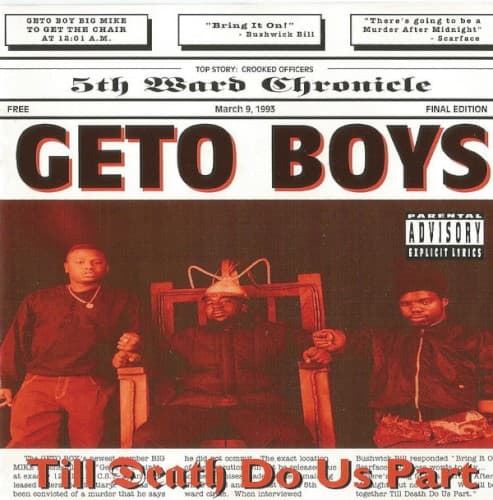
Geto Boys Till Death Do Us Part: A Scarface Album Wearing a Group's Name
Till Death Do Us Part is a Scarface album that happens to carry a group's name, and that fact explains both its best stretch and its slump. Willie D had left the Geto Boys, Big Mike had stepped into the vacancy, and the Houston trio's most volatile voice was suddenly absent. What replaced it is a record that sounds tired in the right way: slow, bass-heavy and fatalistic, the work of men who had already said the unsayable on earlier albums and now had to live with what came after.
My argument is simple. The album is good, not great, and it is good because of its mood rather than its range. When the group commits to dread, with live-feeling low end, crawling tempos and verses about police, funerals and paranoia, it is as convincing as any Southern rap record of its year. When it widens out into solo spots, a posse cut and a lighter closing stretch, the spell breaks, and Big Mike's place in the lineup starts to look like a problem the record never solves.
The stakes are bigger than one lineup change. Rap-A-Lot was trying to prove that Houston could move units without softening its sound, and the album did that: it reached number 11 on the Billboard 200, topped the Top R&B/Hip-Hop Albums chart and went gold the same spring. The Geto Boys were already the standard-bearers for Southern rap that refused to apologize, and this was the test of whether the name could survive the departure of one of its three faces.
It survives, but it survives on Scarface's gravity. His writing sets the temperature on the record's best songs, and Bushwick Bill supplies the unhinged color that keeps the dread from going monotone. Those two are enough to carry the opening half. They are not enough to carry fifteen tracks, and the album's second thesis, written into its sequencing, is that a group built on three clashing personalities cannot run on two and a guest.
Thick Bass, Narrow Subjects, and a Lineup Under Strain
The sound of Till Death Do Us Part is built from the bottom up. Mike Dean is credited with guitar, keyboards, bass guitar, engineering and mixing, and his fingerprints are on the way the record breathes: the low end is thick and unhurried, the keys hang in the air like smoke, and the drums are mixed to thud rather than snap. The production credits are shared among John Bido, J. Prince, N.O. Joe and Tony Randle, yet the album sounds like one room's idea of Houston at night. That consistency is its great strength. Nothing here is trying to be a radio single in the way a pop-rap record would, and even the tracks that charted keep the slow, menacing pulse intact.
The writing leans on a narrow set of subjects, and it handles them with more care than the group's reputation suggests. Police corruption, street death, paranoia and the exhaustion of living inside all three are the recurring concerns, and the best verses treat them as lived conditions rather than shock material. Scarface in particular writes with a patient, almost conversational control: he lets a scene build, states the cost plainly and moves on without celebrating. Bushwick Bill plays the opposite role, delivering his verses with a jittery, theatrical menace that makes the group's sound feel dangerous rather than merely sad. The contrast between the two is the album's main rhythmic engine, a low growl against a high rasp, and it gives the verses a push and pull that the production alone could not supply.
The weaknesses are just as concrete. Big Mike is the clearest one. He has a competent, forceful delivery, but he lacks the specificity of detail and the sense of danger that his two partners bring, and on the tracks where he carries the weight the record loses its personality. The album version of Straight Gangstaism, with two Big Mike verses and one from Mr. 3-2, makes the issue visible: it was released as a single to boost Big Mike's standing, and the video version added a Scarface verse to the end to avoid confusing fans. Even the people behind the song seem to have known that the new member needed help.
A second weakness is repetition of tone. Because the album commits so fully to one mood, a few of its songs blur together: the tempos are close, the hooks are similar, and the subject matter loops around death and street politics until the details start to repeat. The writing is rarely lazy, but it is rarely surprising after the first half hour, and the lack of any real change of pace makes the long songs feel longer than their running times.
What keeps the record above average is craft. The mixing is clear, the live instrumentation gives the songs a warmth that sample-driven records of the period often lacked, and the vocals sit in the mix with a presence that makes even the weaker verses easy to follow. It is a record that rewards listening for sound as much as for lyrics, which is not a trivial strength in a year when Southern rap was still fighting for sonic respect.
A Strong First Half, an Overlong Back End
The sequence is front-loaded, and that is the album's most important structural fact. The opening run sets a mood and sustains it: a short framing piece, a group statement of identity, then a stretch of songs about the law and about death that arrive one after another without letting up. By the time the record reaches its second single, the listener has been inside one atmosphere for twenty minutes, and the sense of a single, coherent world is strong. This is the album at its most convincing, and anyone judging it on its first half would be right to call it one of the better Houston records of the early nineties.
The middle holds, though with less force. The pacing starts to flatten around the point where Big Mike takes more of the spotlight, and the album begins to lose the push and pull between its voices. Tracks arrive at similar tempos, the hooks become less distinctive, and what had felt like a deliberate mood starts to feel like a habit. This is where the length begins to work against the record: fifteen tracks, including an intro and an outro that bracket the album with spoken material, is a lot of runtime for a group operating on two reliable voices.
The closing stretch is the sequence's one real gamble. A long posse cut near the end, running more than eight minutes and crowded with Rap-A-Lot labelmates and affiliates, is meant to widen the picture, and in terms of scene-building it does. As an album track it stalls the momentum the front half built, and the record's final stretch loses focus as a result. The set pieces are not bad; they are simply unevenly placed, and the album would end more strongly if the long cut sat earlier or were removed entirely.
So the length is only partly earned. A tighter version of this record, perhaps ten or eleven tracks, would sound like a classic of its type. As released, it is a very good thirty-five minutes inside a longer album, with a sequence that gets the mood right and then lets it dissipate. The sag does not ruin the experience, but it is the difference between a record people argue about for decades and a record people remember for a handful of songs.
Good Because of Its Mood, Held Back by Its Length
Till Death Do Us Part sits in the middle of the Geto Boys' run: weightier and more controlled than the group's earlier shock-driven work, but without the sense of a full lineup working at its peak. This site has no other Geto Boys albums rated yet, so the placement is provisional, but the record's profile is clear. It is a strong Scarface-led album with a mood that carries it a long way and a fifteen-track sequence that does not quite justify its length. The score reflects that: strong marks for writing, production and delivery, and a clear deduction for cohesion, where the album's pacing and the lineup change leave visible marks.
Who is it for? Anyone interested in Houston rap before the late nineties, anyone who likes slow, bass-forward gangster music with live instrumentation, and anyone curious about how a group handles losing a core member. It is a particularly good fit for listeners who care more about atmosphere than variety. Who should skip it? Listeners who want a front-to-back classic, or who need strong hooks and varied tempos, should look elsewhere; the album offers neither, and its weakest stretch comes late, when attention is most likely to drift.
How has it aged? Better than the group's reputation for shock would suggest. The production still sounds warm and physical, and the best verses retain their weight because they are built on concrete detail rather than provocation. The posse material and the Big Mike demonstrate have dated more, since they depend on a scene context that the album does not explain, but the core of the record holds up.
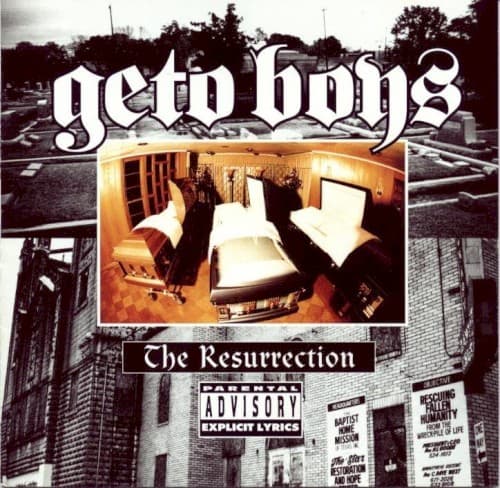
To start, play Crooked Officer, Six Feet Deep and Street Life. The first two are the album's singles and give the clearest picture of its dread and its writing, and the third shows the group at its most reflective. From there, a natural next step is the group's later album The Resurrection, which sets the same lineup of voices in a leaner, funkier frame, and a good way to hear how far the Geto Boys could push this sound when the sequencing matched the writing.
The record's best argument for itself is its slowest moment, where the bass settles in and a verse is allowed to run to its natural end without a hook to rescue it.
Track by track
Track Listing
Intro
SolidA spoken framing piece featuring J. Prince that sets up the album's tone and its Rap-A-Lot identity. It works as scene-setting but adds little on repeat listens, and it is more of a label statement than a musical opening.
G.E.T.O.
StandoutA short, firm group statement that establishes the lineup's voices early. The pacing is brisk by the album's standards, and it works as a quick introduction to who is rapping and what the mood will be. It is solid rather than special, a clean piece of group identity before the heavier material starts.
It Ain’t
SolidA slow, low-slung cut that stretches past four minutes and leans on mood more than on hook. The writing is competent, and the bass carries it, but it is one of the songs that blends into its neighbors on a full run. A fair showing for the group's sound without a moment that stands out.
Crooked Officer
StandoutThe lead single, and the clearest statement of the album's subject: the law as a threat rather than a protection. The beat moves at a deliberate pace, and the verses build a picture through concrete detail rather than slogans. It reached number four on the Hot Rap Songs chart, and it deserves the placement because the song argues its case without raising its voice. A key track, and the best entry point for understanding what the group is doing here.
No Nuts No Glory
SolidA harder, more aggressive cut that pushes the group toward bluster. The delivery is forceful and the beat is heavy, but the writing leans on familiar boasting, and it gives the album less to hold onto than the songs on either side. Solid enough, though it is the sort of track that a tighter sequence might have dropped.
Six Feet Deep
StandoutThe album's second single and its biggest crossover moment, reaching number 40 on the Billboard Hot 100. It is also the record at full strength: slow, grim and patient, with verses that make death sound like routine rather than spectacle. The five-minute length is earned because the mood never wavers. It is the track that best justifies the album's reputation, and the one to play if you only play one.
Murder Avenue
StandoutA street portrait built on the group's usual concerns, with a slower pulse and a heavy low end. The writing is vivid in spots, and the title announces its subject without hedging. It sits comfortably in the album's middle without climbing above it, a solid example of the record's central mood.
Raise Up
SolidA shorter piece with a lighter feel, and a brief change of pace from the surrounding material. It is competent and listenable, but it does not build into much, and the hook is the main reason it stays in memory. It works as a breather rather than a feature.
Murder After Midnight
StandoutA late-night narrative cut that keeps the dread going with the same slow tempo and heavy bass. The scene-setting is the strongest part, and the verses create tension without leaning on shock. Not a standout, but it holds the album's atmosphere together across the middle stretch.
Straight Gangstaism
WeakThe single built to introduce Big Mike, with two of his verses and one from Mr. 3-2 on the album version. It is a competent track, but the verses lack the detail of the Scarface and Bushwick Bill material, and the song feels like a promotional exercise. The video version added a Scarface verse for a reason: the song needs him. Useful as evidence of the lineup's weak point.
Cereal Killer
SolidA short, sharp cut at just over three minutes, and one of the tightest songs on the record. The brevity helps, and the song does not overstay its welcome. It is filler in the sense that it adds no new idea, but it is efficient filler, and the pacing is a welcome change.
This ’s for You
WeakA long, five-and-a-half-minute track with a slower, more sexual focus, and the one place where the record's mood shifts toward the lascivious. The length is hard to justify, and the writing is less sharp than on the album's best material. It is among the weaker tracks and a good candidate for the skip button.
Street Life
StandoutOriginally released as a single for the 1992 film South Central soundtrack, and it plays as the album's most reflective song. The five-minute running time allows the verses space to develop, and the mood is sorrowful rather than menacing. It makes a strong case for the group's range, and it is one of the three songs to hear first.
Bring It On
SolidAn eight-minute posse cut with a long guest list drawn from the Rap-A-Lot orbit and beyond. It works as a showcase for the label's roster, and there are good verses in the pile, but the track overstays its welcome and interrupts the album's momentum. Interesting as a document of the scene, less so as a piece of listening.
Outro
SolidA short closing piece with J. Prince, matching the intro as a label bookend. It does the job of ending the record and little else, and it is the filler that its position implies.
Frequently Asked Questions
Is Geto Boys Till Death Do Us Part good?
Who replaced Willie D on Till Death Do Us Part?
What are the best songs on Till Death Do Us Part?
Styles