The scorecard
8.0/10 · Great
- Writing25%
- 8.0
- Production25%
- 8.0
- Delivery15%
- 8.0
- Cohesion15%
- 7.5
- Originality10%
- 8.5
- Replay value10%
- 8.0
The paranoid first-person writing on the best song is among the sharpest in rap, and the anti-war and street-survival cuts have conviction, though a few shock songs lean on provocation over craft.
Funk samples from Funkadelic, Zapp & Roger, Isaac Hayes and Graham Central Station are slowed and darkened into a Houston sound that feels both groove-heavy and menacing.
Scarface, Willie D and Bushwick Bill each have a distinct voice, from the weary murmur to the booming bark to the frantic rasp, and they trade verses with real chemistry.
Each member gets three solo songs and the sequence mixes landmark tracks with shock-value cuts, so the quality dips noticeably between peaks.
Few records of 1991 put fear, depression and a Southern accent at the center of gangsta rap the way this one does, and its influence on later Houston and Memphis rap is hard to miss.
The key songs still sound alive and the grooves reward repeat plays, while the rougher shock tracks are more dated.
Geto Boys We Can't Be Stopped: The Record Where Houston Learned to Whisper
The loudest thing about We Can't Be Stopped is a whisper. For years the Geto Boys had been the most shocking group in rap, and then in 1991 they made a song that hits harder by lowering the volume: a slow, haunted confession about sleeplessness, fear and a mind that will not turn off. That one track changed how a lot of people heard Southern rap, and it sits inside an album that is rougher, less even and more confrontational than its reputation suggests.
The thesis is that this is the record that gave the South a voice of its own. Before it, regional rap tended to be treated as a curiosity or a copy of what New York and Los Angeles were doing. We Can't Be Stopped is a Houston record from the first beat to the last, built on slowed funk, thick bass and a willingness to sound frightened. It proved that the South could do dark better than anyone else, as Pitchfork's writer later put it, and it did that without borrowing anyone's accent. The album is the foundation stone for what came after in Texas and Memphis.
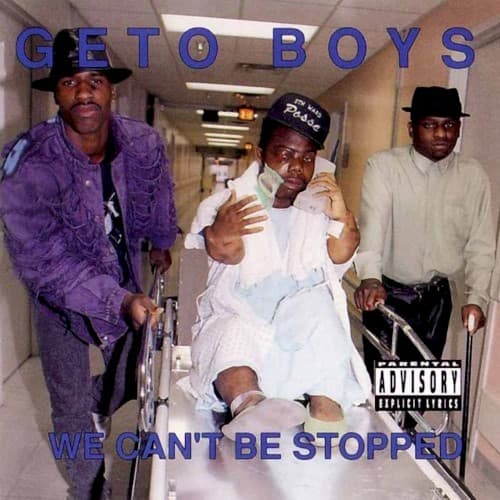
The cover gives the story an uncomfortable edge. It shows Bushwick Bill in a hospital bed after he was shot in the eye, and the photograph was taken under circumstances he later regretted. That image tells you how the group worked: they put real pain and real shock in front of the audience and let you decide how to react. It also says something about the album's tone. These are three rappers who are willing to look at damage, including their own, and the best songs come from that willingness.
The lineage runs forward and backward. Backward to the funk records that supply the samples, to Funkadelic, Zapp and Roger, Isaac Hayes. Forward to every Southern rapper who treated paranoia and depression as legitimate subjects. The record is uneven, and several of its harder songs are more about provocation than craft. But its high points are among the most important in the genre, and they are why this album is still discussed.
Slowed Funk, Three Voices, and the Sound of a Mind Under Pressure
The sound of We Can't Be Stopped is built from funk. The sample credits read like a tour through the genre's history: Funkadelic, Zapp and Roger, George Clinton, Isaac Hayes, Graham Central Station, Sly and the Family Stone and more. What is striking is how the group handles that material. The loops are slowed and thickened, the bass is pushed forward, and the bright party energy of the originals turns into something heavy and ominous. The funk is still there, but it feels like it is moving through water.
That approach gives the record a groove that is unlike the sharp, fast sample collages popular on the coasts. The tempo is deliberate and the space between beats is part of the mood. It is dance music slowed to the speed of dread, and that is why the best songs feel so physical. You can nod to them and be unsettled by them at the same time. It is the clearest example of the Houston sound taking shape: patient, heavy and willing to let a loop breathe.
The delivery is the other half of the formula. The group's three members have three distinct voices, and each of them gets three solo songs, with three more shared among all of them. Scarface speaks in a weary, confessional tone, often sounding like a man talking himself through a bad night. Willie D has a big, booming bark that turns every line into a challenge. Bushwick Bill is the wild card, higher-pitched, frantic and unpredictable. Their contrast gives the album variety, and their trading verses gives the best songs a feeling of an argument held in a dark room.
The writing is where the album is most uneven. At their best, the lyrics are concrete, observant and emotionally honest, and the paranoia of the best song feels earned in every line. The anti-war material is sharp and angry. But several songs are built on shock for its own sake, using crude or violent imagery with no real idea behind it, and they date the album. Entertainment Weekly gave it a B for its stinging, raw honesty, and Robert Christgau liked only the one great song, and both reactions make sense. The album is not consistent.
Still, the combination of voices, grooves and moods adds up to something with real weight. It is rough around the edges, and some of its provocations have worn thin, but it has a clear identity. In 1991 there was nothing quite like it, and the strongest parts still sound distinctive today.
Peaks, Valleys, and One Song That Outweighs the Rest
As a sequence, We Can't Be Stopped is a record of high peaks and low valleys. It opens with a very short, atmospheric intro that sets the mood, and then moves into the title song and a funk-heavy early run that establishes the group's chemistry. The first third is the album's most consistent stretch, with strong grooves and clearly defined voices.
The center of the album is its gravity. Mind Playing Tricks on Me sits in the middle of the tracklist, and everything around it is shaped by it. It is a song so strong that the surrounding tracks sometimes feel like they are waiting for it or recovering from it. The pacing around it is smart, with the slow burn of that song giving way to harder material that restores the energy. But it also means the record has a single center of mass, and the songs that follow rarely match it.
The back half is more uneven. A few cuts are strong and the anti-war song gives the sequence a pointed political edge, but several tracks lean on shock value and do not sustain interest. There is also a very long closer that runs past six minutes, and it stretches an idea that would have worked at four. The album would be tighter with a few of the weaker songs trimmed, and its reputation would be more even for it.
The length is mostly earned. At fourteen tracks and under an hour, the album is not bloated, and the short interludes and quick songs keep the pace moving. The sequencing does mix moods well, shifting between menace, humor and reflection. It simply asks the listener to endure some weaker songs to reach the great ones. For a record of this significance, that is a fair price.
The Blueprint for Southern Darkness
In the Geto Boys catalog, We Can't Be Stopped is the record that put the group on the map as more than a shock act. Certified platinum by early 1992 and among their most successful albums, it also put the group on the Billboard pop Top 40 on the strength of its honesty. It is the album that most clearly shows what the group could do when they mixed provocation with real feeling, and it remains the best entry point to their work. I would rank it as a great album held back from classic status only by its uneven second half.
The case for it rests on a handful of songs and on the sound. The slowed funk, the thick bass and the three contrasting voices set a template that Southern rap would follow for decades, from Houston to Memphis and beyond. The case against it is the filler and the shock tracks, which add little and show their age.
Who should start here? Anyone interested in the roots of Southern rap, listeners who like dark, funk-driven hip-hop, and fans of later Houston artists who want to hear where it began. It has aged as a landmark and as a set of grooves. Who should skip it? Anyone who dislikes explicit content or crude shock material, which the album has in quantity. The best songs are worth the trouble, but not everyone will want to pay it.
For three songs to start with, play Mind Playing Tricks on Me, We Can't Be Stopped and Homie Don't Play That. They show the group at its most haunted, its most confident and its most funky. For what to hear next, explore the solo work of Scarface and Willie D to hear the voices at greater length, and listen to the wave of Houston rap that followed to hear the template in action.
We Can't Be Stopped is the record where a city's fear and its funk became a sound, and one song on it is still the standard for how a rapper can sound afraid.
Track by track
Track Listing
Rebel Rap Family
StandoutA short opener of under a minute and a half built on a sample of the Scarface theme by Giorgio Moroder. It sets a film-noir gangster mood and moves quickly into the main material. A brief, effective introduction.
We Can’t Be Stopped
StandoutThe title song is a confident, funky statement that carries a short verse from DJ Ready Red, who left the group during the sessions. The group's three voices trade lines over a thick, rolling groove, and the chemistry is clear from the first bar. It is a defiant anthem about staying power and a strong early highlight that shows the album's funk foundation at its most energetic.
Homie Don’t Play That
StandoutBuilt from a stack of funk samples that includes Funkadelic, Zapp and Roger and George Clinton, this is the album's most danceable song. The bass is bouncy and the voices ride it easily, and the result is a street party with a hard edge. It is one of the best examples of how the group turned party funk into something menacing.
Another Nigger in the Morgue
SolidA short, grim song that looks at death in the neighborhood with a flat, unflinching tone. The mood is oppressive and the subject is serious, though the writing leans on a single idea. It is effective in short doses and sets up the darker material to come.
Chuckie
StandoutA horror-leaning showpiece that plays up the group's love of macabre imagery. The beat is eerie and the verses are theatrical, with Bushwick Bill's frantic voice well suited to the mood. It is more atmosphere than insight, but the atmosphere is strong.
Mind Playing Tricks on Me
StandoutThe album's landmark and one of the great songs of the decade. Built on loops from Isaac Hayes and Graham Central Station, it is slow, spare and haunted, and it lets the verses describe a mind that cannot rest, haunted by fear and by the people it imagines are coming after it. Each member contributes a verse with a different shade of dread, and the shared hook gives the song its unsettling calm. The production is the secret: the loop sounds soulful and sinister at once. It was named best song by The Source in 1991, ranked highly on Pitchfork's and XXL's lists of the decade's best, and it is the reason to own the album. Start here.
I’m Not a Gentleman
SolidA swaggering song built from samples of Quincy Jones and Funkadelic. The groove is smooth and the delivery is cocky, and the song works as a vehicle for personality more than substance. A solid, entertaining mid-album cut.
Gota Let Your Nuts Hang
WeakA crude, party-minded song built on a New Orleans sample from the Wild Magnolias. The beat has a loose, bouncy feel, but the writing is built on shock rather than substance. It is energetic and typical of the album's weaker side.
Fuck a War
StandoutAn anti-war song with a heavy groove and an angry, direct message. The politics are blunt but the conviction is real, and the sample gives it a loose, funky drive. It gives the sequence a pointed edge and is among the album's stronger cuts.
Ain’t With Being Broke
SolidA song about the pressure of having no money, built on a sample from Fred Wesley and the J.B.'s. The groove is solid and the message is plain, but the song does not add much beyond its premise. Decent, if familiar.
Quickie
SolidA quick, funky track that uses samples from the Honey Drippers and the Delegation. It is light on ideas and built for rhythm, and it moves along without leaving much of a mark. Filler with a good beat.
Punk‐Bitch Game
WeakA short, abrasive track that relies on provocation more than craft. It is the sort of shock song the album could have done without, and at just over two minutes it passes quickly. Weak.
The Other Level
SolidThe longest song on the record runs past six minutes and draws on samples from the Headhunters, Diana Ross and others. The mood is reflective and the groove is smooth, giving the album a more thoughtful, slower close than its earlier songs. It runs longer than its ideas, but it shows a side of the group that is more contemplative than provocative.
Trophy
StandoutThe closing track draws on a stack of samples including a Public Enemy-related loop and Soul Makossa. It is energetic and busy, a good display of the group's ear for funk, and it sends the album off with a burst of movement. A solid finish.
Frequently Asked Questions
Is Geto Boys' We Can't Be Stopped good?
What is the best song on We Can't Be Stopped?
What is the story behind the We Can't Be Stopped cover?
Styles