The scorecard
5.7/10 · Mixed
- Writing25%
- 5.5
- Production25%
- 6.5
- Delivery15%
- 5.5
- Cohesion15%
- 4.5
- Originality10%
- 6.0
- Replay value10%
- 6.0
The mourning of lost friends on the lead single has real feeling, but most verses stay on slogans, money talk and neighborhood loyalty without a single sustained story.
Soul and funk samples from Diana Ross, the O'Jays and Marvin Gaye sit on thick Southern low end, which gives the hits a warmth that the label's rougher records lacked.
Master P's slow drawl and ad-libs are the glue, and Mystikal, Fiend and Silkk the Shocker add punch, but the roster is used more as a chorus than for distinct verses.
Nineteen tracks and nearly eighty minutes in one mid-tempo gear, with a front half far stronger than the back.
The mix of New Orleans bounce, Texas guests and soul-sample sheen was distinct in 1997 even though the songwriting rarely strays from gangsta rap conventions.
The two big singles are permanent fixtures, and a few album cuts earn repeat plays, but the length and repetition make full listens rare.
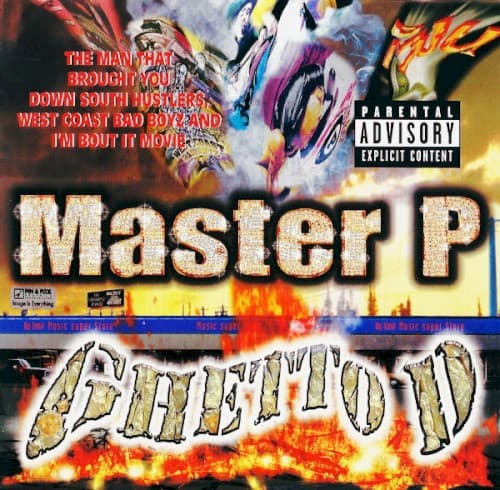
Master P Ghetto D: When the No Limit Machine Learned to Sound Warm
Ghetto D is the sound of the No Limit machine at full speed and, for the first time, in good lighting. The record debuted at number 137 on the Billboard 200 and then jumped to number one the next week on the strength of 726,000 copies sold, which tells you everything about the audience Master P had built before the music arrived. The album that earned that audience is better than its predecessor and noticeably more polished, though it is still a very long record that hides a handful of great songs inside a lot of repetition.
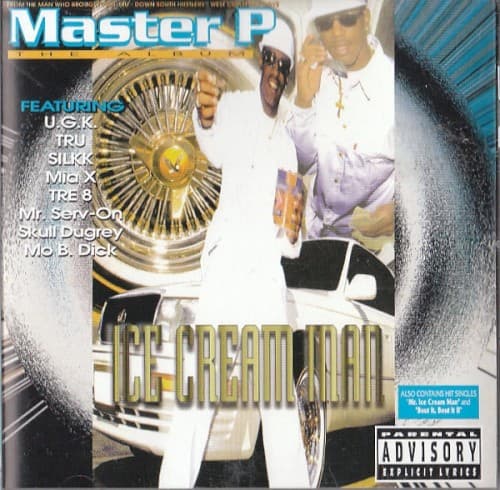
The thesis is that Ghetto D works because it finally lets the soul samples carry the load. Where Ice Cream Man leaned almost entirely on bass and drum machines, this album builds its best songs on samples from the O'Jays, Diana Ross, Marvin Gaye and others, and the warmth changes how Master P's drawl sounds. A slow, flat voice that sounded like a limitation over bare beats sounds like patience over a soul loop. The record is not great, but it is the one where the formula looks like a style.
The lineage is deeply Southern, even when the samples are not. The New Orleans bounce of the label's own roster is joined by Mystikal's barking, Pimp C's appearance on the lead single from Texas, and Fiend's grit. That combination of regional voices, all stacked on one record, was an answer to the East and West Coast dominance of the period, and it signals that the South could assemble its own supergroup. It also shows what later Southern labels would borrow: the roster as a brand, the ad-lib as a hook and the hook as a slogan.
What holds the album back is its length and its writing. Nineteen tracks and nearly eighty minutes of mid-tempo grooves is too much, and the lyrics rarely move beyond familiar neighborhood talk. But when the right sample meets the right chorus, the record gets close to something lasting. At its best, Ghetto D is a rough, loud, strangely tender record about the people who did not make it home.
Soul Loops Under Southern Bass, and a Drawl That Needs the Right Beat
The sound of Ghetto D is a collision between two traditions. On one side is the thick low end of Southern rap: slow kicks, rolling bass and drum machines built for car systems. On the other is the sample-based soul of an older generation, with loops lifted from the O'Jays, Diana Ross, Marvin Gaye, the Isley Brothers and Timex Social Club among others. Put together, they give the record an unusual emotional temperature. The grooves are hard but the melodies are warm, and that warmth makes the album sound more mature than the label's earlier work.
The samples are the album's smartest decision, because they supply what the bare beats of earlier records lacked: melody and memory. Songs built on familiar soul progressions instantly feel bigger, and the sorrow in the sampled material gives the mourning on the lead single a real weight. The best tracks use the sample as a frame and let the bass underline it, and the results sound like nothing else from that moment in Southern rap. The weaker tracks use plain drum-machine loops with no melodic hook, and the quality drop is immediate.
Master P himself remains a limited but effective rapper. His drawl is slow and conversational, his rhymes are plain, and his ad-libs do as much work as his verses. It is a style built for repetition, and over soul samples it takes on a patient, reflective quality that suits the subject matter. The guests do much of the real rapping. Mystikal brings a barking intensity, Fiend a rough, hard-edged voice, Silkk the Shocker an excitable counterpoint, and Mia X a heavier, more serious tone.
The writing is the weak spot. The themes are the usual ones: loyalty, money, the neighborhood, enemies and loss. There is real feeling in the songs about friends who died, but outside of those the lyrics lean on slogans, and very few songs tell a story with a beginning, a middle and an end. The album also relies heavily on its guests for variety, and when the guests appear in large numbers the individual verses blur together.
Another problem is the sheer number of cameos. A single song with five voices can feel like a roll call, not a composition, and several tracks here feel built around that idea. The label's family approach is part of its identity, but it means that Master P often becomes one voice among many on his own album.
Still, the combination of sample warmth and Southern weight works better than it has any right to. The sound is distinctive, the delivery is consistent and the best songs are as good as anything the label ever released. The rest is the cost of volume.
A Strong Front Half and a Long Trip Home
Ghetto D is front-loaded. The first half of the album carries the energy, the best samples and the biggest guests, and the opening run sets a mood of grief and defiance that holds together. The title track opens with a confident statement and the lead single arrives early enough to give the record its emotional center. For the first thirty minutes or so, the sequence feels purposeful.
The second half is where the album loses focus. After the big single in the middle, the record settles into a long run of mid-tempo songs that share a pace, a mood and a set of themes. There are good moments scattered through the back half, but they are further apart, and the guest-heavy approach starts to feel mechanical. The transitions between songs are abrupt and the album never really changes gears.
The pacing problem is mostly a length problem. With nineteen tracks and nearly eighty minutes, the album demands more attention than its material can hold. The songs are mostly four to five minutes, and several run longer than their ideas. A tighter version, with the best twelve or thirteen songs, would have kept the soul-sample highlights and lost the repetition, and that version would likely be remembered as a stronger record.
The ending helps. The final songs are shorter and sharper than the middle stretch, and they give the album a more energetic close than its slow back half would suggest. It is a smart choice that sends listeners out on a high note, but it comes after a long stretch of sameness. The length is not earned, though the best of what it contains is worth the trip.
The Peak of the No Limit Formula, With Its Flaws Intact
In Master P's catalog, Ghetto D is the high point of the sound he built. It is more polished than Ice Cream Man, and the soul-sample warmth gives it a depth that the earlier record lacked, which is why it ranks above that album here. It also has the commercial proof: a number-one debut in its second week, a multi-platinum certification and two singles that became permanent parts of the decade's soundtrack. As a record, it is mixed to good: strong in its best moments, weak in its filler.
The cultural record is complicated. One of its singles shows up on a list of the greatest hip-hop songs and also on a list of the worst songs ever, and that split is a fair summary of how the album sits in memory. Its slogans are loved and mocked in equal measure, and both reactions are earned.
Who should start here? Anyone curious about the No Limit era and the rise of the Southern independent label. It is the best entry point to the catalog, and it has aged as a time capsule better than as a set of songs.
Fans of Southern rap and soul-sampled gangsta rap will find the most to enjoy. Who should skip it? Anyone looking for lyrical depth, sharp storytelling or a tight running time. The album does not offer them.
For three songs to start with, play I Miss My Homies, Gangstas Need Love and Make ’Em Say Ugh. They capture the sound at its warmest, its most tender and its loudest. For what to hear next, go back to Ice Cream Man to hear the rougher, earlier version of the same idea, and then to the UGK catalog to hear the Texas tradition that shows up through Pimp C on the lead single.
Ghetto D is the album where a slow voice and a soul loop turned a regional hustle into a national sound.
Track by track
Track Listing
Ghetto D
StandoutThe title track brings C-Murder and Silkk the Shocker onto a loop built on a classic Eric B. and Rakim sample, and the video aired on MTV and BET. The groove is steady and confident, and it frames the album's themes of survival and loyalty. The verses are plain, but the beat does the work and the song sets the tone well.
Let’s Get ’Em
SolidMystikal and Silkk the Shocker join Master P on a long, aggressive song that runs nearly six minutes. Mystikal's barking delivery gives it a jolt of energy, and the beat is heavy. It is too long for what it says, but the guest turn is worth hearing.
I Miss My Homies
StandoutThe first single and the album's emotional center. It builds on a loop from the O'Jays' Brandy, and the sorrowful sample gives Master P's slow drawl a real weight as he mourns friends who did not make it. Pimp C appears alongside Silkk the Shocker, Mo B. Dick and others, and the Texas voice adds a regional bridge to the New Orleans sound. The song reached number 25 in the US and it is the clearest proof that the soul-sample approach works. It is the best song on the record and the right place to begin.
We Riders
SolidMac joins for a rolling, car-culture track with a thick bass line and a laid-back hook. The groove is the draw, and the verses are secondary. A solid, if familiar, mid-album cut.
Throw ’Em Up
SolidKane and Abel appear on a short, hard-edged song built around a menacing beat. The energy is high and the length is right, but the writing is generic. It works as a quick burst of attitude.
Tryin 2 Do Something
StandoutFiend, Mac and Mo B. Dick join for a song about trying to make something of yourself, built on a loop from the Isley Brothers. The sample gives it a smooth, reflective quality, and the subject matter is more hopeful than most of the album. A strong, human moment in the first half.
Plan B
SolidMia X brings a harder voice to a song about having a backup plan when things go wrong. The beat is steady and the pairing works, but the song does not develop its idea. Decent, and a good vehicle for Mia X.
Weed & Money
WeakA relaxed song about its two titles, with Silkk the Shocker on a hook. The groove is smooth and the mood is easygoing, but the subject is thin and the track runs four minutes without adding much. Mood filler.
Captain Kirk
StandoutFiend, Silkk the Shocker and Mystikal join Master P on a five-minute posse cut with a playful, slightly strange atmosphere. The trio of guests keeps the song lively, and the oddness of the beat makes it one of the more distinctive tracks here. It is too long, but it stands out from the surrounding sameness.
Stop Hatin
StandoutA defiant song built on a loop from Timex Social Club, with Fiend, Silkk the Shocker, Mo B. Dick and O'Dell adding voices. The sample gives it a smooth, bouncy feel, and the message is the album's standard message about rivals. A solid, accessible cut.
Eyes on Your Enemies
SolidA tense, mid-tempo track with Silkk the Shocker, Mia X, Mo B. Dick and O'Dell. The beat is tight and the song is a reasonable length, but it blends into the surrounding run of similar songs.
Make ’Em Say Ugh
StandoutThe second single, with Fiend, Silkk the Shocker, Mia X and Mystikal, is the album's loudest and most famous moment. The chant-like hook built around a single grunt is simple to the point of absurdity, and that simplicity is the genius of it: it works in clubs, in cars and in stadiums. The beat is sparse and heavy, and each guest drops in with a short, punchy verse. Critics have been split on it. It reached number 22 in the US, appears on a VH1 list of the greatest hip-hop songs and also on a Blender list of the worst songs ever. Both reactions say something true about a song that is more slogan than verse.
Going Through Somethangs
SolidBig Ed and Mr. Serv-On join for a more reflective song about hard times. The pace slows and the mood is sincere, but the writing is general and the track sounds like the ones around it.
Only Time Will Tell
SolidMac and the Sons of Funk appear on a slow, soulful song about waiting for change. The tone is warm and the singing adds texture, but at over four minutes the idea is stretched. Decent, but not essential.
After Dollars, No Cents
SolidSilkk the Shocker joins for a song about money and its limits. The beat is smooth and the title is a clever play on words, but the verses stay on the surface. A solid but ordinary track in the back half.
Gangstas Need Love
StandoutBuilt on a loop from Diana Ross's Missing You, with Silkk the Shocker, Mercedes and Lawand, this is the album's tenderest song and one of its best. The sample brings a romantic ache that the rest of the record rarely reaches, and the vulnerability suits Master P's slow delivery. The sung hook gives the song a different texture, and the combination of hard voices and soft melody is the record's strongest argument for its own warmth. A real highlight in the back half.
Pass Me da Green
SolidA short, loose track with a sample drawn from a movie theme, and a relaxed attitude that makes it feel like an interlude with a hook. It is light and not very important, but it is over quickly.
Come and Get Some
StandoutC-Murder and Prime Suspects join for the shortest song on the album, a quick burst of aggression at two and a half minutes. It makes its point fast and does not overstay, which is more than many songs here can claim.
Burbons and Lacs
StandoutSilkk the Shocker, Lil Gotti and Mo B. Dick join for a closing song built on a loop from Marvin Gaye's Let's Get It On. The smooth, luxurious sample suits the title and gives the album a warm, relaxed ending. It is a fitting close and a good example of the sample-based sound at its easiest.
Frequently Asked Questions
Is Master P's Ghetto D good?
What are the biggest songs on Ghetto D?
How did Ghetto D perform on the charts?
Styles