The scorecard
7.3/10 · Good
- Writing25%
- 7.5
- Production25%
- 7.5
- Delivery15%
- 7.5
- Cohesion15%
- 7.0
- Originality10%
- 6.5
- Replay value10%
- 7.0
The verses on First Light of the Day and I Just Wanna Die favor patient, concrete observation over provocation, though a few of the middle tracks run long without adding new information.
Mike Dean and N.O. Joe build a warm, live-sounding funk bed with thick keys and loose drums that unifies fifteen tracks and gives even the slow songs forward motion.
The weary baritone, the jagged theatrical voice and the brisk forceful cadence trade off over the same groove, and the guests on Hold It Down and Blind Leading the Blind supply useful contrast.
Short skits keep the pacing honest and the sound stays consistent, though several five-minute mid-album songs make the sequence longer than it needs to be.
It refines the group's sound into a funkier, more patient form rather than inventing a new one, and the shift from shock to groove is the meaningful change.
The warmth of the production and the observational writing hold up on repeat listens, and the fact that songs have found second lives in film and television points to lasting appeal.
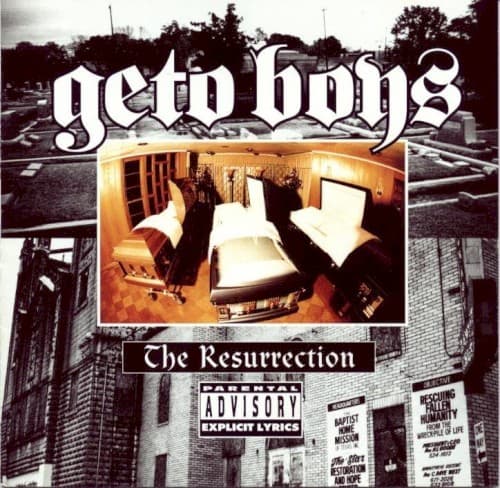
Geto Boys The Resurrection: The Moment Gloom Learned to Groove
The Resurrection is the Geto Boys album where the grimness finally learns to swing. The subject matter has not softened: prison, paranoia, dying young and the daily arithmetic of the street are all still on the table. What changed is the groove under them. Mike Dean and N.O. Joe build most of the record out of warm, rolling funk that sounds as if it were played in a room rather than assembled from a rack, and the group rides that bounce with a looseness the earlier albums rarely allowed. The result is a record that is easier to put on repeatedly than anything else in their catalog, and still harder to shake off than most gangster rap of its era.
My claim is that this is the Geto Boys at their most complete, and that the reason is arrangement rather than shock. Earlier records announced the group's menace; this one lets it hang in the air. The tempos are unhurried, the basslines do much of the talking, and the verses have room to land. Gloom set to a head-nodding rhythm is a very Houston idea, and The Resurrection makes the case for it better than anything else the group released.
The commercial record agrees with the critical one. The album peaked at number six on the Billboard 200, reached the top of the Top R&B/Hip-Hop Albums chart and was certified gold within two months of release. Its lead single, The World Is a Ghetto, made the Billboard Hot 100 and the UK singles chart, and later life has been kind in odd places: one cut turned up in a 1999 comedy film, another closed out a 2019 television episode. A record can be remembered for strange reasons and still deserve the attention, and here the long afterlife traces back to the same quality, a texture warm enough to sit under almost anything.
Where it stumbles is length and a handful of slack stretches in the middle, and I will name them. But the strongest argument for The Resurrection is how little of it sounds like a group straining to be what it was in 1990. It sounds like a group that has settled into its voice, and the funk is the proof.
Warm Funk, Patient Verses, and Guests Used Sparingly
The production is the album's center of gravity, and it is unusually well documented: Mike Dean, N.O. Joe, Scarface, Derick Edwards and Uncle Eddie share the credits, with Dean on the majority of the tracks. That overlap explains why the record sounds so unified. The keys are thick and a little hazy, the guitar sits in the pocket rather than on top of it, and the drums have a loose, human push that gives even the slow songs forward motion. This is Southern funk filtered through a Houston sense of space: plenty of air between the notes, bass that feels physical, and no rush to resolve a groove before it has done its work.
The writing matches the music by staying patient. The subjects are the ones the group had been circling for years, imprisonment, violence, mortality and distrust, but the treatment is more observational and less aimed at provocation. Verses take their time to set a scene, use specific detail rather than slogans, and often end on a flat statement of consequence rather than a punchline. That restraint is the reason the album plays as serious rather than merely bleak. It also gives the voices more to do: one rapper's weary baritone, another's jagged and theatrical delivery, a third's brisk, forceful cadence, all trading off over the same warm bed. The contrast between those textures is a big part of why the record stays interesting across fifteen tracks.
Guests are used sparingly and mostly well. Facemob, Menace Clan, DMG and FLAJ appear on individual songs, and the record never turns into a reveal for outsiders. The group's own voices remain the focus, and the guests function as seasoning, a change of cadence or a hook, rather than as a distraction. The one criticism is that the guest spots are more functional than memorable: none of them reshapes a song, and a few arrive just when a track could have used another idea from the main trio instead.
The weaknesses are concrete. Several of the middle tracks run past five minutes, and while the grooves are strong enough to support that length, the verses do not always add enough new information to justify it. The mood is also consistent to the point of sameness: a run of mid-tempo, funk-driven songs can start to blur if the listener is not paying close attention to the writing. The album's comic and lighter material is thinner than its serious cuts, and the lyrical register sometimes drifts toward familiar boasts rather than the scene-setting that makes the best songs stand out.
Still, the balance is right. The record trusts its rhythm section, keeps its tempos grounded, and lets the voices carry the narrative weight. For a group whose earlier work was often defined by its most extreme moments, this is an album that is defined by its steadiness, and that steadiness is what gives the best songs their authority. The skits and short spoken pieces are brief enough not to disrupt the flow, and they frame the music rather than interrupting it.
Skits as Breath Marks in a Long Groove
The sequence is the quiet strength of The Resurrection. The album opens with a short spoken piece that frames the mood without overstaying, and then moves straight into a run of songs that sets the tempo, the tone and the sound in a handful of minutes. The pacing is patient, and what makes it work is that the record never rushes to establish a hit. The early stretch sets up the group's voices, the middle builds out the themes, and the late stretch gives them room to land. For a fifteen-track album that includes several short interludes, that is an efficient structure.
Short pieces keep the pacing honest. A thirty-six-second skit and a spoken segment of under a minute and a half do not interrupt the flow; they work as breaths between long songs, and they keep the record from feeling like a single unbroken slab of mid-tempo funk. The vinyl edition omitted seven tracks, including several of these, cutting the listing roughly in half, and the choice is telling: the skits and interludes are the connective tissue, and a version without them loses some of the album's rhythm even if it gains concision.
The peak arrives in the middle and in the last third, where the group's best writing and the warmest grooves overlap. After that, there is a gentle sag. A few of the long mid-album songs sit at five minutes and beyond, and the album's energy dips just before the final stretch, where the closing material pulls it back into focus. The sag is not serious, but it is audible, and it keeps the album from the kind of airtight front-to-back run that the best records of the decade manage.
Is the length earned? Mostly. Fifteen tracks is a lot, but the fact that several are skits and a few are brief means the actual music is closer to a tight hour. The album would be stronger at twelve or thirteen songs, and nobody would miss the least distinctive cuts. Even so, the sequence works because the record commits to a single sound and trusts it. The best proof is how easily the album plays straight through: very few rap records of this length can say the same, and the ones that can tend to be the ones people return to.
The Geto Boys Record to Start With
The Resurrection is the Geto Boys' most complete album and the one to start with. This site has no other Geto Boys records rated yet, so the placement rests on the record itself, but the argument is strong: it has the best-sustained sound in the group's catalog, the warmest production and the most balanced distribution of voices. Fans and critics frequently call it the group's best, and the evidence on the record supports that view. It also helped set up the follow-up, the 1998 album Da Good da Bad and da Ugly, which continued the same creative stretch.
Who is it for? Listeners who like Southern rap built on live-sounding funk, anyone interested in Houston's regional sound, and anyone who wants gangster rap with room to breathe. It is an easy recommendation for people who find the group's earlier work too abrasive. Who should skip it? Listeners who want sharp, hook-driven singles and quick tempos will find the pace slow, and anyone looking for the group's most shocking material will find it comparatively restrained.
How has it aged? Very well. The production avoids the dated drum sounds and rigid sampling that mark some mid-nineties rap, and the live feel of the instrumentation keeps it sounding natural. The fact that one of its songs found a second audience through a film and another through a television series suggests that the textures still translate. The writing, with its emphasis on observation over provocation, has aged better than the more confrontational work that preceded it.
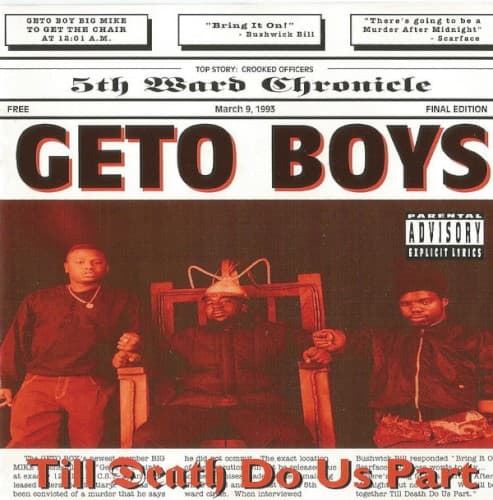
To start, play Still, The World Is a Ghetto and First Light of the Day. The first is the group's most recognizable cut and a good model of its pocket, the second is the lead single and a fine example of the album's blend of weight and groove, and the third shows the record at its most reflective. For further listening, go back to Till Death Do Us Part, which has the same dread but less of the warmth, or ahead to Da Good da Bad and da Ugly, which carries the creative run forward.
The strongest proof of this album's staying power is how little it relies on shock: take away the subject matter and the groove would still hold the room.
Track by track
Track Listing
Ghetto Prisoner
SolidA brief spoken opener, under a minute and a half, that sets the confined, claustrophobic mood. It works as framing rather than music and does its job quickly.
Still
StandoutProduced by N.O. Joe, this is the album's most enduring cut and the one that later found a second life in a 1999 film and a 2008 television episode. The groove is slow and warm, the verses are patient, and the mood is weary rather than angry. It earns its reputation because the beat does not demand attention: it simply sits, and the voices fill it with detail. The four-minute length is just right, and the sense of fatigue is the point. A key track and the best single entry point for the record's sound.
The World Is a Ghetto
StandoutThe lead single, produced by Mike Dean and N.O. Joe with FLAJ on the hook, reached the Billboard Hot 100 and the UK chart. The bounce is the star: the bass rolls forward while the verses describe a community under pressure in plain, observational terms. It is more accessible than the group's earlier singles without losing weight. A strong song and a fine summary of what makes the album work.
Open Minded
SolidA mid-tempo cut featuring DMG, with Dean and N.O. Joe on the beat. It keeps the album's funk intact and offers a change of voice through the guest, but the writing is more routine than on the stronger songs. Solid and listenable, though it does not reshape the record.
Killer for Scratch
SolidA skit of about half a minute. It is a brief break that adds a little texture and then disappears, and it is filler in the best sense.
Hold It Down
SolidFeaturing Facemob and produced by Scarface and Mike Dean, this five-and-a-half-minute cut leans on its groove and gives the guests room. The beat is strong enough to carry the length, but the verses are more functional than inspired, and it runs a little long. Good rather than great.
Blind Leading the Blind
StandoutMenace Clan joins on a track produced by Dean and Scarface. The mood is darker here and the writing more pointed, and the guests provide a contrast in cadence that keeps the song moving. At just over five minutes it is on the long side, but the tension holds. A solid, atmospheric mid-album piece.
First Light of the Day
StandoutProduced by Mike Dean, Uncle Eddie and Scarface, this is the album at its most reflective and its best writing. The tempo is slow, the keys are hazy, and the verses read like a series of observations made at dawn after a long night. It later closed a 2019 television episode, which says something about how well the mood translates out of context. The five-minute running time is earned because the song builds a feeling rather than a plot. A key track, and one of the three to hear first.
Time Taker
SolidA Mike Dean production running just over five minutes, with a steady groove and a more philosophical tone. The theme of time passing is handled with some care, but the song does not add a new idea to the album and the length is a little generous. Competent and atmospheric.
Geto Boys and Girls
SolidThe longest cut on the album at nearly six minutes, and a lighter, more social track than most of its neighbors. The groove is relaxed and inviting, which is welcome, but the writing is thinner and the song overstays. A fair showing of the group's loose side without being essential.
Geto Fantasy
SolidProduced by Dean and N.O. Joe, this is a smoother, more melodic cut that gives the record a change of tone. It works as a breather, and the production is polished, though the lyrics are lighter than the album's best. Solid but not a highlight.
I Just Wanna Die
StandoutA darker, more serious cut produced by Dean and N.O. Joe, and one of the few places where the record directly confronts despair. The groove is slow and heavy, and the delivery is restrained rather than theatrical, which makes it more affecting. A strong late-album track that brings the weight back after the lighter material.
Niggas and Flies
StandoutProduced by Derick Edwards and the shortest full song on the album at just over three minutes. It is a harder, more compressed cut that changes the texture of the late sequence. The brevity helps, and it provides a necessary jolt. Solid and efficient.
A Visit With Larry Hoover
SolidA spoken interlude of about a minute and a half. It works as a short piece of scene-setting and moves quickly into the closer, and it is filler that serves the pacing.
Point of No Return
StandoutA compact closer produced by Scarface and Mike Dean, running a little over three minutes. It wraps the record with a sense of finality and does not overstay, which is the right instinct after a long run of mid-tempo songs. A strong, economical ending.
Frequently Asked Questions
Is Geto Boys The Resurrection their best album?
What are the best songs on The Resurrection?
How well did The Resurrection sell?
Styles