J. Cole KOD — When the Preacher Started Pointing at Himself
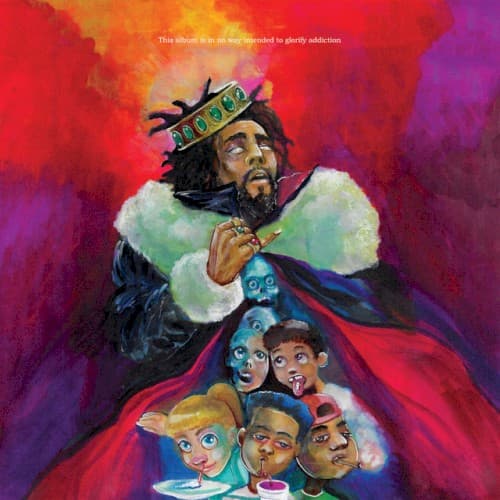
J. Cole made this entire album alone in two weeks and never let you forget it. Every producer credit reads kiLL edward, his own alter ego, every mix decision his, every conceptual thread woven by one person in a studio with the door locked. That isolation bleeds into the music itself, which sounds like a man talking to himself at three in the morning, trying to sort out whether he has the moral authority to lecture anybody. The result is forty-two minutes of discomfort dressed up as consciousness, an album that wants to warn the youth about pills and codeine and materialism while acknowledging that the messenger spent the last decade chasing the same validation he now claims to reject.
The premise arrives threefold through the acronym itself. Kids On Drugs. King OverDosed. Kill Our Demons. Cole presents addiction as spectrum, from the pharmacological to the psychological, from the trap house to the therapist couch.
He positions himself as both observer and participant, elder and cautionary tale, which should make for compelling tension. Instead it often reads like a college essay that forgot to pick a thesis. The album wants to be a Public Service Announcement and a confessional, a warning and an apology. Do the seams show whenever Cole toggles between modes without committing fully to either?
What saves KOD from collapsing under its own self-seriousness is the sound. Cole strips his production down to drum patterns that knock like someone pounding on a door, bass lines that rumble beneath rather than lead, vocal samples chopped into fragments that repeat like intrusive thoughts. The palette is claustrophobic by design, no guest verses to break the monotony, no radio-friendly hooks to offer relief. You either sit with Cole for the full runtime or you bail.
Drums That Knock and Melodies That Haunt
Cole built this album on a foundation of live drums and 808s tuned to rattle car trunks, the kind of low-end thump that demands attention in traffic but never overpowers the lyrics. The percussion hits hard and direct, snares cracking like arguments, hi-hats flickering with the jittery energy of someone who has had too much caffeine or not enough sleep. As kiLL edward, Cole uses repetition as weapon and meditation tool, looping vocal chops until they blur into mantras, doubling his own voice until it sounds like a conversation between past and present selves. The production philosophy mirrors the thematic content, sparse and deliberate, leaving space for discomfort rather than filling every bar with sonic decoration.
Lyrically Cole operates in parable mode, offering scenarios and moral dilemmas wrapped in first-person narratives that may or may not be autobiographical. He writes about credit card debt and strip club addiction and the woman who enabled his uncle's drug use, painting portraits of people trapped by their own choices. His delivery shifts between sing-song flows that mock the melodic trap he critiques and sharp-edged verses that land like accusations. The technical craft remains solid, multisyllabic rhyme schemes executed with precision, internal rhymes stacking neatly within bars.
But does the writing itself lack the imagery that made his earlier work memorable?
Too many lines explain rather than illustrate, telling the listener what to feel instead of showing them why they should care.
The album stumbles hardest when Cole adopts the voice of the reformed addict lecturing the current user. Sincerity curdles into sanctimony. The bars about checking bank statements and choosing therapy over retail therapy land flat because they reduce complex human behavior to budget advice. Cole seems aware of this weakness, peppering the album with moments of self-awareness, admitting his own hypocrisy.
Awareness does not equal solution. Knowing you sound preachy and sounding preachy anyway produces the same result.
What keeps the project from collapsing entirely is the vocal performance. Cole sings more than he ever has, not always well but always committed, his voice cracking under the weight of melodies he stretches beyond his natural range. The imperfection serves the material, the strained falsetto on certain hooks reinforcing the desperation baked into the subject matter. He also experiments with pitch-shifting and vocal layering, creating harmony stacks that sound like arguments, verses where multiple versions of Cole debate each other without reaching consensus.
The Long Walk Through Consequence and Doubt
The album opens with sixty seconds of scene-setting before diving into the title track, which establishes the sonic template and thematic framework for everything that follows. From there the pacing moves like someone walking through a neighborhood they grew up in but no longer recognize, pausing at familiar corners to remember what used to stand there, what got torn down, who moved away or got locked up or died. The first stretch balances social commentary with personal reflection, Cole toggling between observer and subject, never settling fully into either position.
The middle section leans harder into confession, Cole examining his own complicity in systems he claims to critique. The sequencing grows heavier, the tempo slowing, the melodic elements becoming more prominent as the bars give way to sung refrains that loop like obsessive thoughts. Momentum stalls here intentionally, the album refusing to offer easy answers or cathartic resolution. You sit with the discomfort or you skip ahead, and skipping ahead feels like missing the point even if staying feels like homework.
The back half shifts toward resolution without quite achieving it. An interlude arrives two-thirds through to reframe the entire project, offering context that should have appeared earlier, followed by tracks that attempt to tie thematic threads together but leave most of them dangling. The closing run includes both the album's most direct plea for change and its strangest detour, a closing track aimed at younger artists that plays like an addendum rather than conclusion. The album ends not with finality but fadeout, Cole walking off mid-thought, leaving the listener to finish the sentence.
The Sound of a Man Arguing With His Own Shadow
KOD sits firmly in the middle of Cole's discography, more ambitious than the albums that chased commercial appeal but less cohesive than the projects where he trusted his pen enough to let stories breathe. The self-production gambit works as artistic statement, proving Cole can craft an album soup to nuts without outside help, but it also exposes his limitations as beatmaker. The sonic palette, while intentional, grows repetitive across twelve tracks. The lack of guest features removes texture and perspective, leaving only one voice to carry every idea, and that voice sometimes runs out of things to say before the song ends.
Fans who appreciate Cole's consciousness will find enough substance here to justify repeat listens. The thematic exploration of addiction, materialism, and self-medication resonates even when the execution stumbles. Casual listeners expecting bangers will bail after three tracks. This is not a party album, not a flex tape, not designed for passive consumption.
It demands attention and offers little reward for those unwilling to meet it on its own terms. Critics will always point to the sermonizing as fatal flaw, the moments where Cole sounds less like peer and more like parent. They are not wrong, but they miss the moments where his vulnerability cuts through the lecturing, where he admits he does not have answers, only questions.
The album has aged into an interesting time capsule of late-2010s rap consciousness, arriving just before the melodic trap it critiques fully conquered mainstream radio. In retrospect it reads as last stand, one veteran trying to pump the brakes on a culture speeding toward pharmaceutical oblivion. Whether it convinced anyone to flush their Xanax or check their credit score remains unknowable. What remains is forty-two minutes of a very good rapper wrestling with questions that have no clean resolutions, delivered over beats that hit hard enough to make you listen even when the answers fall short.
Start with the title track to understand the mission statement, skip to the interlude for the emotional core, end with the final track for the strangest left turn in Cole's catalog. Fans of introspective rap built on sparse production should explore good kid, m.A.A.d city for similar terrain or Vince Staples' Big Fish Theory for social commentary wrapped in abrasive sonics. KOD will not convert skeptics, but it confirms Cole's place as one of the few rappers still trying to say something beyond self-promotion. That alone makes it worth the listen, even if you spend half the runtime wishing he would just shut up and let the beat ride.
Track Listing
Intro
●Sixty seconds of atmospheric production, chopped vocal samples looped into hypnotic patterns, scene-setting without narrative. Cole layers his own voice into a choir of whispers, establishing the claustrophobic intimacy that defines the project. Functions exactly as intended, a threshold between the outside world and the album's internal landscape, no wasted motion, no unnecessary detail.
KOD
▲The mission statement arrives with drums that rattle like pill bottles and a hook sung in strained falsetto that mocks and mourns simultaneously. Cole breaks down the triple meaning of the title across three verses, each examining a different facet of dependency, from pharmaceutical to psychological. The production loops a vocal sample until it becomes mantra, the repetition itself a kind of addiction. His flow toggles between melodic sing-song and sharp declarative bars, the contrast creating tension that holds attention even when the moralizing veers toward heavy-handed. This is Cole at his most focused, using the title track to establish every thematic thread the album will pull. The beat's minimalism lets the concept breathe without drowning in unnecessary ornamentation. Strong opening salvo that clarifies intent immediately.
Photograph
●A personal narrative about strip club economics and the women who work them, Cole positioning himself as both customer and confessor. The production builds around a simple piano loop and rumbling bass, the melody haunting enough to offset lyrics that veer dangerously close to Captain Save-a-Ho territory. Cole's pen sharpens when detailing the transactional nature of desire, the mathematics of singles and schedules, but softens into sentimentality when trying to grant the subject humanity she never asked him to provide. The hook works despite itself, Cole's voice cracking under the weight of a melody he cannot quite hit cleanly. Solid middle-tier track that accomplishes its narrative goal without reaching for transcendence.
The Cut Off
▲The album's hardest-hitting production, a trunk-rattling banger that somehow serves as vessel for Cole's most bitter observations about loyalty and betrayal. He catalogs the people he had to remove from his life, the friends who became liabilities, the family members who mistook proximity for entitlement. The drums knock with physical force, the 808s tuned to shake dashboards, Cole's flow riding the pocket with the confidence of someone who knows exactly how good this beat is. The hook may be the catchiest moment on the entire album, repetitive but effective, designed for arena crowds even though the subject matter is deeply personal. This is Cole at his technical best, multisyllabic rhymes stacking neatly, internal rhymes clicking into place, the craft on full display. One of three tracks that justify the album's existence on replay value alone.
ATM
▲The anti-materialism anthem that somehow became a materialist anthem, Cole delivering bars about credit card debt over a beat that sounds like money counting machines. The irony seems intentional, the dissonance between message and medium creating friction that makes the song work. Cole raps from the perspective of someone trapped in the cycle of earning and spending, the treadmill of consumption that defines American capitalism. His flow adopts the melodic cadence of the trap rappers he critiques, the mimicry bordering on parody but never crossing fully into mockery. The production rides a hypnotic loop that could soundtrack a luxury car commercial or a debt counseling PSA depending on your perspective. The track works better than it should given how didactic the premise reads on paper, proof that Cole's instincts as producer occasionally outpace his impulses as preacher.
Motiv8
▼The weakest link in the first half, a motivational speech dressed up as rap song, Cole delivering platitudes about hard work and self-belief over a beat that plods when it should knock. The hook repeats the title until it loses meaning, the production lacking the sonic urgency that elevates similar tracks elsewhere on the album. Cole's verses articulate familiar themes without offering fresh perspective, the bars technically proficient but emotionally inert. This is the sound of Cole filling space rather than mining depth, a track that exists because the album needed another song between moments of actual insight. Skip-worthy on repeat listens, the kind of filler that drags the overall rating down half a point.
Kevin's Heart
▲A story-song about infidelity and self-sabotage, inspired by Kevin Hart's public cheating scandal but applicable to any man who risked everything for momentary pleasure. Cole's storytelling sharpens here, the narrative unfolding with cinematic detail, the production building around a melancholic guitar loop that sounds like regret materialized. He writes from the perspective of the cheater rather than the cheated, refusing to offer easy moralizing, letting the consequences speak louder than any sermon could. The hook delivers the kind of melodic earworm that sticks around long after the album ends, Cole's voice straining to hit notes that enhance rather than undermine the emotional stakes. This is the album's best pure song, the rare moment where message and medium achieve perfect balance, where Cole trusts the story enough to step out of the way and let it land. Essential listening.
BRACKETS
●Tax bracket analysis as rap verse, Cole breaking down where his money goes and who benefits from his labor. The concept reads better than it plays, the verses dense with information but light on imagery, Cole explaining systems of oppression rather than illustrating their impact. The production mirrors the subject matter, mechanical and repetitive, drums ticking like countdown timers, the melody absent entirely. This is homework disguised as music, the kind of track that earns points for ambition but loses them for execution. Cole sounds like he is reading from tax forms rather than spitting from the heart, the technical precision undermining the emotional urgency the topic demands. Admirable failure, proof that not every idea translates to effective song.
Once an Addict (interlude)
▲The album's emotional core arrives two-thirds through, Cole recounting his mother's addiction and recovery with raw vulnerability that cuts through every moment of preaching that preceded it. This is the confession that reframes the entire project, the personal history that explains why Cole feels entitled to lecture about dependency. His voice cracks reading what sounds like a spoken-word letter, no beat beneath it, just silence and truth. The placement is perfect, arriving exactly when the album threatens to collapse under its own self-righteousness, offering context that transforms sanctimony into survival story. Essential for understanding what drives the entire project.
FRIENDS
▲The anti-drug PSA that actually works, Cole writing to a friend spiraling into addiction with genuine concern rather than condescension. The production loops a sample that sounds like a music box winding down, the melody childlike and haunting, Cole's verses stacking internal rhymes while maintaining conversational tone. This is the most effective execution of the album's central thesis, the moment where Cole's pen and perspective align to produce something that resonates beyond the runtime. The hook borrows from the chorus every D.A.R.E. program used, flipping it into something that feels earned rather than imposed. Strong late-album highlight that justifies the thematic journey even if the path there stumbled frequently.
Window Pain (outro)
●A six-minute meditation on success and survivor's guilt, Cole unpacking the psychological cost of making it out when so many did not. The production stays minimal, just piano and drums, giving space for Cole to work through complex emotions without sonic distraction. His verses meander between childhood memories and present-day reflections, the structure loose enough to feel like actual thought rather than engineered narrative. The length works against it, the track sprawling past the point where it has new things to say, but the moments of clarity justify the runtime. Functions as intended conclusion, Cole walking away from the microphone mid-thought, leaving the listener to sit with questions rather than answers.
1985 (intro to "The Fall Off")
●The strangest closer in Cole's catalog, a four-minute open letter to mumble rappers and SoundCloud artists warning them about the industry machinery that will chew them up and spit them out. Cole adopts the tone of concerned older brother, offering advice nobody asked for to artists who likely will not hear it. The beat rides a mellow groove that contradicts the urgency of the message, Cole's flow relaxed to the point of sleepy, the performance lacking the edge that would make the warnings land with force. The track feels like addendum rather than conclusion, Cole unable to resist one more lecture even after the album proper ends. It has aged into fascinating time capsule, capturing the exact moment when older rappers realized they had lost the culture war to the youth they tried to save. Worth hearing once for historical context, skippable on every subsequent listen.