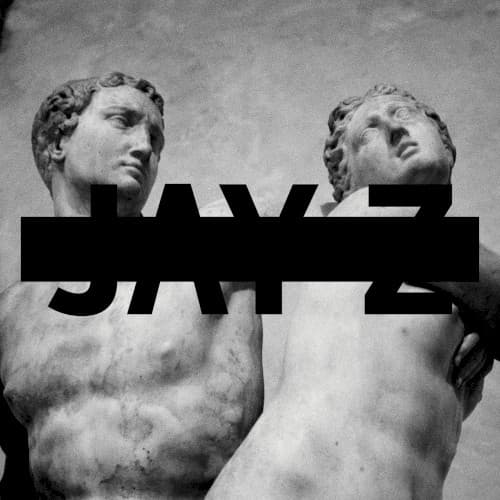
The scorecard
6.0/10 · Mixed
- Writing25%
- 5.5
- Production25%
- 7.0
- Delivery15%
- 6.5
- Cohesion15%
- 5.5
- Originality10%
- 5.5
- Replay value10%
- 5.5
Jay Z Blue and Nickels and Dimes find real tension in fame and fatherhood, but much of the record trades images for brand names, as Tom Ford does.
Timbaland and J-Roc's spacious drums on Picasso Baby and Part II (On the Run) give the album a rich, expensive sound, with WondaGurl's Crown adding grit.
Jay-Z sounds loose and in control on Picasso Baby and Oceans, but Justin Timberlake's hook on Holy Grail and several guest spots carry more energy than his own verses.
The two sub-one-minute interludes and the late stretch from Beach Is Better to La Familia break momentum, so the sequence runs out of ideas before the closer.
It pairs Jay-Z with fresh young producers but repeats the wealth-as-subject template he and Kanye West had just worked on Watch the Throne.
A handful of songs hold up well, while the name-dropping and the thin middle make a full front-to-back replay hard to justify, which is a projection from how the album has settled.
Jay-Z Magna Carta Holy Grail: A Sold-Out Album With Nothing at Stake
Magna Carta Holy Grail was a commercial success before anyone had heard a note, and that fact explains most of what works and what does not. A deal with Samsung put a million copies in the hands of app users for free, the album was certified platinum on the day it appeared, and the financial risk was gone. What the deal could not buy was a reason to play the record twice. The argument of this review is that Jay-Z made an album from a position of total security, and it sounds like a man hedging between two jobs, rapper and brand, without fully committing to either.
The hedge is not all bad. He sounds relaxed, the beats are expensive, and when a verse turns toward something real, such as what fame does to fatherhood or what it costs to be the most comfortable person in every room, the record finds a pulse. But those moments sit between songs that read like a mood board of luxury goods. Jay-Z described the sessions as a minimalist approach with a 1990s feel, and the finished product is glossier and busier than that promise.
The career context shapes the risk calculation. Coming off Watch the Throne and a long run of touring, he had nothing left to prove commercially and a lot to lose by taking creative chances. The rollout reflects that. No retail single came before the album, the promotion ran through commercials and an app, and the tour announcements stacked up behind it, including a stadium run with Justin Timberlake and later a joint tour with Beyoncé. The album works as the hub of a business, and the music is the least risky part of that business.
That makes it a hard record to rate. It has real craft in places and a great deal of interchangeable boasting in others. Set beside Watch the Throne it feels smaller in ambition, and beside 4:44 it sounds like an early draft of the more honest record Jay-Z had not yet been ready to make.
Expensive Drums, Cheap Name-Drops
The sound is the strongest argument in the album's favor. Timbaland and Jerome 'J-Roc' Harmon produced most of the record, and their drums are thick, slow and spacious, leaving room for Jay-Z's voice to sit on top instead of fighting the beat. Picasso Baby is the clearest case: by Jay-Z's own account it set the direction of the album, and its dusty Adrian Younge sample gives him a rolling groove that carries long, unhurried phrases. When other producers step in, the variety helps. Boi-1da and Vinylz supply a heavy, bouncing frame for the Rick Ross collaboration, Hit-Boy and Mike Dean give Somewhere in America a short, swaggering sketch, and a 16-year-old WondaGurl built the rattling skeleton of Crown, which Travis Scott and Mike Dean then filled out.
The writing is where the record loses ground. Jay-Z is still a technician. His phrasing is conversational, his rhymes land inside the line as often as at the end of it, and he rarely stumbles.
The problem is the subject matter, which turns in a small circle. Galleries, couture, watches and private collections recur until they stop meaning anything, and the references work as price tags instead of images. Tom Ford is the cleanest example, a song whose entire pleasure is the brand name, and its borrowed M.I.A. sample is more interesting than anything said over it. Reviewers at the time called the name-dropping reflexive, and the charge sticks on a large share of the tracklist.
The better verses abandon the shopping list. Jay Z Blue and Nickels and Dimes deal with fatherhood, legacy and the pressure of being a symbol, and they are the places where the language sharpens and the stakes become personal. Oceans, with its Frank Ocean hook, pushes the wealth theme into uncomfortable territory, which makes it more useful than a dozen songs that simply enjoy the money. These tracks show what the album could have been if the same energy had run through the whole sequence.
Guest work is handled like a brand partnership, with each name chosen for what it signals. Justin Timberlake gives Holy Grail a pop hook that leans on a Nirvana sample, which is smart marketing and a slightly awkward fit for a verse about the cost of fame. Beyoncé's turn on Part II (On the Run) works because the two sound like partners rather than a collaboration of convenience. Elsewhere the features often carry more energy than Jay-Z himself.
A second weakness is sameness. The mix is polished to the point where several mid-tempo songs blur into one another, and the confidence that makes the best verses fun also makes the weaker ones feel effortless in the wrong way. The record never sounds rushed, but it often sounds unchallenged, as though no one in the room was in a position to say that a verse needed another draft.
A Strong Opening Run and a Slow Fade Into the Back Half
The sequencing front-loads the album's best ideas. The opening stretch moves from a big, pop-aware single into a slow-rolling Timbaland groove, then into a loud Southern-flavored posse-style beat, and the changes of pace feel planned. Jay-Z sounds fully engaged here, and the guests arrive at moments that make the arc more varied instead of more crowded. If the album stopped after the first third, the story would be one of a veteran enjoying himself on well-chosen beats.
The middle section is where the pace changes for the worse. Two interludes run under a minute each and neither adds enough to justify breaking the momentum, and the following songs are comfortable, mid-tempo, and similar in mood. The album has a clear peak around its sixth and seventh tracks, then settles into a long plateau where the quality of the beats stays high but the quality of the ideas drops. A late recovery arrives with the two most personal songs, which makes their placement strange: they would work better earlier, when the listener still has patience for a change of tone.
The length is not earned. Sixteen tracks is manageable on paper, but the running time includes a lot of repeated posture. Cutting the two weakest mid-tempo songs and one of the two short interludes would not damage any argument the album is making, and it would sharpen the contrast between the show-off tracks and the reflective ones. As built, the sequence feels like a catalog of moods in a tasteful order rather than an album that builds toward a closing statement.
The closer, Nickels and Dimes, is long and the most direct about legacy, which gives the sequence a decent ending even if it arrives after the interest has dipped. Picasso Baby, early in the order, remains the best piece of pacing on the record: it sets the tone for how slow, confident and loose the album wants to be, and almost nothing afterward matches its balance of ease and effort.
Mid-Table Jay-Z: Good Beats, Light Stakes
Magna Carta Holy Grail ranks below both Watch the Throne and 4:44 in this catalog, and the gap is easy to explain. Watch the Throne had a bigger sound and a partner who pushed Jay-Z into bolder choices; 4:44 stripped the luxury posture away and replaced it with a record's worth of honest self-examination. This album sits between them without the strengths of either: it has the polish of the former and a fragment of the latter's honesty. It is a good record by general standards and a disappointing one by his own.
The verdict on the central question is that it is worth hearing but not worth owning in full. It is for listeners who like Timbaland production, Jay-Z at his most relaxed, and a clear picture of how a major rap act operated at the top of the business in the early 2010s. It is also for anyone studying marketing, since the Samsung rollout is as interesting as several of the songs. Skip it if you want the tight storytelling and high-stakes rhyming of his early albums, or if name-dropping wears on you quickly.
Start with Picasso Baby for the groove and the best sustained verse, then Oceans for the album's most interesting idea, and Nickels and Dimes for the closest thing to a statement. After that, move to 4:44 to hear the same artist drop the posture and write about his own mistakes, and to Watch the Throne to hear the luxury theme given a bigger canvas and a sharper foil.
The album has aged as a snapshot more than a statement. Its commercial footprint was enormous, but its influence on how rap albums are made and written is small, and its best songs have outlasted its attempts to be an event. For a record that was guaranteed to succeed before release, it is notable how few of its choices carry any risk, and the best argument for revisiting it is that three or four of its songs are better than the whole.
Track by track
Track Listing
Holy Grail
StandoutThe lead single is the album's best argument for its own strategy. The beat builds on a Nirvana sample that is stretched into a slow, eerie frame, and Justin Timberlake's hook gives it a pop appeal that explains the chart run and a Grammy win. Jay-Z's verses are about the trap of fame, and the delivery is measured and unhurried. The weakness is the gap between the song's sincerity and the rest of the album's luxury posturing, which makes this feel like a different record's opening statement. Even so, it is polished, memorable and well placed at the front of the sequence.
Picasso Baby
StandoutThe Timbaland and J-Roc beat built around an Adrian Younge sample is the sonic center of the album. It is spacious and dusty, and it lets Jay-Z stretch his phrases in a way few of the other tracks allow. The art-collector concept is a flex, but the writing finds some humor in it and the delivery turns an arrogant premise into a performance. The track works because it sounds effortless, which is also the album's central flaw.
Tom Ford
WeakA brand name carries the whole song, and the M.I.A. sample is more interesting than the verses. It was a chart success and a single, but the writing is thin.
FuckWithMeYouKnowIGotIt
StandoutHeavy, bouncing production from Boi-1da and Vinylz, with a Pimp C vocal at the start and Rick Ross handling the hook and a verse. Jay-Z rides the beat comfortably and the energy is high, though the content is standard bragging. It is a loud, effective change of pace.
Oceans
StandoutThe oldest song on the album, with Pharrell and Timbaland producing and Frank Ocean on the hook. It is the track where wealth becomes a problem to be thought about instead of just a prize to be listed, and Ocean's voice gives it a mournful pull that the other guests never match. Jay-Z's flow is controlled, the arrangement is sparse, and the song feels more serious than anything around it. It is the best case that the album could have had a weightier idea at its core.
F.U.T.W.
SolidA Timbaland and J-Roc mid-tempo cut that fits the album's mood and does not stand out. Solid beat, forgettable verses.
Somewhere in America
SolidAt 2:28 this is a short, jumpy sketch from Hit-Boy, Hey DJ Camper and Mike Dean, built on a Johnny Guitar Watson sample. The energy is good and the brevity keeps the bragging from wearing out, but it does not develop into a full idea.
Crown
StandoutThe beat is the story here: a rattling, dark frame created by WondaGurl at 16, then shaped by Travis Scott and Mike Dean and built on a Sizzla sample. It is the most modern-sounding moment on the record and the closest it comes to risk. Jay-Z adapts his cadence to the sparse, off-kilter rhythm, and the result sounds like an older rapper being pulled into a new sound without losing his composure. It could have used a stronger hook, but the atmosphere is distinctive and it earns its place.
Heaven
SolidA Timbaland and J-Roc production with an Adrian Younge sample and a lyrical nod to R.E.M. It reaches for a reflective tone and mostly gets there, though the religious imagery is more suggested than developed. Good atmosphere, middling payoff.
Versus
WeakA 51-second interlude with a Tribe Called Quest sample and a Bruno Spoerri sample. It is a brief jab at the rap game that adds little and cuts the momentum.
Part II (On the Run)
StandoutA duet with Beyoncé, built on a One Way sample from Timbaland and J-Roc, that functions as a preview of the joint tour that followed. The chemistry is real, the beat is warm, and the verses play the outlaw-couple fantasy with some wit. It is more theater than confession, and at 5:33 it runs a little long, but it is the album's most successful bid for pop crossover that does not feel hollow. It also charted as the third single, which fits its commercial purpose.
Beach Is Better
WeakA 55-second Mike Will Made It and Marz interlude that sounds like an idea rather than a song. Filler.
BBC
SolidPharrell's production gives the song a loose, collaborative feel, and it is one of the few late tracks with a genuine sense of fun. It plays as a roll call more than a statement, but the beat has bounce.
Jay Z Blue
StandoutThe most personal writing on the album, built on a Notorious B.I.G. sample and a film monologue from Faye Dunaway, with production from Timbaland, J-Roc and Timberlake. Jay-Z worries about the kind of father he will be and about what his fame might do to his child, and the song is stronger for being unresolved. The sample choices give it a tense, uneasy backing, and the delivery is quieter than anywhere else on the record. Several critics singled it out as one of the few moments of real substance, and they were right. It is a preview of the territory 4:44 would explore more fully.
La Familia
SolidA Timbaland and J-Roc cut with a family-and-loyalty theme. The idea is fine but the verses stay general, and it sits in the sagging stretch of the sequence.
Nickels and Dimes
StandoutThe longest and most reflective track, closing the album at 5:03 over a Gonjasufi sample and production credited to Hip Hop and Mike Dean. Jay-Z uses the space to talk about money, legacy and what he has to answer for, and the writing is more detailed and less ornamental than on most of the record. The beat is dark and spare, and the performance is the most committed on the second half of the album. It finishes the sequence with substance and is the best place to hear what the project might have been with sharper editing. A critic singled it out as one of the few well-written moments, and the praise holds.