The scorecard
6.1/10 · Mixed
- Writing25%
- 5.5
- Production25%
- 7.5
- Delivery15%
- 6.5
- Cohesion15%
- 5.0
- Originality10%
- 5.5
- Replay value10%
- 6.0
Wayne's verses stay inside the standard Cash Money vocabulary of cars, jewelry and rivals, and the Village Voice complaint that his ad libs outshine his rhymes has real support.
Mannie Fresh's elastic synth bass, snapping drums and the warm Dennis Edwards sample on Way of Life give the record a complete, instantly recognizable New Orleans bounce.
Wayne's clipped, nasal drawl pockets Fresh's drum patterns with real timing on Gangsta Shit and the title track, even if his voice is still finding its authority.
Three radio skits, a medium-tempo sameness in the middle and an hour-plus runtime make the album sag, with only the Jazze Pha tracks changing the sound.
It is a polished example of the house style rather than an extension of it, and its main idea, answering Juvenile's 400 Degreez, is borrowed from another record.
The beats and the best singles reward a return visit, while the skits and generic late cuts are easy to skip.
Lil Wayne 500 Degreez — Mannie Fresh's Bounce, Wayne's Apprenticeship
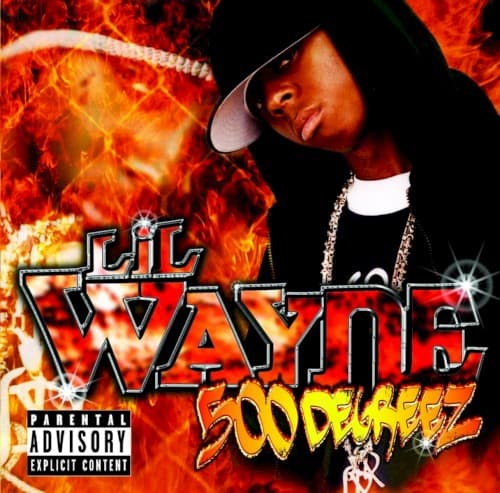
500 Degreez is a Mannie Fresh album with Lil Wayne rapping on it, and the order of those names is the whole story. Wayne was still a young rapper when it appeared, already a veteran of the Cash Money machine, and he sounds like what he was: a gifted apprentice working inside a house sound so complete that it did not need him to lead. The beats bounce, the drums knock with that sticky New Orleans swing, and the voice on top is raspy, quick and still searching for its own authority.
The case I will make is that this is a better record to move to than to study. As a Southern party album it works in long stretches. Fresh's production is confident and warm, and some of his ad libs steal songs outright. As a platform for the rapper who would later become the most consequential figure of his generation, it is thin, because Wayne mostly plays the role of the club-ready young hustler and rarely says anything that sounds like him in particular.
The stakes were not small. The title was a deliberate answer to Juvenile's 400 Degreez, released when the Hot Boys lineup was breaking up and Wayne was the one member left standing at the label. Wayne later framed the project as a statement that the label would be fine without its departed star. That ambition shows in the confident tone and in the guest list, but it makes the record sound more like a message to a rival than a document of its own artist.
Commercially it did what it was meant to, debuting in the top ten and topping the R&B and hip-hop chart before going gold. Critics were less convinced. Some praised Fresh's beats and Wayne's drawl, while others called it another average Cash Money release, and both camps had a point. It sits well below the peak of Lil Wayne in the catalog, and it is worth hearing mainly for the sound of a style at full strength before its best rapper learned how to match it.
Toy-Keyboard Melodies, Clipped Verses and a Producer Who Steals the Show
The production is the reason to listen. Mannie Fresh built nearly the entire record, with Jazze Pha handling two tracks, and the sound is unmistakable: elastic synth bass, hand-clap snaps, rolling drum machine patterns and melodies that sound like they came off a toy keyboard played by someone who knew exactly what they were doing. It is bounce music dressed for the radio, and it is closer to the Dirty South of Atlanta and New Orleans than to the cleaned-up pop-rap of the period. When the beat is at its best, as on the title track and the singles, the arrangement leaves room for Wayne to ride it instead of fighting it.
The weak point is that the beats are more varied than the rapping. Wayne's voice at this stage is nasal, clipped and quick, and he has the rhythmic instincts to pocket a Fresh drum pattern, but his writing leans on the standard vocabulary of the label: cars, jewelry, women, rivals, the block. USA Today's critic complained that he covers too much familiar bling-bling and gangster territory, and the Village Voice made a sharper point, that his between-track ad libs were more entertaining than his actual rhymes. That is a harsh judgment, but the record does give it support.
What saves the verses is attitude and timing. Wayne fits the lines in the spaces between the kicks with a looseness that anticipates his later flows, and there are bars where an unusual image slips through the template. They are brief, though, and none of them is developed into a verse that could stand alone. The performance is professional, and professional is not the same as distinctive.
The guests are a mixed set. The Big Tymers and TQ give the singles a communal, cookout feel. Petey Pablo adds raw, high-voltage energy that the album sorely needs. Baby appears twice in the Cash Money fashion, and he adds familiarity rather than surprise. The hooks tend to be sung by someone else, which leaves Wayne's songs structured around a chorus he did not write, and it contributes to the impression that he is a guest on his own record.
The skits and interludes are the other weakness. A trio of radio-style bits, with Big Tigger and Rob Nice, break the flow without building a world, and USA Today's observation that they add length but not depth is simply accurate. In an era when albums were expected to run long, this one carries more padding than it can justify.
A Party That Starts Loud and Overstays Its Welcome
The sequence opens with a short intro and a strong run, and the first half moves with real momentum. The opening stretch gets the singles and the best beats close together, so the album feels like a party that starts at full volume. The sample-driven lead single gives the first third its center, and the trade between Wayne and the Big Tymers on the early cuts has a looseness that suggests a room of friends rather than a studio assignment.
After that the album gets long. The radio skits arrive at regular intervals and reset the energy each time, which is a poor strategy when the music is trying to build a groove. By the middle of the tracklist the tempo has settled into the same medium bounce, and the subject matter has stopped changing, so songs that would have been welcome on a mixtape start to feel like the same song in different outfits.
There is a late lift when the label's other producer, Jazze Pha, appears, because his work has a different, slicker, more singsong shape than Fresh's, and the contrast is audible. That is the only moment when the album's sound materially changes, and it works because it breaks the rhythm. A few other late songs find a gear, but the closing stretch is padded, and the final track is more a victory lap than a finale.
At twenty-one tracks and more than an hour of music, the length is not earned. If the three radio skits and a handful of the most generic cuts were removed, the remaining record would be tighter, funnier and easier to love. As it stands, it is a good fifty-minute album trapped inside a bloated one.
A Fun Chapter in a Catalog That Got Much Better
Within the catalog, 500 Degreez sits comfortably in the middle: far above Rebirth, which scores 3.8, and well below the two Carter albums, which score 7.6 and 7.9. The reason is clear on the page. Tha Carter III and Tha Carter II have a rapper who has taken over his own records, with ideas, jokes and a voice that matches the production. Here the production matches itself, and the rapper is still learning.
The right audience is anyone who wants to hear the Cash Money sound at its craftiest, anyone curious about Wayne before he became Weezy, and anyone who thinks of Southern rap as music for the body first. The wrong audience is the listener who wants lyrical depth, a unified concept or a reason to hear Wayne as a great rapper. He is a good one here, in training, and the record does not hide it.
As for aging, the beats have held up better than the lyrics. Fresh's drum programming and synth tones still sound alive, and they are the reason the album rewards a return visit twenty years on. The rapping is dated in the way a young rapper's cliches always are, and the skits have not improved with age. It is a historical document that happens to be fun.
Start with the lead single, then the title track and the Petey Pablo collaboration, which have the sharpest combination of beat and energy. After that, move to Juvenile and his 400 Degreez to hear the record that provoked this one, and to Tha Carter II to hear what Wayne became once the voice and the ideas caught up with the sound.
The best thing on 500 Degreez is Mannie Fresh, and the best thing about Wayne on it is that you can already hear he is about to outgrow it.
Track by track
Track Listing
Fly Talkin’
SolidA brief intro that sets the party mood and lets Fresh's bounce announce the sound. It is over before it develops, and works as a doorway rather than a song.
Look at Me
SolidA solid opener proper, with a heavy drum pattern and Wayne working in a clipped, confident register. The hook is plain but the beat carries it, and it sets the tone of a young rapper insisting he belongs.
Way of Life
StandoutThe lead single, with the Big Tymers and TQ, peaked at number 71 on the Hot 100 and contains elements from Dennis Edwards's Don't Look Any Further. The soulful sample gives the beat a warmth that most of the album lacks, and TQ's sung hook turns it into a communal anthem. Wayne's verse is fluent and relaxed, and critics singled the song out for its Southern flair. It is the clearest example of what the record does best.
Big Tigger Live on the Radio
WeakA radio skit that interrupts the momentum. It places the album in a time and place but adds nothing to the music.
Gangsta and Pimps
SolidA team-up with Baby that drifts into well-worn gangster posturing. The beat is capable and the two voices bounce off each other, but the subject matter is the territory critics said had been trodden too many times already.
Lovely
SolidA softer, more melodic Fresh production that gives Wayne room for a smoother delivery. It is pleasant and more relaxed than the hard-edged tracks around it, though it does not leave a deep impression.
Gangsta Shit
StandoutPetey Pablo is the best guest on the album, and his rough, high-energy voice injects the grit that the Fresh bounce otherwise lacks. Wayne rises to meet him, tightening his flow, and the contrast is the song's strength. AllMusic singled out Pablo's turn for praise, and it is easy to hear why.
Big Tigger Live on the Radio #2
WeakA second radio skit, shorter than the first, and no more necessary. It is filler.
Bloodline
SolidA mid-album cut with a steady Fresh groove and a lyric about loyalty and family. The theme gives Wayne a little more to hold onto, but the track is solid rather than special.
Where You At
StandoutOne of the two songs that received a video, and it deserves the attention: the beat is springy, the hook is catchy, and Wayne's flow has a bounce that matches the production. It is one of the stronger examples of the album's party instincts.
Worry Me
SolidA mood piece with a darker edge, where Wayne sounds more wary than boastful. It is a welcome change of tone, though the writing stays general.
500 Degreez
StandoutThe title track is the statement of intent, a swaggering response to Juvenile built on a heavy, clanging Fresh beat. Wayne sounds hungry and pointed, and the track gives the album its sharpest sense of purpose. It lacks the specificity of a true diss, but the energy is real, and it is one of the few moments where the rapper rather than the producer is the main attraction.
Go Hard
SolidA straightforward energy track with a heavy beat and a chanted hook. It does what it says, and little else.
Young n’ Blues
SolidA reflective cut where Wayne slows down and the writing gets a little more personal. The beat has a bluesy tint, and the tone is a useful break from the party records, but it stretches past four minutes without developing.
Believe That
StandoutA Jazze Pha production with Blaque and Mannie Fresh, and the difference is immediate: the sound is silkier, more R&B-leaning and more melodic. It does not fit the rest of the record and that is why it helps, since it is the one track that sounds like a different record.
Rob Nice Live on the Radio
WeakA third radio interlude that adds nothing. By this point the skits have become a habit rather than an idea.
Fuck You
SolidAnother Big Tymers collaboration with a defiant hook and a heavy beat. The attitude is the point, and the track offers little beyond a mood of aggression and a rhythm that suits a car stereo.
What Does Life Mean to Me
SolidA very short cut with TQ and the Big Tymers that gestures toward introspection but is over before it says anything. It reads as a sketch that was never finished.
Get That Dough
SolidThe second Jazze Pha beat, with Baby, Tateeze and Cristale. The slick, sing-along sound is a late change of pace, and the posse feel is fun, if lightweight.
Fo Sheezy
SolidA Fresh production that returns to the bounce formula for a final burst. It is energetic and silly in a good way, though by this point it feels like the same party at a later hour.
Fly Talkin’ Go Home
SolidThe closing track is a victory lap that echoes the opening mood. It rounds the record off, but it is too long and too close to what came before to land as a finale.
Frequently Asked Questions
Is Lil Wayne 500 Degreez a good album?
Why is it called 500 Degreez?
Who produced 500 Degreez?
Genres
Styles