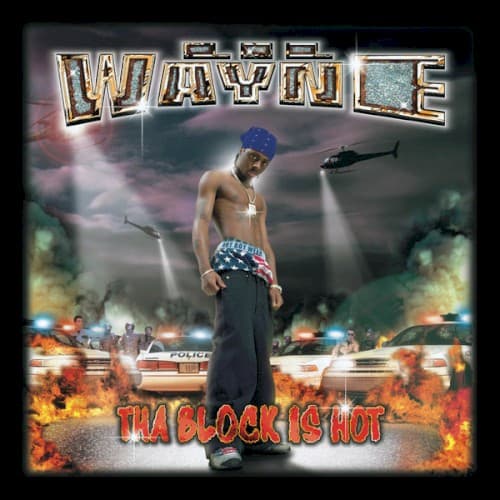
The scorecard
6.1/10 · Mixed
- Writing25%
- 5.5
- Production25%
- 7.5
- Delivery15%
- 6.0
- Cohesion15%
- 5.5
- Originality10%
- 5.5
- Replay value10%
- 6.0
Wayne's squeaky, slang-heavy bars are lively but mostly stay at the level of boasts and street talk, with little of the imagery or wordplay he would develop.
Mannie Fresh produced every track, and the bass-heavy bounce on Tha Block Is Hot and Loud Pipes is the main reason the record still moves.
The young, high-pitched voice has real character and energy, yet it often sits in the shadow of B.G. and Juvenile instead of leading.
Seventeen tracks with a steady Fresh sound hold together, but the guest-heavy back half repeats the same moves and sags.
It is a polished example of the Cash Money template rather than an expansion of it, with the strongest personality coming from the beats.
The title track and Loud Pipes stay fun, but the record works better as a period piece than as something to return to in full.
Lil Wayne Tha Block Is Hot: A Debut Where Mannie Fresh Does the Heavy Lifting
Tha Block Is Hot is a Mannie Fresh album with Lil Wayne on it. That is a fair criticism and an honest compliment at once. As a debut, it sells a sound more than it sells a rapper: bass that rattles a trunk, synth lines with a toy-box shine, and drums that bounce rather than hit. The new voice in the middle of it, high and scratchy and in a hurry, is more a texture than a presence, and the best moments belong to the beats and the crew around him.
That tension is the whole story of the record. The album went to number three on the Billboard 200 in its first week and was certified platinum within about five weeks, which tells you the Cash Money machine was working at full power. It also tells you the album was built as a product of the label, with Fresh producing every song, Baby and Slim as executive producers, and a rotating cast of B.G., Juvenile, the Hot Boys and the Big Tymers sharing the microphone. Wayne is a member of the family here rather than the head of it.
The case for the album is that this is a very well-made version of a very specific thing. Nobody else in 1999 had a house sound as recognizable as Fresh's, and the best tracks, which are about a third of the record, still bounce. The case against it is that Wayne has not yet found what makes him interesting. The writing here is street talk and bravado at a level a dozen rappers could match, and the personality that later made him a star only flickers.
So it is a good record, but a good Cash Money record and not yet a good Lil Wayne record, and the difference matters for anyone deciding where to start.
Fresh's Bass, Wayne's Squeak
Everything starts with the production. The fact sheet is plain on this: every song is Mannie Fresh, recorded at Cash Money Studios in Metairie, and the sound is consistent enough that the album plays as one long argument for his style. The bass is low and fat, the keyboards are bright and slightly cartoonish, and the drum programming leaves a lot of open space so the voices can bounce around inside it. It is New Orleans bounce at its commercial peak, a sibling to the Southern rap that was spreading through Atlanta and Houston at the same time but with its own lighter touch. Tha Block Is Hot and Loud Pipes are the clearest examples; each makes a hook out of a rhythm.
Wayne's contribution is harder to pin down. The Chicago Tribune's line that his appeal lies in esoteric slang and squeaky-voiced phrasing is accurate, and it also names the limit. The voice is a distinctive instrument, fast and slightly breathless, and it sounds like a kid trying to out-talk the grown men beside him. But the verses lean on slang and repetition more than on images or turns of phrase. There are plenty of lines that exist to rhyme with the line before them, and there is very little of the sideways wordplay that would define his later work.
The guests make the issue more visible. B.G. and Juvenile rap with more gravity, and on songs like Respect Us and Enemy Turf the hierarchy is obvious. That is not a flaw of the casting so much as an honest picture of the label in 1999, but it means the album often functions as a Cash Money display rather than a debut statement. The Big Tymers and Hot Boys cameos add color, though they also reinforce the sense that Wayne is supporting talent.
There is also a content ceiling. The themes are street credibility, spending, cars and loyalty to the crew, and the album rarely steps outside them. A few tracks are stronger because the hook is tighter, not because the lyrics say something new. The weaker songs, particularly in the final third, rely on a mid-tempo bounce that begins to sound like the same beat in a different outfit.
Still, the craft is high. Fresh's arrangements stay clean and punchy, nothing sounds rushed, and the mix gives the bass real weight without muddying the vocals. If you listen to the album as a display for the label's sound rather than as a lyrical debut, most of its choices make sense.
Front-Loaded Heat, Then a Long Cruise
The sequencing is smart where it counts. A short intro with the Big Tymers sets the label-first tone, and the title track follows almost immediately with B.G. and Juvenile, so the album announces its sound and its family before anyone has time to wonder who the star is. The first third has the best energy: tight tempos, big hooks, and guests who each get a clear lane. It plays like a party that starts quickly.
The middle holds up reasonably well, because the variety of voices keeps things moving. B.G., Juvenile and the Hot Boys rotate in on different tracks, and the feel changes enough that the beats are not the only thing carrying the record. Seventeen songs at a little over an hour is long for a debut, but the pace is steady and nothing here is a skit. That discipline is to its credit.
The sag arrives in the final third. By then the bounce has been used so heavily that the best ideas are behind you, and the closing tracks run on routine. The record does not build to a climax; it simply stops when the track count runs out. A tighter fourteen-song version would have sounded more confident, with the stronger hooks given more room and the filler trimmed.
The length is only partly earned. The consistency of Fresh's sound makes the album easy to put on in the background, but it also means no track stands out as a dramatic departure. If you listen all the way through, expect a pleasant, steady groove with a few real peaks early and a lot of comfortable repetition later.
The Starting Point, Not the Summit
In the Wayne catalog, Tha Block Is Hot sits below the albums that made his case, and the ranking is deliberate. It is well above Rebirth, which scored 3.8 here, because it knows exactly what it wants to be and delivers it. It falls below Tha Carter II at 7.6 and Tha Carter III at 7.9, where the production stays strong and the writing and delivery finally match it. Here, the beats are the best part of a record by a rapper still finding his voice. A 6.2 reflects that balance: a strong production grade, a modest writing grade, and a cohesive but overlong sequence.
This album is for fans of late-1990s Southern rap who want the Cash Money sound at its commercial height, and for anyone tracing Wayne from the beginning. It is also a useful document of Mannie Fresh's craft. Skip it if you are looking for the sharp, inventive lyricist of the later albums, or if you need a front-to-back statement; you will hear the voice, but not yet the writer.
Start with Tha Block Is Hot, the title track with B.G. and Juvenile, which captures the whole pitch in four minutes. Add Loud Pipes, which has the heaviest bounce and samples an earlier Juvenile song, and then Drop It Like It's Hot, a long, loose cut with B.G. and Mannie Fresh that shows the sound at its most relaxed.
For what came next, go to Tha Carter II, where the production stays tough and Wayne has become the main event. If you want to hear the first real step in that direction, try Tha Carter, which keeps the Fresh sound but gives Wayne more room. Heard in that order, this debut plays like the sound of a label at its peak and a rapper standing just behind the loudest speaker.
Track by track
Track Listing
Intro
SolidA short label-first opener with the Big Tymers that sets the party tone. Functional and brief, and it tells you who is in charge.
Tha Block Is Hot
StandoutThe calling card. Mannie Fresh builds a low, rattling frame around a simple hook, and B.G., Juvenile and Wayne trade verses with distinct personalities, Wayne's high, quick voice cutting through the heavier ones. It is the best example on the record of the Cash Money pitch: bounce first, rhymes second, and a chorus anyone can shout. Wayne is not the main attraction, but he is not out of place either. The song still sounds like the clearest statement of what the label sounded like at that moment, and it earns its place as the title.
Loud Pipes
StandoutWith B.G., Juvenile and the Big Tymers, and built on a sample of an earlier Juvenile song per the fact sheet, this is the heaviest bounce on the album. The beat is thick and deliberate, and the number of voices keeps it varied. The car-culture theme is simple, but the rhythm does the persuading. A highlight and the track that most clearly shows the strengths of Fresh's production.
Watcha Wanna Do
SolidA solo cut where Wayne carries the song alone, and it shows both the promise and the limits: the voice has energy, but the bars are routine. The beat keeps it moving.
Kisha
SolidA Hot Boys feature that leans on the group's chemistry. The hook is catchy and the mood is light, though the writing stays surface-level.
High Beamin'
SolidB.G. guests on a smooth, mid-tempo Fresh groove. Wayne sounds comfortable, though the song adds a familiar flex theme to a record that already has plenty.
Lights Off
StandoutA solo track with a darker, quieter mood than the party songs around it. The change of atmosphere helps the pacing, even if Wayne's lyrics do not push far past the usual themes.
F*** tha World
SolidAn attitude song where Wayne goes solo and snarls through defiant bars. The beat is aggressive enough to match, but the lyrics remain more posture than perspective.
Remember Me
SolidB.G. joins for a track about staying power and respect. The hook is solid and the beat has a soulful lift, though the verses are interchangeable with others on the album.
Respect Us
StandoutJuvenile takes the guest slot and, as often happens here, sets the standard for weight and authority. Wayne holds his own on a sturdy Fresh beat, and the pairing is one of the better collaborations on the back half.
Drop It Like It's Hot
StandoutWith B.G. and Mannie Fresh, this is a long, relaxed cut that gives the album a different gear. The pace is looser than the singles, and the extended length lets the beat settle in. Not to be confused with any later song of the same name; this is its own thing, a casual, confident Cash Money groove.
Young Playa
StandoutThe Big Tymers help on a track about youth and status. Fresh's beat is bright and fun, and the theme suits Wayne's age and voice better than most.
Enemy Turf
SolidJuvenile returns for a tougher, street-focused cut. The beat is menacing and the mood is serious, though the lyrics rely on well-worn imagery of rivals and territory.
Not Like Me
SolidB.G., the Big Tymers and Paparue crowd the track, which becomes a posse cut with a lot of voices and not much focus. Energetic, but Wayne gets lost in the crowd.
Come On
WeakA B.G. feature that fits the late-album pattern: pleasant bounce, familiar boasts, nothing that stands out. Filler of the competent variety.
Up to Me
SolidA solo track that tries a more personal angle, with Wayne talking about control over his own path. It is a welcome change of subject, but the delivery is plain and the track does not leave a lasting impression.
You Want War
SolidA closing cut with Turk that brings a hard-edged mood. The beat is serious, but the album ends on routine street talk rather than a memorable final statement.
Frequently Asked Questions
Is Tha Block Is Hot a good album?
Who produced Tha Block Is Hot?
How well did Tha Block Is Hot sell?
Genres
Styles