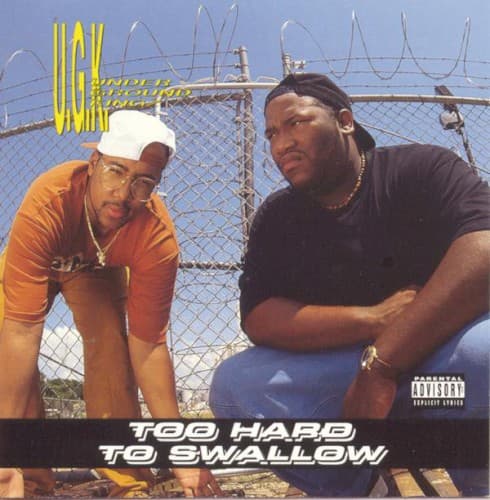
The scorecard
7.5/10 · Great
- Writing25%
- 7.5
- Production25%
- 7.5
- Delivery15%
- 8.0
- Cohesion15%
- 7.0
- Originality10%
- 7.5
- Replay value10%
- 7.5
The street storytelling on tracks like 'Pocket Full of Stones' and 'Cocaine in the Back of the Ride' is plainspoken and detailed, though the writing has less shape and fewer big images than it would later.
Soul and funk samples from Rufus, the Isley Brothers and Bill Withers give the record a warm, slow-rolling base, but the arrangements stay close to their source loops.
Pimp C's nasal, sly cadence and Bun B's heavier, steadier voice trade verses with an obvious chemistry, and the pocket they find on the slow tracks is the main reason to return.
The tone is consistent across twelve tracks and the early stretch establishes the duo's strengths before the limits show, though several songs run past six minutes on a single loop and the album ends with an alternate version of its opener.
A slow, Southern-accented approach to street rap built from soul samples was distinct in 1992, even if its parts overlap with Geto Boys and other Texas peers.
The best songs reward repeat listens for the vocal interplay alone, while the weaker middle tracks fade into the background.
UGK Too Hard to Swallow: The Sound of a Duo Finding Its Pocket
Too Hard to Swallow is the sound of two rappers who already know exactly how they want to sound and are still building the room to do it in. The tempos are slow, the samples are warm, and the voices of Pimp C and Bun B slide over the top of the beats with a confidence that does not need volume. It is a debut with a finished sense of identity and an unfinished sense of craft, and the interest of the record lies in the distance between those two things.
The argument here is that Too Hard to Swallow is a strong, distinctive debut whose appeal is mostly in delivery and chemistry, not in songwriting or sequencing. The best tracks, 'Pocket Full of Stones' and 'Cocaine in the Back of the Ride' among them, show the duo's whole approach: unhurried storytelling, laid-back swagger, and a plainspoken take on street life that feels closer to testimony than performance. The weaker tracks show a group still learning how to turn that voice into complete songs.
The material around the record helps explain why it holds up. The samples come from soul and funk, with Rufus, the Isley Brothers, Bill Withers and Curtis Mayfield among the sources, and the choices give the album a warmth that contrasts with the content. The rapping is relaxed even when the subject is not. That contrast is what distinguishes the duo from the harder, more aggressive Southern records of the period, and it sets up everything they did afterward.
In context, this is not the album most people mean when they talk about UGK at their best. That honor belongs to Ridin' Dirty, a tighter and richer record that took the same instincts further. Too Hard to Swallow is the starting point: looser, rougher, and more dependent on the charm of its two voices. Whether that is enough for a modern listener depends on how much they enjoy watching a great duo find its footing.
Soul Loops, Slow Drawls and a Rough-Cut Pocket
The production is built on borrowed warmth. The sample credits on the record read like a soul and funk crate dig: Rufus, the Isley Brothers, Bill Withers, Curtis Mayfield, Steve Miller Band, and a few rap sources including Geto Boys, LL Cool J and Mellow Man Ace. The result is a set of beats that groove slowly, leaving a lot of space for the voices.
This approach has real advantages. The loops are familiar enough to feel comfortable, the tempos let each line settle before the next one arrives, and the contrast between smooth backing and rough subject matter gives the music its character. The drawback is that most of the arrangements stay close to their sources. There are few moments where the beat does something surprising, and across a record this long the sameness starts to show.
The delivery is the album's real engine. Pimp C works in a nasal, sly register that sounds like a smirk, and Bun B answers with a heavier, steadier voice that anchors the verse. The two share a pocket in a way that most rap duos never manage, and they hand off lines without breaking the rhythm. On the best songs the interplay turns the track into a conversation, and the slow tempo makes the humor and menace in both voices easy to hear. This is also where the record sounds most Southern: the vowels stretch, the cadence is conversational, and the flow sits behind the beat instead of racing ahead of it.
The writing is plainspoken and often detailed. The duo tell stories about hustling, paranoia and loyalty without much ornament, and the straightforward approach gives the narratives a documentary feel. The strongest verses use small specifics to carry a scene, a trait that matters more on a record this relaxed than flashy wordplay would. The limitation is range. Many songs revisit the same territory with similar tones, and the occasional attempt at wordplay or a hook can feel less assured than the narrative verses. The rhymes are good, but they are not yet the dense, quotable writing the duo would deliver later.
There is also a gap between the length of the songs and the amount of material in them. Several tracks pass six minutes, and while the slow tempo makes that feel natural at first, the lack of a beat change or structural turn means a few of them overstay their welcome. The guest appearance on 'Cramping My Style' adds a different voice, but it does not change the formula much. Taken together, the album is better at establishing a mood than at developing a song, and that is the clearest weakness of an otherwise convincing debut.
Twelve Slow Tracks and a Remix at the Finish Line
The sequence begins with confidence. The opening track sets the tone with a smooth, sample-driven groove and an unhurried pace, and the album stays in that gear for most of its run. The early stretch is the strongest, with the storytelling songs arriving close together and establishing the duo's strengths before the listener has time to notice the limits of the formula.
The middle of the record is steadier than it is exciting. Tempos barely change, loops run long, and the songs share a lot of tonal territory, so the album can feel like one extended session instead of a series of distinct statements. This is not a flaw in any single track so much as a consequence of sequencing: with similar songs placed next to each other, none of them stands out enough to feel like an event. A listener who plays the record start to finish will probably find their attention drifting somewhere in the second half.
The back end brings back some energy with a quick, punchy track and a short closer, and then the record finishes with an alternate version of its own opening song. That last choice is revealing. As a bonus, the remix is a nice extra and a hint at what the duo could do with more control over production. As a final track, it is an anticlimax, because it asks the listener to hear the same song twice at the very end of a long album.
The length is mostly earned by the quality of the voices but not by the variety of the songs. At twelve tracks and over an hour of music, the record has the time to create a world, and it does. It would be sharper with one or two of the mid-album cuts removed and a stronger closing statement. Even so, the consistency of tone is part of the appeal: this is a record that does not break its own spell, and the spell is the point.
A Debut That Promised More Than It Delivered, and Delivered a Lot
In the catalog, Too Hard to Swallow sits well below Ridin' Dirty, and the gap is deliberate. The later album is sharper in nearly every way: the writing has more shape, the production is more varied and the sequencing is tighter. This debut scores lower because it is looser and less complete, though the lead it gives to delivery and chemistry keeps it well above average for a first album. It is a record that shows the group's instincts before their craft caught up.
It is best for listeners who already like the duo and want to hear where the sound began, and for anyone who enjoys slow, soul-sample-based Southern rap with strong voices at the center. It is a poor first stop for someone who wants dense lyricism, big hooks or a modern, high-energy sound. Those listeners should begin with the later record and return here once the voices have grown on them.
The album has aged well in its strongest moments. The slow tempos and warm samples still sound good, and the vocal interplay remains the main reason to return. The weaker tracks have not improved with time, and the length is more noticeable now than it was in the era of long, sprawling debuts. Still, the best songs sound sure of themselves in a way that many debuts do not.
Start with 'Pocket Full of Stones', which shows the duo's storytelling and chemistry at their clearest, then 'Cocaine in the Back of the Ride' for a more compact version of the same approach, and 'Short Texas' for a longer, more atmospheric track. After that, go to Ridin' Dirty to hear the same group with sharper focus, and to Geto Boys for the harder Texas counterpart that surrounded this release. The first half of this album is the part worth a second visit.
Track by track
Track Listing
Something Good (extended version)
StandoutThe opener builds its groove from a pair of soul samples, Rufus and the Isley Brothers, and sets the album's warm, unhurried tone from the start. The extended version gives the duo time to settle in, and the beat is smooth enough to carry a long run. It is a confident introduction, though the loop does not change much across its length, so the track works better as a statement of mood than as a developed song.
Use Me Up
SolidBuilt on a Bill Withers sample, this is a smooth, relaxed cut that suits the duo's easy delivery. The groove is pleasant and the vocal trading is natural, but the song does not develop far beyond its opening idea. A solid, likeable mid-tempo track that works better as atmosphere than as a highlight.
Pocket Full of Stones
StandoutOne of the clearest showcases of what the duo do best. The tempo is slow, the voices trade lines with an easy rhythm, and the storytelling is plainspoken enough to feel believable. The samples from LL Cool J and Mellow Man Ace add a rap-era texture that sits comfortably alongside the soul sources elsewhere on the record. Over more than six minutes the pacing never rushes, and the verses use small details to carry the scene instead of relying on big images. It is the best place to hear the group's chemistry and one of the first songs a new listener should play. The only complaint is that the beat could have used one more turn to match the strength of the performances.
Short Texas
StandoutA long, atmospheric track at more than six minutes, and one of the album's most distinctive cuts. The pace is slow and the mood is heavy, giving the duo room to settle into a conversational flow. It leans on a regional identity that gives the record a sense of place, and the performances carry the length well. The loop is steady and a little plain, so the track depends on delivery over production. A strong, characterful piece that rewards patient listening, even if its length and similarity to the surrounding songs keep it from standing as the album's single best moment.
Cocaine in the Back of the Ride
StandoutAt 3:44 this is among the tighter songs on the record, built around a Curtis Mayfield sample that supplies a cold, haunted backdrop. The subject matter is dark, but the delivery stays calm, and that gap between tone and content gives the track its edge. The shorter length helps the song hit harder than the longer cuts around it, and the verses stay focused on a single scene. It is one of the strongest arguments for the duo's storytelling and a good second song for a new listener after 'Pocket Full of Stones'.
It’s Too Hard to Swallow
SolidThe title track, running over five minutes, states the album's attitude directly. The beat is steady and the verses are confident, though the song does not add much to the territory already covered by the earlier tracks. A solid, representative entry that feels more like a statement of identity than a new idea.
Cramping My Style
SolidWith Infinity as a guest and an Isley Brothers sample underneath, this song adds a different voice to the record's two-man formula. The groove is smooth and the extra vocal color is welcome, but the track stays close to the established sound and does not push far beyond it. A pleasant mid-album track that offers a change of texture more than a change of direction.
Feel Like I'm the One Who’s Doin’ Dope
StandoutBuilt on a Geto Boys sample, this six-minute cut leans into a paranoid, drawn-out mood that suits the source. The pace is slow and the vocal delivery is heavy with attitude, giving the song a darker color than much of the record. It is one of the more atmospheric tracks and works well as a mood piece. The length again tests the loop, since the arrangement changes little across the running time, but the tone is consistent and the performance holds together. A strong, brooding entry that serves as a useful reference point for the Texas rap tradition the duo came from, even if it is not the cleanest song on the album.
I’m So Bad
StandoutA compact 3:34 track over an Isley Brothers sample, built around swagger and attitude. The shorter running time gives it a snap that the longer songs lack, and the delivery is playful enough to stand out. It is a bit lightweight on content, but it is one of the album's more energetic moments.
Trill Ass Nigga
SolidA mid-length track that doubles down on the duo's self-image and local identity. The groove is steady and the attitude is clear, though the song does not move far beyond its central idea. A solid, functional entry that adds to the album's sense of character more than to its range.
976‒Bun B
SolidA short 2:48 showcase for Bun B over a Steve Miller Band sample, and the quickest song on the record. It works as a change of pace and a spotlight for his heavier voice, though it is slight enough to feel like an interlude. Enjoyable, brief and not essential.
Something Good (Pimp C’s remix)
SolidA bonus remix of the opener that closes the record with the same song it began with. It is a nice look at what Pimp C could do with a beat, and the reworked groove has its own charm. As a final track, though, it repeats an idea the listener has already heard, and it ends the album on an anticlimax.
Frequently Asked Questions
Is UGK's Too Hard to Swallow a good album?
Which songs should I hear first on Too Hard to Swallow?
How does Too Hard to Swallow compare with Ridin' Dirty?
What samples does Too Hard to Swallow use?
Styles